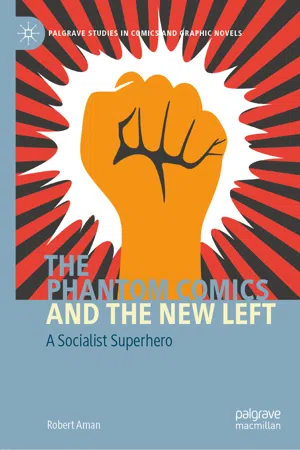
This book is about the Phantom in Sweden, or, more correctly, about Sweden in the Phantom. Robert Aman uncovers how a peripheral American superhero – created in 1936 by Lee Falk – that has been accused of both racism and sexism has become a national concern in a country that several researchers have labelled the most antiracist and gender equal in the world. When a group of Swedish creators began their official production of licensed scripts based on The Phantomcomic in 1972, the character was redefined through the prism of New Left ideology. The plots of these comics, besides aiming to entertain, also sought to affirm for readers the righteousness and validity of an ideological doctrine that, at the time, was dominant among the Swedish public and influential in the country's foreign policy. Ultimately, Aman demonstrates how the Swedish Phantom embodies values and a political point of view that reflect how Sweden sees itself and its role in the world.
Trusted by 375,005 students
Access to over 1.5 million titles for a fair monthly price.
This chapter introduces the Phantom, his backstory, and publication history in different parts of the world. The chapter continues by introducing the main argument of the book that the Phantom, a product of American mass culture, was refashioned to meet the interests and demands of a Swedish audience. Some of the most active contributors to the series in recent decades have been the Sweden-based creators known as Team Fantomen. Team Fantomen became an international publication node in The Phantom franchise in 1972 when they set up their official production of licensed scripts which enabled them to redefine the character, accused of both racism and sexism, in line with the progressive Left-wing politics which dominated Swedish politics and public discourse throughout the 1960s and 1970s.
Keywords
The PhantomNew LeftLee FalkSuperhero comicsIdeologySocialism
End Abstract
On Wednesday August 27, 1986, a larger crowd than usual had paid the entrance fee at Parken Zoo in the Swedish town of Eskilstuna. This time the public was not there to visit the zoo’s white tigers—the park’s main marketing focus—but to witness Lee Falk (1911–1991), creator of The Phantom, officially opening the zoo’s latest attraction: Fantomenland (Phantom Land). “Fantastic. Wonderful. Amazing,” were the spontaneous comments picked up by a journalist from the local daily, Folket, accompanying Falk around as he inspected the amusement park devoted to his creation. Although an industrial city located outside Stockholm may seem a long way from the exotic jungle environment where the Phantom resides on the comic pages, visitors could enter his home in the ancient Skull Cave, sit on the Skull Throne, inspect the cave’s vast treasure trove, roam around a scaled-down replica of a jungle village and, of course, meet and greet the Phantom himself in person. In a later interview with Princetown Arts, Falk expressed both joy and astonishment at the global spread and apparent commercial appeal of his character, referring to the theme park as a “modest version of Disneyland.”1
The Phantom, an adventure series set in the fictional African nation-state of Bangalla, debuted as a daily strip in 1936, making him a pioneer in the superhero genre. Despite his mythical name, however, the Phantom is an ordinary man without the mutant powers often associated with superheroes—from Superman and Green Lantern to Wonder Woman and Aquaman—that rose to fandom around the same period—times that are often referred to retrospectively as the “Golden Age of comics.” Although he displays most of the essential characteristics included in definitions of a superhero in recent scholarly work—“enemies, a strong moral code, a secret identity, a costume” (McLain 2009, 1; cf. Coogan 2006; Reynolds1992)—the Phantom makes up for his lack of extraordinary powers with ingenuity, skill and integrity as he faces everything the criminal world can throw at him. In theory, his abilities are such as any reader could achieve with the right dedication and training. In contrast to most readers, however, the Phantom rights, wrongs and combats evil in all its forms in the dense jungle he calls home (“the Deep Woods”) as well as in every corner of the world.
Despite being a lone ranger and subsequently working almost exclusively alone—whether battling pirates on the African coast, taking on organized crime in Italy or resolving a kidnapping drama in Mexico—the Phantom can count on the infinite support of several key characters. A constant companion is Devil, his faithful gray mountain wolf, often mistaken for a dog by others to which the Phantom readily replies: “He’s not a dog, he’s a wolf.” Having developed an understanding only rivaled in comic books by that between Tintin and Snowy, Devil understands almost everything the Phantom tells him and does not shy away from showing his deadly fangs and attacking on command whenever his master is under threat. They are later joined by Hero, a majestic white stallion, gifted to the Phantom by the Maharajah of Nimpore as a reward for rescuing his daughter.2 Since 1977, the Phantom has been married to his American college sweetheart, Diana Palmer, who appeared in the very first strip. At various points in her adventurous life, she has been an explorer, an aviator, a nurse and an Olympic swimmer. More recently, Diana has worked as a United Nations official. Nine months after their wedding, the couple had twins, Kit and Heloise. The best man at the wedding was Guran, the stocky and diminutive African chief who is the Phantom’s best friend. At first represented as a loyal black servant to the white Phantom, he was later upgraded to the position of respected companion (Fig. 1.1).
Fig. 1.1
Phantom and Diana finally tie the knot in 1977 before the President of Bangalla
The Phantom wears one of his signature rings on each hand: the Skull Ring and the Good Mark Ring. Villains and foes came to dread the Sign of the Skull, etched onto the ring worn on his right hand.3 Whenever the Phantom throws a powerful punch against a villain, the ring leaves a permanent scar in the shape of the skull. The symbol, the Phantom’s own mark of Cain, is a grim and permanent reminder of the violent encounter. Akin to the biblical reference, the mark serves as a visual warning to others not to commit crimes. On his left hand—symbolically closer to the heart—the Phantom wears the matching Good Mark Ring. For generations, the Phantom has bestowed the Good Mark upon those who have saved his life or otherwise come to his aid. Represented by four crossed swords, the symbol is either gently stamped onto the recipients’ wrists or gifted as a necklace granting them “the protection of the Phantom for life.”
In the absence of superpowers, the Phantom’s near mythical qualities are further enhanced by the leitmotif of “Old Jungle Sayings.” Falk introduced this dramatic device in narrative captions more than once in a while in the stories. “When the Phantom moves, he shames the lightning,” used in the 1946–1947 story “Mister Hog,” was the first of many.4Falk continued to coin various “Old Jungle Sayings” to illustrate his Phantom stories throughout his career, and by his death, he had created roughly 250 of them, albeit with many variants on the same theme (Goulart2010). By way of rationalizing, these multiple sayings have been narrowed down to twelve in the Swedish The Phantom comic book and have in the process become considered somewhat canonical (Patrick 2017). These include “The Phantom moves as silently as the jungle cat,” “The Phantom is rough with roughnecks” and “The Phantom has a thousand eyes and a thousand ears.”
Another frequently referenced “Old Jungle Saying,” both within and beyond the Phantom series, is “There are times when the Phantom leaves the jungle and walks the streets of the town like an ordinary man,” indicating the character’s dual identity. Ever since the Phantom superheroes have generally had dual identities—they have been both civilians and superheroes—which comics scholarship define as a trademark of the superhero genre (Reynolds1992). Be they Superman and Clark Kent, Iron Man and Tony Stark, or Daredevil and Matt Murdoch, they all share the characteristics—alongside colorful outfits and magnificent jawlines—of devotion to justice, substituting on a daily basis their masks and spandex for a civilian outfit. Regularly changing garments also serves as an important plot device, as it allows the extraordinary nature of the superhero to be contrasted with the ordinariness of the alter ego. Whenever the Phantom leaves the jungle, he transforms into his alias Mr. Walker, which means covering his bodysuit with a gray trench coat, scarf and trousers while concealing his unmasked face—presumably a safety precaution as another “Old Jungle Saying” warns that whoever “looks upon the Phantom’s face will die a horrible death”—beneath a broad-brimmed hat and dark sunglasses.
Unlike Clark Kent’s employment as a reporter for the Daily Planet, Matt Murdoch’s daytime job as a lawyer, or Tony Stark running his own industrial company, the Phantom’s alter ego is not a recognizable public persona. Nor does he have any ambition to be. This means that the Phantom does not have a civilian occupation or everyday life that is recognizable to most readers, while—like many other superheroes—having to constantly ensure that his true identity as a costumed crime fighter is not exposed to the public. In fact, the Phantom never takes a break from breathing down the necks of the criminal underworld; he is always fighting crime. Subsequently, the ...
Table of contents
Cover
Front Matter
1. Introduction
2. White Ghost’s Burden and Colonial Adventures
3. International Solidarity and Swedish Foreign Policy
4. Apartheid and Antiracism
5. The Women’s Movements and Gender Politics
6. Conclusion: When the Phantom Became Swedish
Back Matter
Frequently asked questions
Yes, you can cancel anytime from the Subscription tab in your account settings on the Perlego website. Your subscription will stay active until the end of your current billing period. Learn how to cancel your subscription
No, books cannot be downloaded as external files, such as PDFs, for use outside of Perlego. However, you can download books within the Perlego app for offline reading on mobile or tablet. Learn how to download books offline
Perlego offers two plans: Essential and Complete
Essential is ideal for learners and professionals who enjoy exploring a wide range of subjects. Access the Essential Library with 800,000+ trusted titles and best-sellers across business, personal growth, and the humanities. Includes unlimited reading time and Standard Read Aloud voice.
Complete: Perfect for advanced learners and researchers needing full, unrestricted access. Unlock 1.5M+ books across hundreds of subjects, including academic and specialized titles. The Complete Plan also includes advanced features like Premium Read Aloud and Research Assistant.
Both plans are available with monthly, semester, or annual billing cycles.
We are an online textbook subscription service, where you can get access to an entire online library for less than the price of a single book per month. With over 1.5 million books across 990+ topics, we’ve got you covered! Learn about our mission
Look out for the read-aloud symbol on your next book to see if you can listen to it. The read-aloud tool reads text aloud for you, highlighting the text as it is being read. You can pause it, speed it up and slow it down. Learn more about Read Aloud
Yes! You can use the Perlego app on both iOS and Android devices to read anytime, anywhere — even offline. Perfect for commutes or when you’re on the go. Please note we cannot support devices running on iOS 13 and Android 7 or earlier. Learn more about using the app
Yes, you can access The Phantom Comics and the New Left by Robert Aman in PDF and/or ePUB format, as well as other popular books in Social Sciences & Ethnic Studies. We have over 1.5 million books available in our catalogue for you to explore.