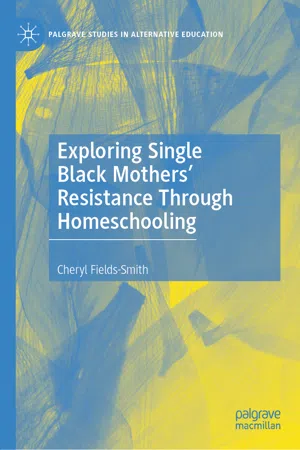
This book expands the concept of homeplace with contemporary Black homeschooling positioned as a form of resistance among single Black mothers. Chapters explore each mother's experience and unique context from their own perspectives in deciding to homeschool and developing their practice. It corroborates many of the issues that plague the education of Black children in America, including discipline disproportionality, frequent referrals to special education services, teachers' low expectations, and the marginalization of Black parents as partners in traditional schools. This book demonstrates how single mothers experience the inequity in school choice policies and also provides an understanding of how single Black mothers experience home-school partnerships within traditional schools. Most importantly, this volume challenges stereotypical characterizations of who homeschools and why.
- English
- ePUB (mobile friendly)
- Available on iOS & Android
eBook - ePub
Exploring Single Black Mothers' Resistance Through Homeschooling
About this book
Information
Topic
EducationSubtopic
Education General© The Author(s) 2020
C. Fields-SmithExploring Single Black Mothers' Resistance Through HomeschoolingPalgrave Studies in Alternative Educationhttps://doi.org/10.1007/978-3-030-42564-7_11. Voices Speaking Truths from Our Past and Our Present
Cheryl Fields-Smith1
(1)
Department of Educational Theory and Practice, University of Georgia, Athens, GA, USA
Keywords
Self-agencySelf-determinationDiscipline disproportionalityMarginalization of Black parentsSingle Black mothersToday, more than 60 years after the Brown vs BOE mandate, Black families increasingly choose to homeschool their children. Black students represent an estimated 8% of the estimated two million homeschooled students in the USA (McQuiggan & Megra, 2017). Moreover, Ray (2015) indicated that homeschooling has increased by 90% among Black families between the years 1999 and 2010. Given the varying reporting policies state to state, these numbers most likely represent underestimations; not all states report number of students homeschooled. But the trend toward increasing Black home education in USA signifies a growing departure from a cultural heritage of looking to traditional schooling for uplift and is worthy of further understanding.
The rise in homeschooling among Black families serves as a counter-narrative to characterizations of Black parents’ disinterest in their children’s education. As Ford (2017) indicated, such negative stereotypes have been perpetuated for decades, in part, by the policies and practices that stemmed from the Moynihan Report. Black mothers in particular have faced undue scrutiny and characterization as ‘absent’ or from a deficit perspective. Continued privileging of White, middle-class norms surrounding appropriate family engagement (Cooper, 2009), and effective mothering (Lois, 2013) have promoted deviant perceptions of low-income and Black mothers’ ways of being. For example, Cooper’s (2007, 2009) work posited Black mothers’ ways of engaging in their children’s learning represented elements of caring through their fighting against and resisting inequity, and injustice, which looked very different from White, middle-class parental involvement norms and often depicted Black mothers as confrontational.
As home educators, Black mothers assume full responsibility for their children’s education. Even if they use a third-party source to provide instruction, parents must research their options and they remain ultimately accountable to their children to provide an effective education outside of traditional schools, when they choose to homeschool.
Further, research on today’s Black home education documents Black parents’ decision-making in the era of school choice . The Black community has rarely functioned as a monolith. In fact, even during the implementation of the Brown decision, the late Dr. Horace Tate, former Georgia senator and educator, critiqued the plan for integration. He so accurately forewarned,
But, in trying to wipe out segregation, it is not my desire and it must not be your desire to substitute second-class integration for segregation, for second-class integration is evil no matter who thinks otherwise. In a manner, second-class integration is more evil than was segregation because second-class integration has a way of [entering into] the psyche and penetrating the fibers of the brain and of the soul. (as found in Walker, 2009, p. 272)
This fragment taken from a speech given Dr. Tate in 1970 indicates that he perceived something of great value to Black children would be lost in the integration process as conceived. The lived experiences of single Black home educators, and Black homeschooling in general, demonstrate the ways in which Dr. Tate’s speech has become prophetic.
Definitively, the significance of contemporary Black homeschooling lies in the ways in which their voices speak to African American educational history and Black children’s schooling experiences in today’s schools. Waters (2016) explained, “From a historical perspective, she [an African American Mother] is raising her children to enter, perform, and gain success within systems that have been designed to destroy them psychologically, intellectually, economically, and physically” (p. 4). The tumultuous historical context of the education of Black children in the USA distinguishes the significance of today’s Black home education from homeschooling among any other group in the USA. Further, Llewellyn (1996) posited, “Many black people homeschool to save themselves from a system which limits and destroys them, to reclaim their own lives, families, and culture, to create for themselves something very different from conventional schooling” (p. 13). This quote suggests that contemporary homeschooling offers Black families a way to overcome the challenges associated with education of Black children in traditional schools.
Black families’ need to ‘save themselves’ from traditional1 schools by homeschooling, as suggested by Llewellyn’s quote above, thwarts the deficit-thinking regarding Black parent’s concern, indicts the systemic practices within public schools that promote the myth of Black inferiority, and represents Black homeschooling as a return to something that previously existed (reclaiming) as a form of agency and resistance . Written 20 years later, Waters’ quote above speaks to the persistently lingering destructive factors that continue to serve as the backdrop of many Black families’ educational experiences today. These practices and policies, which will be detailed in this chapter, have been well documented and further corroborated by the existing literature on Black homeschooling. The remainder of this chapter provides an overview of the historical and contemporary context of contemporary Black homeschooling.
Speaking to Our Past: Relevant Historical Context of Black Homeschooling
Inevitably, when I give a talk related to research on Black home education I am asked, “Is there really any difference between homeschooling among Black families compared to families of other ethnic/racial backgrounds?”. In addition to Waters (2016) quote above, the response to this question also depends on what one knows and believes regarding the historical and contemporary experiences of Black families in public because the sociocultural historical and current sociopolitical context in which Black children have, and continue to learn in, remain quite distinct from children of other racial backgrounds. The rise in homeschooling among Black families speaks directly to these unique set of circumstances (historical and contemporary).
For decades, scholars have provided credible evidence of the diligence and resiliency exhibited in Black parents’ efforts to provide their children with excellence in education (e.g., Anderson, 1988; Cecelski, 1994; Gutman, 1977; Walker, 1996; Williams, 2005). Yet, negative images of Black families’ involvement in their children’s education linger. Today, however, Black parents increasingly chose to educate their children themselves through homeschooling.
Superficially, the rise in homeschooling among Black families may appear to be a sharp contrast to African American’s historic pursuit of access to equal education within public schools, which led to the Brown v. Board of Education decision to desegregate public schools sixty plus years ago. However, the history of African American communities’ fervor for excellence in education has been relatively ignored by most public schools, but relates directly to contemporary Black homeschooling.
Beginning with slavery , slave owners, for the most part, determined that African slaves should not be taught to read or write because they viewed literacy as a threat to the master-slave positioning; as a result, slave owners joined forces to quell the rise of literacy among slaves to protect their profits (Williams, 2005). Though laws forbade slaves to read or write, they risked their lives to learn nonetheless. African slaves believe that literacy equated to freedom fueled bravery to defy/resist the laws. As a result, African slaves employed deeply clandestine strategies to learn to read including the creation of pit schools (Cline-Ransome, 2013; Williams, 2005). As Williams (2005) described, “Slaves would dig a pit in the ground way out in the woods, covering the spot with bushes and vines. Runaways sometimes inhabited the pits, but they also housed schools” (p. 20). Late into the night, African slaves would sneak out into the woods to go into the pit for their lesson, which would usually be taught by an African slave who had managed to learn. In addition, Williams used phrases such as “web of secrecy” and “patchwork of teachers” to describe how a free woman in Georgia found ways to become educated. As the author reported, “They truly had to “steal” an education” (2005, p. 20). In addition to pit schools, slaves and freed people’s clandestine learning strategies included sneaking into willing teachers’ homes, learning from White children, hiding books in their clothing, and trading what little they had (or could find) of value to learn. Gutman (1977) also described how African slaves even used sewing classes as a cover to learn to read while someone served as a lookout. These examples and others have documented that African Americans have a legacy of being self-taught .
However, the collective nature of African American self-taught(ness) must be noted. Self-taught did not reflect individualism. Instead, se...
Table of contents
- Cover
- Front Matter
- 1. Voices Speaking Truths from Our Past and Our Present
- 2. Conceptualizing Contemporary Black Homeschooling and Single Black Mothers’ Resistance
- 3. Margaret: Homeschooling as a Mother’s Right
- 4. Dahlia: Homeschooling as a Last Resort
- 5. Yvette: Homeschooling as Split-Schooling—Homeschooling One of Two
- 6. Chloe: Homeschooling as Way of Life
- 7. The Significance of Single Black Mothers Homeschooling
- Back Matter
Trusted by 375,005 students
Access to over 1.5 million titles for a fair monthly price.
Study more efficiently using our study tools.
Frequently asked questions
Yes, you can cancel anytime from the Subscription tab in your account settings on the Perlego website. Your subscription will stay active until the end of your current billing period. Learn how to cancel your subscription
No, books cannot be downloaded as external files, such as PDFs, for use outside of Perlego. However, you can download books within the Perlego app for offline reading on mobile or tablet. Learn how to download books offline
Perlego offers two plans: Essential and Complete
- Essential is ideal for learners and professionals who enjoy exploring a wide range of subjects. Access the Essential Library with 800,000+ trusted titles and best-sellers across business, personal growth, and the humanities. Includes unlimited reading time and Standard Read Aloud voice.
- Complete: Perfect for advanced learners and researchers needing full, unrestricted access. Unlock 1.5M+ books across hundreds of subjects, including academic and specialized titles. The Complete Plan also includes advanced features like Premium Read Aloud and Research Assistant.
We are an online textbook subscription service, where you can get access to an entire online library for less than the price of a single book per month. With over 1.5 million books across 990+ topics, we’ve got you covered! Learn about our mission
Look out for the read-aloud symbol on your next book to see if you can listen to it. The read-aloud tool reads text aloud for you, highlighting the text as it is being read. You can pause it, speed it up and slow it down. Learn more about Read Aloud
Yes! You can use the Perlego app on both iOS and Android devices to read anytime, anywhere — even offline. Perfect for commutes or when you’re on the go.
Please note we cannot support devices running on iOS 13 and Android 7 or earlier. Learn more about using the app
Please note we cannot support devices running on iOS 13 and Android 7 or earlier. Learn more about using the app
Yes, you can access Exploring Single Black Mothers' Resistance Through Homeschooling by Cheryl Fields-Smith in PDF and/or ePUB format, as well as other popular books in Education & Education General. We have over 1.5 million books available in our catalogue for you to explore.