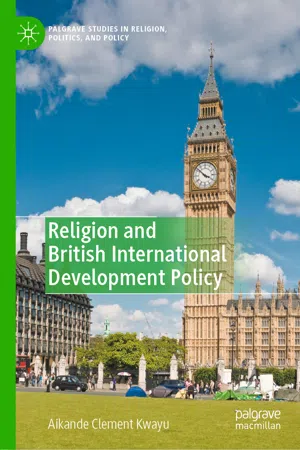
This book studies the relationship between British government and faith groups in its international development agenda within and beyond the context of Brexit. It includes aspects of International Relations, International Development, and Religion and Politics to trace the relationship between the British government and faith groups, showing that the relationship is enhanced on three conditions: (i) the resurgence of religion in international affairs; (ii) the attitudes of politicians and political parties towards the third sector (i.e. voluntary and private sectors); and (iii) the rising prominence of the international development agenda in British politics. The third condition triggers the need to understand this relationship in the wake of Brexit. Thus, the book aims to analyze to what extent the increasing prominence of an international development agenda in British politics explains the relationship between the government and faith groups, and ultimately whether Brexit has increased the prominence of international development agenda and brought faith groups into closer relations with the government.
- English
- ePUB (mobile friendly)
- Available on iOS & Android
eBook - ePub
Religion and British International Development Policy
About this book
Information
Topic
Teologia e religioneSubtopic
GlobalizzazionePart IIntroduction, Research Design and Context Setting
© The Author(s) 2020
A. C. KwayuReligion and British International Development PolicyPalgrave Studies in Religion, Politics, and Policyhttps://doi.org/10.1007/978-3-030-38223-0_11. Introduction
Aikande Clement Kwayu1
(1)
Development Research and Consultancy, Bumaco Limited, Moshi, Tanzania
Aikande Clement Kwayu
Religion in International Relations
Analysing the relationship between faith groups and the UK government in regard to international development policies is a contribution of this book towards the study of religion in international affairs. Since the end of the Cold War, religion has re-emerged as an important phenomenon in international affairs. This has received a considerable amount of attention from the scholarly community of the international relations (IR) discipline. IR scholars started to analyse the role of religion in various areas such as new terrorism, conflicts and peacemaking (Juergensmeyer 1993; Thomas 2005). Before 1989, the issues pertaining to the Eastern and Western blocs had been so contentious that other challenges in the international community attracted little academic recognition. Religion was one aspect that was almost absent in IR as a discipline during the Cold War (Wald and Wilcox 2006). However, the lack of attention to religion in IR goes back to before the Cold War started. In the history of IR theory, religion was recognised as an important force in the period before the 1648 Treaty of Westphalia that brought an end to the Thirty Years’ War. The Thirty Years’ War (1618–1648), which devastated Europe with an enormous death toll and an approximate reduction in the German population from 60 per cent to 20 per cent (Cooper et al. 2013), had a strong religious element through which the Holy Roman Empire sought to expand its dominance via the Pope and the Catholic Church. In the Westphalian Treaty, the monarchs of Western Europe agreed “to give the individual kings the authority to choose a version of Christianity and impose it upon their country; that the king (and not the church) was granted spiritual authority over the inhabitants of his kingdom, and no outside actor had the right to challenge this authority within his realm” (Knutsen 1997: 84). That agreement (referred to in the treaty as cuius regio eius religio) separated the church from the state (king). The king (representative of a sovereign territory) and not the church was in control of the state. Although there is no consensus in IR scholarship that the Treaty of Westphalia marked the beginning of modern IR theory (Buzan and Little 2000; Krasner 2001; Osiander 2001), the international state system that emerged after the Treaty has significantly influenced both the discipline and the role of religion in international affairs (Holsti et al. 1991; Bagge Laustsen and Wæver 2000). The Treaty, as Stephen Krasner observes, “validated the idea that international relations should be driven by balance-of-power considerations rather than the ideals of Christendom” (Krasner 2001: 21). Considering the situation before 1648, it was, arguably, appropriate for the Treaty to ensure the separation of church and state. Nevertheless, it was a mistake for IR scholars to ignore religion when the discipline became an established academic subject at the end of the First World War. The discipline’s tendency to overlook some of the crucial aspects within the international scene led to the marginalisation of religion. After the First World War, “the subject matter of International Relations”, writes Knutsen (1997: 211),
Discussed in the first formative years was curiously out of touch with the political realities of the age; many of the courses taught were theoretically barren; many of the books written were ideologically myopic. Early students of world affairs confined themselves to the Wilsonian vision of world politics, and rarely ventured to explore the many non-liberal theories, which swept the streets outside their ivory towers…’
With the same insight, Carr observed that “the passionate desire to prevent war determined the whole initial course and direction of the study” (Carr 1964: 8). In that respect, IR was preoccupied with security studies in attempts to avert another war. War and peace discourses turned out to be the centrepieces of IR. This was partly the argument for the establishment of the League of Nations in 1919 and, subsequently, the United Nations (UN) in 1945. However, the ideological differences between the East and West led to the Cold War, which took over as the key issue-area in IR. The politics of the Cold War and the subsequent focus on bipolarity and state systems, as well as the Westphalia legacy of ignoring religion, prevented IR scholarship from recognising religious forces that were materialising in the international system.
In 1979, an Islamic revolution associated with Ayatollah Khomeini took place in Iran, and this revolution, Esposito argues, had a global impact (Esposito 1990). The revolution was one event where religion resurfaced with tremendous force, and yet it had little impact on scholarly understanding of religion in international affairs. The force of religion, in events such as the Iranian Revolution, had to wait until the end of the Cold War to receive any attention from the discipline. “What appeared to be an anomaly when the Islamic revolution in Iran challenged the supremacy of Western culture and its secular politics in 1979”, writes Juergensmeyer (1993: 1–2), “has become a major theme in international politics in the 1990s. The new world order that is replacing the bipolar powers of the old Cold War is characterised not only by the rise of new economic forces, a crumbling of old empires, and the discrediting of communism, but also by the resurgence of parochial identities based on ethnic and religious allegiances”. Hatzopoulos and Petito (2003) made similar observations.
The end of the Cold War released the discipline from its obsession with power-politics/state-centric analyses and prompted the discovery of ‘newer challenges’ in international affairs. During the Cold War, most security analysts were preoccupied with conventional military issues and saw the state, especially aggressive states such as the former Soviet Union, as the main centres or sources of threat. However, in the post-Cold War period, there has been a tendency to recognise ‘new enemies or new sources of threat’, which need to be located within the broader framework of the ‘New Security Agenda’. Thus, we see this debate between ‘traditionalists’ who focus on the state as the main source of threat and ‘wideners’ who have expanded the security agenda to deal with new threats and new enemies (Buzan et al. 1998). The so-called Copenhagen School has championed the New Security Agenda. The Copenhagen School presents the securitisation theory. From this theoretical perspective, securitisation is a “speech act through which an inter-subjective understanding is constructed within a political community to treat something as an existential threat to a valued referent object, and to enable a call for urgent and exceptional measures to deal with the threat” (Buzan et al. 2003). Religion might be analysed in the context of securitisation theory (Buzan et al. 2003; Bagge Laustsen and Wæver 2000; Krahmann 2005; Betts 1998; Hoffman 1996). Issues of religious extremism and radicalisation have led to global security challenges. Religion has been used as a mobilisation and justification tool to recruit followers and supporters of terrorism. Subsequently, a number of scholars have gone on to study religion in IR. There has been a proliferation of workshops and working groups on religion and IR, such as the Religion and IR Section in the International Studies Association (ISA); the British International Studies Association (BISA) working groups on Religion, Security, and IR; and the European Consortium of Political Research (ECPR) standing group on Religion and IR. Furthermore, statesmen and diplomats are mentioning religion in their speeches, thus underlining the importance of religion in contemporary world affairs. Various university departments have established research centres for Religion and IR.1
Nonetheless, many aspects of religion in IR are still treated at only a cursory level in the literature. The literature is focused mainly on the role of religion in international politics, with little focus on how governments are responding to that phenomenon.2 It is important to analyse governments’ reaction towards the rise of religion in international affairs, especially since the line between international and domestic affairs has become blurred (Putnam 1988; Risse-Kappen 1991). It should be noted that international politics cannot be explained in isolation, without addressing some aspects of domestic politics. In the UK, for example, some of the government policies that were designed to deal with issues of religion could be categorised as both domestic and international. An example of this was the 2003 Foreign and Commonwealth Office (FCO) ‘Engaging with the Islamic World’ policy. The policy aimed at countering the ideological and theological underpinnings of the terrorist narrative, in order to prevent radicalisation, particularly among the young, in the UK and overseas; and increasing the understanding of, and engagement with, Muslim countries and communities, and working with them to promote peaceful, political, economic and social reform (FCO 2004; Brighton 2007). This is just one example that shows the close link between international and domestic politics dealing with religion.
In looking at this connection, mention can be made of the tide of Islamism that rose in the UK, which some policy experts and security officials saw as a response to the British involvement in Iraq and Afghanistan, as well as general Western foreign policy in the Middle East, Afghanistan and Pakistan. To understand this, it is crucial to note the historical trend to frame British Muslim identity and reactions to global events. Ahmad and Sardar (2012) document how international events such as the OPEC Oil Crisis in the early 1970s, the Iranian Revolution, the Rushdie Affair and recently September 11, 2001 have all framed British Muslim identity and conceptions of Islamism. On the other side, this framing is also contributed to by reactive actions by some British Muslim (Ahmad and Sardar 2012). For example, some British-born radicalised Muslims reacted by performing terrorist attacks in the UK (Ahmed 2005). That was obvious from the speech made by Mohammed Saddique Khan, one of the London 7/7 bombers (McGrory and Theodoulu 2005), who apportioned the blame for his terrorist acts to the British government for intervening in Iraq. Many British-born Muslims feel strongly about their collective Islamic identity, i.e. the ummah, which refers to the worldwide Muslim community. The ummah is seen as one big Muslim family and thus if the West attacks innocent Muslims in the Middle East, radicalised and extremist British-born Muslims might react to this by bombing people or properties in the UK, because of their collective sense of Islamic identity (Choudhury 2007). This is problematic, as Sardar and Ahmed (2012: 3) argued “an identity that is specifically based on religion is, by definition, problematic. At the very least, it raises questions of loyalty: if Muslims owe their allegiance to a universal community- the ummah – what are they first: British or Muslim?” Islamist ideologues such as Maulana Mawdudi from Pakistan have argued that the worldwide Muslim community or the ummah is like a human body. Islamist ideologues such as Mawdudi and his writings would have a profound impact on British-born Muslims because he is from Pakistan and most British-born Muslims have a Pakistani background. According to the 2011 Census, Muslims compose of 4.8 per cent of the population of England and Wales. O...
Table of contents
- Cover
- Front Matter
- Part I. Introduction, Research Design and Context Setting
- Part II. Analysis of Religion at the Government Policy Making Level
- Back Matter
Trusted by 375,005 students
Access to over 1.5 million titles for a fair monthly price.
Study more efficiently using our study tools.
Frequently asked questions
Yes, you can cancel anytime from the Subscription tab in your account settings on the Perlego website. Your subscription will stay active until the end of your current billing period. Learn how to cancel your subscription
No, books cannot be downloaded as external files, such as PDFs, for use outside of Perlego. However, you can download books within the Perlego app for offline reading on mobile or tablet. Learn how to download books offline
Perlego offers two plans: Essential and Complete
- Essential is ideal for learners and professionals who enjoy exploring a wide range of subjects. Access the Essential Library with 800,000+ trusted titles and best-sellers across business, personal growth, and the humanities. Includes unlimited reading time and Standard Read Aloud voice.
- Complete: Perfect for advanced learners and researchers needing full, unrestricted access. Unlock 1.5M+ books across hundreds of subjects, including academic and specialized titles. The Complete Plan also includes advanced features like Premium Read Aloud and Research Assistant.
We are an online textbook subscription service, where you can get access to an entire online library for less than the price of a single book per month. With over 1.5 million books across 990+ topics, we’ve got you covered! Learn about our mission
Look out for the read-aloud symbol on your next book to see if you can listen to it. The read-aloud tool reads text aloud for you, highlighting the text as it is being read. You can pause it, speed it up and slow it down. Learn more about Read Aloud
Yes! You can use the Perlego app on both iOS and Android devices to read anytime, anywhere — even offline. Perfect for commutes or when you’re on the go.
Please note we cannot support devices running on iOS 13 and Android 7 or earlier. Learn more about using the app
Please note we cannot support devices running on iOS 13 and Android 7 or earlier. Learn more about using the app
Yes, you can access Religion and British International Development Policy by Aikande Clement Kwayu in PDF and/or ePUB format, as well as other popular books in Teologia e religione & Globalizzazione. We have over 1.5 million books available in our catalogue for you to explore.