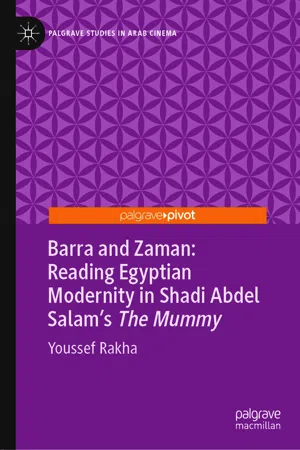
Brilliantly introduced by Nezar Andary, this book is a work of creative nonfiction that approaches writing on film in a fresh and provocative way. It draws on academic, literary, and personal material to start a dialogue with the Egyptian filmmaker Shadi Abdel Salam's The Mummy (1969), tracing the many meanings of Egypt's postcolonial modernity and touching on Arab, Muslim, and ancient Egyptian identities through watching the film.
Trusted by 375,005 students
Access to over 1.5 million titles for a fair monthly price.
Y. RakhaBarra and Zaman: Reading Egyptian Modernity in Shadi Abdel Salam’s The MummyPalgrave Studies in Arab Cinemahttps://doi.org/10.1007/978-3-030-61354-9_2
Begin Abstract
Youssef Rakha’s Mummification: An Opening of the Mouth
Youssef Rakha1
(1)
Cairo, Egypt
Keywords
Gamal Abd El NasserShadi Abdel SalamYoussef ChahinePharaohEgyptian cinemaMuslimKhedive IsmailCreative non-fictionArab cinemaWalter BenjaminThe Mummy
End Abstract
Cairo and Alexandria were cosmopolitan not so much because they contained foreigners, but because the Egyptian born in them is himself a stranger to his land.
—Waguih Ghali, Beer in the Snooker Club, 19641
1
It is the summer of 2020 and I am about to watch a film. But, maybe because I’m not in a movie theater, I am not very excited about it. It’s a film I know well already, though I haven’t seen it since 2009. Was I ever really excited to see it after the first time?
2
I’ve never felt the need to judge The Mummy (1969) by Shadi Abdel Salam (1930–1986),2 also known as The Night of Counting the Years. It is universally acknowledged to be the greatest masterpiece of Egyptian cinema. This must be my fourth viewing, and I’m as keen on the experience as I was the last time. But, whether because I’m 44 rather than 33 or because this time I know I will be writing about it, I also find myself needing to acknowledge the fact: The Mummy just will not grip or provoke me the way I expect a good film to. How come?
3
With its real-time slowness and meticulous framing—the way it seems to illustrate rather than conjure up its subject matter—the only other film I like that I can compare The Mummy to is the Soviet-Armenian director Sergei Parajanov’s The Color of Pomegranates (made in the same year). Taking narrative out of the equation, The Color of Pomegranates uses the symbolism and allegory inherent to the medieval Armenian troubadour—or ashugh—tradition to illuminate rather than recount the biography of the great poet-musician Sayat Nova (1712–1795). A Georgia-born ordained priest who wrote provocative secular songs in Azerbaijani, Farsi and Georgian as well as Armenian, Sayat Nova lived all over central Asia, initially as a married man, and was killed when the army of the shah Agha Mohammad Khan Qajar (1742–1797) stormed the monastery where he served in Haghpat, Armenia. A sequence of animated tableaux, the film seems to translate the power of Sayat Nova’s poetry—and music—into deeply evocative, always mysterious imagery, something that sets it apart from the history of film as it is generally understood. Like The Mummy, it left me bowled over the first time I saw it, but I still find it hard to get excited about it as a movie.
4
Narrative is minimal in Andrei Tarkovsky’s Andrei Rublev (1966), too, another Soviet biopic that comes to mind—about the great fifteenth-century icon painter. But, like the iconoclastic English artist-director Derek Jarman’s Caravaggio (1986), The Mummy, by contrast, wants to tell a story. A kind of remix of the Renaissance painter’s life intermingling elements and motifs from different historical periods but using intense emotive acting and taut causal drama to tell its story, Caravaggio is as gripping and provocative as anything I’ve seen. And I could try and persuade myself of an affinity between it and The Mummy, too, but I’d be pushing it.
5
Both The Mummy and The Color of Pomegranates have the peculiar quality of suggesting a cinema wholly different from what we know and love, and that is why the latter has some remarkably withering YouTube reviews despite its breathtaking beauty. It is this same quality of cinematic otherworldliness that makes it hard to place The Mummy in a more local context. As I try to do that any number of great Arab films from the Egyptian YoussefChahine’s CairoStation (1958) to the Palestinian Elia Suleiman’s Divine Intervention (2002) parade through my head. Not one is remotely like it.3
6
Here’s an interesting tidbit. The Mummy was written right before and shot in the wake of Egypt’s catastrophic defeat in the June War of 1967: the Naksa (or “setback”), as the event was euphemistically called. The third peak in an Arab-Israeli conflict that was not resolved until 1979—war broke out in 1948, 1956 and 1973 as well as 1967—the Naksa was a huge, humiliating defeat that gave the lie to the regime’s claims about a powerful, in-control army. It spelled the end of a 15-year-old experiment in postcolonial nation building, and it left writers and artists who had been invested in that experiment especially disoriented. If not born of that disorientation, The Mummy definitely reflects it.
7
It is the summer of 2020, nearly 10 years after the Arab Spring demonstrated how skin deep “love of the homeland” could be. But even now the Egyptian intelligentsia are by and large a patriotic bunch. They were probably even more patriotic back when the Naksa hit them, especially those of them who would later become known as the Sixties Generation.4 They had witnessed what must’ve felt like a cosmic transformation. Within four years in 1952–1956—thanks as much as anything to the charisma and ruthlessness of a young army officer named Gamal Abd El Nasser (1918–1970)—Egypt had changed from an ailing kingdom under British occupation to an independent republic leading the struggle against colonialism in Africa or the Middle East where, championing the Palestinian cause, it also spearheaded the Arab nationalist movement. In the young revolutionary-populist leader who steered that transformation the Sixties Generation saw a new brand of patriarch: a pharaoh , but a grassroots, authentic one, egalitarian and progressive. And, rallying around him, they believed or pretended to believe he really was a kind of demigod (Fig. 1).
Fig. 1
Nasser and his Prime Minister Ali Sabri hand Che Guevara (1928–1967) a state decoration in 1966. Touted to this day by his admirers across the Arab world and beyond, Nasser’s regional and to some extent global role as a champion of the anti-imperial struggle and the Liberation of Peoples meant that figures like Che Guevara became friends of the state. (Public domain image from Cuban archives, from Wikipedia)
8
“My relationship to Nasser was pathological,” the star lyricist-poet and cartoonist Salah Jahine (1930–1986) famously said in his “last interview.” “To love someone to the point of him spreading in your soul and becoming part of your psychological constitution and a psychiatric condition of yours, so that the person’s rise or fall, his collapse or triumph or defeat reflects on you – that is no doubt a pathological condition… That is why when Nasser, my father died, I was afflicted with a kind of orphanhood.”5
9
No matter how ludicrous they sound today, and no matter how much they helped to advance the careers of their makers, sometimes at the expense of other artists,6 “patriotic songs” like the 1956 Eḥna El Shaʿb (or “We are the people”)—“You who promised us holy days / your crescent has been sighted / Tomorrow covets a look at the magic of your beauty / Tomorrow is our hero, our efforts’ fruit….”7—were heartfelt expressions of genuine worship. Practically all the musical and lyrical talents of the time partook in such songs, but the phenomenally famous trio responsible for Eḥna El Shaʿb—together with Jahine (1930–1986), the composer Kamal El Tawil (1923–2003), and the singer Abdel Halim Hafez (1929–1977)—produced what amounted to hymns in worship.
10
After all Nasser was the first indigenous Egyptian to take charge of the country since Nectanebo II (380–340 BC). And he had promised true sovereignty and rapid development. This was all the more reason to be devastated when, after years of repression and rhetoric, the country ended up in dire straits, with Sinai occupied by the enemy and Egyptians as deprived and dependent as they had ever been. Demigod or not, there was no sign of dignity, glory, Arab or African unity.
11
Some such dignity or glory did exist in recent memory, but it was thanks to a different kind of pharaoh and that kind wasn’t in vogue at the time. The Albanian-Ottoman general Muhammad Ali Pasha (1769–1849) was neither egalitarian nor an indigene. In fact the Arab Spring was an occasion to revive at least one attempt at disputing his positive legacy.8 He didn’t look anywhere as sexy. But he did found modern Egypt. For a while before everything changed again, he even made it seem like a good idea. It was Muhammad Al...
Table of contents
Cover
Front Matter
Series Editor’s Foreword: An Introduction to Youssef Rakha’s Mummification
Youssef Rakha’s Mummification: An Opening of the Mouth
Back Matter
Frequently asked questions
Yes, you can cancel anytime from the Subscription tab in your account settings on the Perlego website. Your subscription will stay active until the end of your current billing period. Learn how to cancel your subscription
No, books cannot be downloaded as external files, such as PDFs, for use outside of Perlego. However, you can download books within the Perlego app for offline reading on mobile or tablet. Learn how to download books offline
Perlego offers two plans: Essential and Complete
Essential is ideal for learners and professionals who enjoy exploring a wide range of subjects. Access the Essential Library with 800,000+ trusted titles and best-sellers across business, personal growth, and the humanities. Includes unlimited reading time and Standard Read Aloud voice.
Complete: Perfect for advanced learners and researchers needing full, unrestricted access. Unlock 1.5M+ books across hundreds of subjects, including academic and specialized titles. The Complete Plan also includes advanced features like Premium Read Aloud and Research Assistant.
Both plans are available with monthly, semester, or annual billing cycles.
We are an online textbook subscription service, where you can get access to an entire online library for less than the price of a single book per month. With over 1.5 million books across 990+ topics, we’ve got you covered! Learn about our mission
Look out for the read-aloud symbol on your next book to see if you can listen to it. The read-aloud tool reads text aloud for you, highlighting the text as it is being read. You can pause it, speed it up and slow it down. Learn more about Read Aloud
Yes! You can use the Perlego app on both iOS and Android devices to read anytime, anywhere — even offline. Perfect for commutes or when you’re on the go. Please note we cannot support devices running on iOS 13 and Android 7 or earlier. Learn more about using the app
Yes, you can access Barra and Zaman: Reading Egyptian Modernity in Shadi Abdel Salam’s The Mummy by Youssef Rakha in PDF and/or ePUB format. We have over 1.5 million books available in our catalogue for you to explore.