Winner of the 2021/2022 People's Book Prize Best Achievement Award
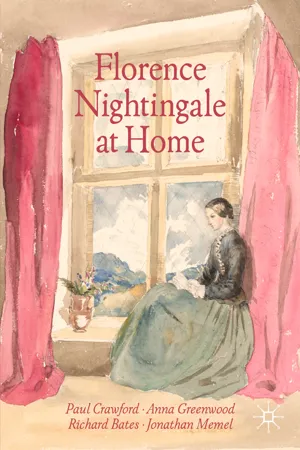
Homes can be both comforting and troubling places. This timely book proposes a new understanding of Florence Nightingale's experiences of domestic life and how ideas of home influenced her writings and pioneering work. From her childhood homes in Derbyshire and Hampshire, she visited the poor sick in their cottages. As a young woman, feeling imprisoned at home, she broke free to become a woman of action, bringing home comforts to the soldiers in the Crimean War and advising the British population on the home front how to create healthier, contagion-free homes. Later, she created Nightingale Homes for nursing trainees and acted as mother-in-chief to her extended family of nurses. These efforts, inspired by her Christian faith and training in human care from religious houses, led to major changes in professional nursing and public health, as Nightingale strove for homely, compassionate care in Britain and around the world. Shedid most of this work from her bed after contracting the debilitating illness, brucellosis, in the Crimea, turning her various private homes into offices and 'households of faith'. In the year of the bicentenary of her birth, she remains as relevant as ever, achieving an astonishing cultural afterlife.
Trusted by 375,005 students
Access to over 1.5 million titles for a fair monthly price.
On Sunday 3 August 1851, Florence Nightingale went for a walk by the river Rhine. Earlier that day she had been required to greet a Prussian princess, who was visiting the infirmary at the Kaiserswerth training institution for deaconesses where Nightingale was spending the summer. In the lunchtime heat she crossed the garden by the institution’s chapel, where her fellow trainees were singing.1 The song that Nightingale heard—written by the American dramatist John Payne in 1823 and set to a melody by the English composer Henry Bishop—was one of the most popular of the nineteenth century:
Mid pleasures and palaces, though we may roam,
Be it ever so humble, there’s no place like home,
A charm from the sky seems to hallow us there,
Which, seek through the world, is ne’er met with elsewhere,
Home, sweet home!
There’s no place like home.
An exile from home, splendor dazzles in vain!
Oh, give me my lowly thatched cottage again!
The birds singing gaily that came at my call, –
Give me them, with the peace of mind dearer than all!
Home, sweet home!
There’s no place like home!
2
This song became well known in nineteenth-century society, with its sheet music selling by the thousands around the world. In the 1850s, French writers noted the phrase ‘home sweet home’ as a distinctively English expression.3 The song epitomised how the late Georgian and early Victorian period constructed home as the place where the heart resided: an idealised haven of comfort, civility, and unity.
When Nightingale heard the song on that hot German Sunday in August, she wept. She did so not out of sorrow at being away from her English home and family. Rather, this marked a moment when she knew that henceforth her home lay not in her family’s English country houses, but in work—as represented by Kaiserswerth and its commitment to training women in nursing and other forms of socially useful employment. ‘I thought of the home of happy exertion, of peaceful labour which awaits us all’, she wrote to her sister, Parthenope, and ‘my old tears flowed’.4 Nightingale’s tears were borne of her joy and relief at finally realising that her calling was to undertake the kinds of work for which her name has endured.
Nightingale’s vision of home only lying in the ‘happy exertion’ of hard work put her at odds, however, with the prevailing ideals of Victorian society. Since the late eighteenth century, British society had an increasingly idealised vision of the home as a place of domestic tranquillity. In part, this was a reaction to the dramatic social and economic upheavals caused by the Industrial Revolution. Domestic stability and family bonds were celebrated in part out of nostalgia, for as Beatrice Gottlieb has argued, these were thought to be ‘the very values that humanity was in danger of losing in the new industrial age’.5 The English poet John Clare highlighted a sense of alienation and disorientation associated with home and its loss in his poem ‘The Flitting’ (1832), which conveyed a state of being both homeless and at home:
I’ve left mine own old home of homes,
Green fields and every pleasant place;
The summer like a stranger comes,
I pause and hardly know her face
…
I sit me in my corner chair
That seems to feel itself from home,
I hear bird music here and there
From hawthorn hedge and orchard come;
I hear, but all is strange and new
6
Home was constructed as a lost idyll—yet this ostensibly backward-looking process was in fact something new. As the nineteenth century progressed, the ideal of bourgeois domesticity exerted an ever-greater hold on British culture. Homes became places to display respectability, whether through the choice of neighbourhood, interior furnishings, or in social rituals such as afternoon tea. In many people’s minds, respectability also centrally assumed an acceptance of the gendered role of women as homemakers, whose entire existence was dedicated to the fostering of a comfortable, sweet home. The concept of home became the focus of wider debates about society, morality, and economics—indissociable from arguments about women’s work, or about design, style, and taste.7 As Judith Flanders puts it, for the Victorians, ‘[t]he notion of home was structured in part by the importance given to privacy and retreat, and in part by the idea that conformity to social norms was an outward indication of morality’.8
There was an explosion of new writing about homes and households in the Victorian period, epitomised by the proliferation of magazines with names such as The Home Companion, The Sunday at Home, and The Home Friend. Charles Dickens’sHousehold Words perhaps most clearly marked this cultural trend when, in its first issue of 1850, it announced its aspiration to ‘live in the Household affections, and to be numbered among the Household thoughts, of our readers’.9 Popular Victorian writing presented idealised home scenes of children, pets, musical instruments, reading, family meals, parties, and parlour games. The lead article of a January 1860 issue of The Sunday at Home, for example, was illustrated with the image of a doting wife, clinging to the shoulder of her husband, while the family cat stared into the glowing fireplace—the ‘domestic altar’, as architect and designer Edwin Heathcote aptly calls it (Fig. 1.1).10 Early and mid-Victorian fiction by writers such as Dickens, Charlotte Brontë, Elizabeth Gaskell, and George Eliot further contributed to this wide-ranging culture of home, regularly featuring plots centring on themes of family, kinship, homelessness, and exile.
Fig. 1.1
Front cover of The Sunday at Home, 5 January 1860
Art of the period further underlined the importance of domestic life and the sanctity of the family and household. Both Frederick Daniel Hardy’s Baby’s Birthday (1867, Fig. 1.2) and William Powell Frith’s Many Happy Returns of the Day (1856, Fig. 1.3) rendered visible the notion of the sweet home. In the former, a modest but aspiring family is depicted celebrating a baby’s first birthday with the lighting of a cake in the middle of the painting, surrounded by children, mother, and a cat. The fire is glowing, toys lie on the floor, writing equipment and books lie on the mantelpiece, and a fiddle hangs in the corner. At the door, the father is depicted welcoming the grandfather and grandmother, who bring a doll and basket of fruit as gifts. In Frith’s painting, an altogether more luxurious tea party is underway, with the focus on an older, garlanded child surrounded by other children, parents, grandmother, and, this time, a servant bearing gifts. To the right of the image, a child kindly offers her newspaper-reading grandfather a glass while her father looks on dotingly. Both images—by no means exceptional examples—purposefully extended popular visions of families in joyful, relaxed togetherness, epitomising the Victorian ideal of the sweet home.
Fig. 1.2
Baby’s Birthday (1867), oil painting, Frederick Daniel Hardy, Wolverhampton Art Gallery, OP371
Fig. 1.3
Many Happy Returns of the Day (1856), oil painting, William Powell Frith, Mercer Art Gallery, Harrogate
Needless to say, the realities of Victorian home life were frequently a long way away from this aspirational ideal. Actual homes came in all sizes depending on the wealth and social standing of their occupants, to the extent that, as David Rubenstein argued, ‘[t]here was no such thing as “the Victorian home”’.11 Much urban accommodation was shared, da...
Table of contents
Cover
Front Matter
1. Home Sweet Home?
2. Childhood Homes
3. Leaving Home
4. Health at Home
5. Homely Institutions
6. Home Front
7. Working from Home
8. Spiritual Home
9. Afterlife
Back Matter
Frequently asked questions
Yes, you can cancel anytime from the Subscription tab in your account settings on the Perlego website. Your subscription will stay active until the end of your current billing period. Learn how to cancel your subscription
No, books cannot be downloaded as external files, such as PDFs, for use outside of Perlego. However, you can download books within the Perlego app for offline reading on mobile or tablet. Learn how to download books offline
Perlego offers two plans: Essential and Complete
Essential is ideal for learners and professionals who enjoy exploring a wide range of subjects. Access the Essential Library with 800,000+ trusted titles and best-sellers across business, personal growth, and the humanities. Includes unlimited reading time and Standard Read Aloud voice.
Complete: Perfect for advanced learners and researchers needing full, unrestricted access. Unlock 1.5M+ books across hundreds of subjects, including academic and specialized titles. The Complete Plan also includes advanced features like Premium Read Aloud and Research Assistant.
Both plans are available with monthly, semester, or annual billing cycles.
We are an online textbook subscription service, where you can get access to an entire online library for less than the price of a single book per month. With over 1.5 million books across 990+ topics, we’ve got you covered! Learn about our mission
Look out for the read-aloud symbol on your next book to see if you can listen to it. The read-aloud tool reads text aloud for you, highlighting the text as it is being read. You can pause it, speed it up and slow it down. Learn more about Read Aloud
Yes! You can use the Perlego app on both iOS and Android devices to read anytime, anywhere — even offline. Perfect for commutes or when you’re on the go. Please note we cannot support devices running on iOS 13 and Android 7 or earlier. Learn more about using the app
Yes, you can access Florence Nightingale at Home by Paul Crawford,Anna Greenwood,Richard Bates,Jonathan Memel in PDF and/or ePUB format, as well as other popular books in History & Social History. We have over 1.5 million books available in our catalogue for you to explore.