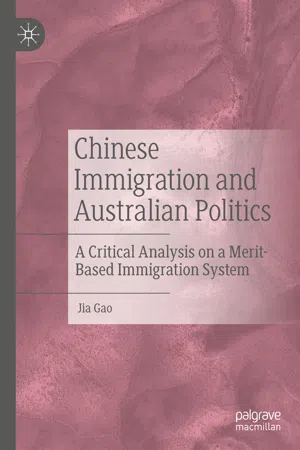
This book analyses how an increasing number of new Chinese migrants have integrated into Australian society and added a new dimension to Australian domestic politics as a result of Australia's merit-based immigration system and its shift towards Asia. These policies have helped Australia sustain its growth without a recession for decades, but have also slowly changed established patterns in the distribution of job opportunities, wealth, and political influence in the country. These transformations have recently triggered a strong Sinophobic campaign in Australia, the most disturbing aspect of which is the denial of the successful integration of Chinese migrants into Australian society. Based on evidence gathered through a longitudinal study of Chinese migrants in Australia, this book examines the misconceptions troubling Australia's current China debate from six important but overlooked perspectives, ranging from migration policy changes, economic factors, grassroots responses, the role of major political parties, community activism, to knowledge issues.
Trusted by 375,005 students
Access to over 1.5 million titles for a fair monthly price.
Australia’s China debatePost-multicultural realitiesPre-multicultural ideologiesChinese Australians
End Abstract
This book aims to analyse how an increasing number of new Chinese migrants have integrated into Australian society and added a new dimension to Australian domestic politics as a result of Australia’s strategic shift towards Asia and its merit-based migration selection system. The turning point in public awareness of this new dimension is the country’s heated debate on China’s interference in its domestic politics and its open assumptions, if not direct allegations, of active meddling of many Chinese Australians in Australian politics. This chapter briefly introduces the debate as a crucial part of the context of this analysis.
Recent debates over China form the latest part of an ongoing topic of discussion in Australia, in part because of, as noted in the Preface, Australia’s fear of China, and perhaps its migrants as well, which has long been part of the psyche of European settlers in Australia. Discussions over China have intensified since July 2016, when a Hague-based arbitral tribunal made a ruling in favour of the Philippines’, and ruled that China’s nine-dash line and its historical claim over almost the entire South China Sea were invalid. The Hague’s ruling triggered a series of rallies by Chinese migrants and international students in Australia within a few days. A large demonstration was organised in Melbourne, attracting the support from more than 100 Chinese community organisations (Wen and Flitton 2016). It shocked many observers from politics, academia, media organisations and government agencies, particularly the public call from the rally organisers on the Australian Government to maintain its not-taking-sides policy and ‘not to toe the American line’ (Sun 2016, p. 47).
The Liberal prime minister at the time, Malcolm Turnbull, was profoundly shocked by pro-China rallies by many Chinese community members, which was exacerbated by the exposure of Labor senator Sam Dastyari’s receiving gifts from an ethnic Chinese businessperson.1Turnbull did not only openly question the national loyalty of Sam Dastyari, but he reportedly ordered an investigation after the pro-China demonstration in Melbourne on 23 July 2016 to find out the extent of foreign interference in Australia. The word ‘foreign’ in this special socio-political context has been often used in the debate to refer to China.
Australia’s AustralianBroadcasting Corporation (ABC) chose to become involved in the investigation into China’s political interference in Australia. On its purpose-built website, called China Power, an ABC reporter wrote the following, which reveals that there was an investigation in 2016, resulting in some oversimplified and highly politicised conclusions:
A top-secret report has raised concerns that the Chinese Government has attempted to influence Australia’s political parties for the past decade … One intelligence source told the ABC there had been infiltration at every layer of Australian Government, right down to local councils (Borys 2018, n.p.).
A couple of months before this report, another piece appeared on China Power, making the target of Australia’s debate over China’s meddling even clearer than before. With the eye-catching headline, ‘Chinese agents are undermining Australia’s sovereignty, Clive Hamilton’s controversial new book claims’ (Welch 2018, n.p.),2 the focus of the debate has evidently shifted from China to Chinese community members, including international students from China. What is also apparent is that the debate’s main focus has been expanded from looking into individual cases, such as the case of Sam Dastyari, to Chinese agents and spies working in Australia. In this particular report, the most troubling and damaging message that the China debate could possibly produce has spread widely and rapidly, the core points of which are as follows:
Thousands of agents of the Chinese state have integrated themselves into Australian public life—from the high spheres of politics, academia, and business all the way down to suburban churches and local writers’ groups—according to a controversial book to be published on Monday (Welch 2018, n.p.).
As noted in the Preface, it is a most harmful mistake, by any standard, of the debate to target ordinary members of Chinese communities as a whole, who have long been enthusiastically and positively embraced as ‘national assets’ by many Australians (DFAT 2013, p. 6; Shorten 2014, n.p.). The radical shift from debating the South China Sea issue to investigating China’s direct interference activities in Australia, from revealing several Chinese donation cases to claiming thousands of Chinese agents and spies have infiltrated every layer of Australian society, has been guided by an analytical problem, if we are to leave aside various motives. This analytical problem has led to a situation in which Australia’s post-multicultural realities have been debated according to pre-multicultural ideologies.
This chapter discusses the analytical problem behind Australia’s debate on China and Chinese migrants in four sections to infer how such a big mistake could have been made. The first section sketches the history of Chinese immigration to Australia, with an emphasis on recent periods that make Australia’s multiculturalism and merit-based selective immigration policies stand out clearly. The second section reviews the existing literature related to three broad areas: studies of recent Chinese migration to Australia; studies of worldwide merit-based immigration systems; and studies of policy impact and evaluation with a focus on the medium-term and long-term impact. The third section will be a brief discussion of the approach to be used in this analysis. The fourth section of this chapter sketches the structure of this book, which includes a brief synopsis of each chapter.
Chinese in Australia
Chinese immigrants have been part of Australian society since the continent was still a group of colonies, large and small. In my book published in 2015, I divided the history of Chinese migration to Australia from the 1850s to the present time into six periods (Gao 2015). These were the gold rush period in the 1850s and 1860s; the establishing period from the 1870s to the 1890s; the consolidation period in the early decades of ‘White Australia’ from the 1900s to the 1940s; the diversification period as a flow-on of the Colombo Plan in the 1950s and 1960s; the multicultural period in the 1970s and 1980s, and the current or ‘model community’ period from the early 1990s to the present.
For the purpose of analysing the issue of this book, however, it would be more helpful and meaningful to look at the history of Chinese migration to Australia from the new perspective of taking into account how the Chinese have come, under what socio-economic circumstances or policy conditions they have come, who they are, and how many of them there are. Accordingly, the entire history of Chinese migration to Australia could be simply divided into three main periods.
The first period is the 100-year history of Chinese migration to Australia from the 1850s to the early 1950s. This period was mainly characterised by a large number of indentured Chinese labourers initially, and then other types of settlers, although there were some successful entrepreneurs who have been identified by various recent studies (Fitzgerald 2007; Kuo 2009). This long period also largely featured Chinese sojourners, who, it is believed, intended to earn some money and then return to their homeland, the explanation of which has been called the sojourner hypothesis (Yang 1999). This hypothesis has been rejected by some, because of the introduction of the ‘White Australia’ policy in 1901, when several colonies formed a federation. The policy to stop Chinese and other non-white labourers and settlers coming to Australia was legislated through two pieces of legislation: the Immigration Restriction Act 1901, and the Pacific Island Labourers Act 1901. These laws reduced the number of Chinese settlers in Australia, which was fewer than 10,000 in the late 1940s, before such racist and unpopular laws were progressively abandoned between 1949 and 1973.
During the gold rush, the number of Chinese labourers and settlers increased so dramatically that they accounted for around 4 per cent of Australia’s population (Blainey 1982), and more than 12 per cent of Victoria’s population in 1859 (McConnochie et al. 1988). However, the number drastically reduced by almost two-thirds after the gold rush (Willard 1967; Clark 1969). For many decades before and after Australia became a federation, governments sought to attract migrants from certain European countries. As revealed in Fig. 1.1, the number of migrants from other European countries surpassed those from the UK in the 1960s.
Fig. 1.1
Foreign-born population in Australia, 1901–71. (Source: DIBP (Department of Immigration and Border Protection) (2015, p. 16))
The second period of the history of Chinese migration to Australia took place from the early 1950s, when the Colombo Plan was launched to handle the postwar geopolitical situation in South and South-East Asia, to the late 1980s. During this period, the ethnic Chinese community recovered from a relatively small community with fewer than 10,000 members nationally in the late 1940s, growing to about 200,000 people in 1986 (Kee 1992). It also transformed itself from a mostly low-end, working-class population, working in tailor shops, barber shops, fast food or restaurants, laundries, market gardens and furniture factories, to a diverse one with a growing number of professionals.
There were two major policy changes that drove these transformations in postwar Australia. As noted, the first key policy initiative was the Colombo P...
Table of contents
Cover
Front Matter
1. Post-multicultural Realities Distorted by Pre-multicultural Ideologies
2. Australia’s New Immigration Selection Tetralogy
3. Chinese Entrepreneurialism and Australia’s China-dependent Economy
4. Australian Responses to the Rise of Chinese Immigration
5. Chinese as Voting Blocs in Australian Politics
6. Integration-Inspired Community Activism and Pushing the Bamboo Ceiling in Australia
7. Established Elites Challenged by the Historical Shift Towards Asia
8. Conclusion: Getting Back on the Track of Nation-Building
Back Matter
Frequently asked questions
Yes, you can cancel anytime from the Subscription tab in your account settings on the Perlego website. Your subscription will stay active until the end of your current billing period. Learn how to cancel your subscription
No, books cannot be downloaded as external files, such as PDFs, for use outside of Perlego. However, you can download books within the Perlego app for offline reading on mobile or tablet. Learn how to download books offline
Perlego offers two plans: Essential and Complete
Essential is ideal for learners and professionals who enjoy exploring a wide range of subjects. Access the Essential Library with 800,000+ trusted titles and best-sellers across business, personal growth, and the humanities. Includes unlimited reading time and Standard Read Aloud voice.
Complete: Perfect for advanced learners and researchers needing full, unrestricted access. Unlock 1.5M+ books across hundreds of subjects, including academic and specialized titles. The Complete Plan also includes advanced features like Premium Read Aloud and Research Assistant.
Both plans are available with monthly, semester, or annual billing cycles.
We are an online textbook subscription service, where you can get access to an entire online library for less than the price of a single book per month. With over 1.5 million books across 990+ topics, we’ve got you covered! Learn about our mission
Look out for the read-aloud symbol on your next book to see if you can listen to it. The read-aloud tool reads text aloud for you, highlighting the text as it is being read. You can pause it, speed it up and slow it down. Learn more about Read Aloud
Yes! You can use the Perlego app on both iOS and Android devices to read anytime, anywhere — even offline. Perfect for commutes or when you’re on the go. Please note we cannot support devices running on iOS 13 and Android 7 or earlier. Learn more about using the app
Yes, you can access Chinese Immigration and Australian Politics by Jia Gao in PDF and/or ePUB format, as well as other popular books in Politics & International Relations & Public Policy. We have over 1.5 million books available in our catalogue for you to explore.