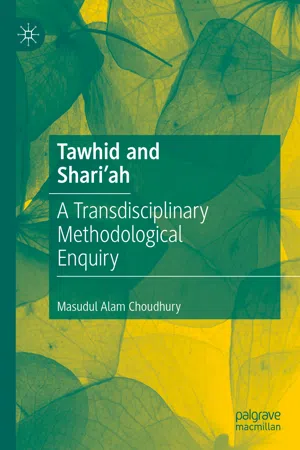
This book invokes the Tawhidi ontological foundation of the Qur'anic law and worldview, and is also a study of ta'wil, the esoteric meaning of Qur'anic verses. It presents a comparative analysis between the Tawhidi methodology and the contemporary subject of Shari'ah. Masudul Alam Choudhury brings about a serious criticism of the traditional understanding of Shari'ah as Islamic law contrary to the holistic socio-scientific worldview of the unity of knowledge arising from Tawhid as the law. A bold repudiation of the Islamic traditional understanding and the school of theocracy, Choudhury's critique is in full consonance with the Qur'an and Sunnah. It is critical of the sectarian (madhab) conception of relational independence of facts. Thus the non-creative outlook of Shari'ah contrasts with universality and uniqueness of Tawhid as the analytically established law explaining the monotheistic organic unity of being and becoming in 'everything'. This wide and strict methodological development of the Tawhidi worldview is articulated in this work. The only way that Tawhid and Shari'ah can converge as law is in terms of developing the Tawhidi methodology, purpose and objective of the universal and unique law in consonance with the ontology of Tawhid. Such a convergence in the primal ontological sense of Tawhid is termed as maqasid as-shari'ah al-Tawhid.
Trusted by 375,005 students
Access to over 1.5 million titles for a fair monthly price.
M. A. ChoudhuryTawhid and Shari'ahhttps://doi.org/10.1007/978-3-030-49087-4_1
Begin Abstract
1. Introduction
Qur’anic Elan on Tawhid (Monotheism) and Shari’ah (Shari’atan)
Masudul Alam Choudhury1
(1)
Postgraduate Program in Islamic Economics & Finance, Faculty of Economics (IEF), Trisakti University, Jakarta, Indonesia
End Abstract
Introduction
This book by invoking the Tawhidi ontological foundation of the Qur’anic law and worldview is also a study on ta’wil, meaning deepening in exploring the hidden meaning of Qur’anic verses. On this aspect of learning the Qur’an, there is the hadith of the Prophet Muhammad as follows1: “The Quran possesses an external appearance and a hidden depth, an exoteric meaning and an esoteric meaning. This esoteric meaning in turn conceals an esoteric meaning so it goes on for seven esoteric meanings (seven depths of hidden depth).” A saying of the Prophet Muhammad goes as follows: “In truth, the Qur’an possesses an inner and outer, and its inner possesses another inner up to seven inners.”2 Furthermore, there is a hadith of Prophet Muhammad that states the Qur’an has an inner meaning, and that this inner meaning conceals a yet deeper inner meaning, and so on (up to seven successive levels of deeper meanings), has sometimes been used in support of this view.3
It is only ta’wil of the overarching meaning of Tawhid as law in the Qur’an that the socio-scientific study of the Qur’an covers the universal meaning,4 its explanation, and application of Tawhid as law as the way and substance that is implied in the context of the term ‘shariatan’ in the Qur’an. When the meaning of the term ‘shari’ah’ denotes the common Qur’anic law and the universal and unique worldview of Tawhid as law, then the meanings of Tawhid and shari’ah coincide. Other than this common worldview of Qur’anic law, shari’ah over the ages became a sectarian and human-concocted law of jurisprudence. In this form, neither the resulting extraneous nature of juristic interpretation by maqasid al-shari’ah nor shari’ah-compliance are acceptable within the Qur’anic fold. The unique focal point is that the Qur’anic meaning of Tawhid and ‘shariatan’ must be unequivocally premised on the worldview of unity of knowledge that the Qur’an has explicated in terms of organic and symbiotic embedded relationships between all things in pairs (pairing of the universe). Without this unique foundation of knowledge and worldview it is impossible to learn from the Signs of Allah by unity of knowledge in the order and scheme of ‘everything’. The human-concocted origin of shari’ah as jurisprudence and its rampant practice today is permanently oblivious and unknowing about this cardinal ta’wil of the Qur’anic worldview of Tawhid in terms of its meaning of symbiotic pairing of the universe in its generality and details (Qur’an 36:36).
The equivalence of shari’ah and Tawhid is therefore stated as follows:
Tawhid = Shari’ah = Way of arising from learning in and leading towards the understanding of monotheistic oneness in the scheme and order of the symbiotic universal reality.
Hence, the emergence of Qur’anic socio-scientific thought is ontologically premised in the ta’wil of Qur’anic verses. Thus, Tawhid as the pairing of the generality and particulars of the universe is the ta’wil meaning of organismic and symbiotic relations of oneness. ‘Shariatan’ implies the way derived from and towards confirmation of Tawhid as universal law ‘between the heavens and the earth and all that is below it and above it’. Such depth of learning and discovery is by ta’wil the ways of understanding the signs of Allah in the order and order and scheme of ‘everything’ (Qur’an 41:53)5. Shari’ah as jurisdiction fails in this by its absence of premising knowledge explicitly in Tawhid as the paired unity of knowledge extending between the heavens and the earth by symbiotic manifestation.
Indeed, Tawhid is ontologically primal. It dawned as reality in the universal order at the moment of creation (kun fa-yaqun in the Qur’an). At the simultaneous moment of creation, Tawhid as total law depicting the signs and understanding of the oneness of Allah in the order and scheme of things was revealed in two of its integral forms. Firstly, it entered the domain of intrinsic belief in monotheism (iman in the Qur’an). Simultaneously, it expatiated as organic unity of knowledge in the generality and particularity of the world-system in respect of the signs of Allah. The two elements together form the universal and unique functioning of Tawhid as law in ‘everything’. Now if we denote {θ} as the levels of comprehending unity of knowledge in respect of the signs of Allah in everything, and {ε} as the degree of belief, then the embedding of belief in knowledge causing the configuration of knowledge and the world-system can be denoted by {θ(ε)}. Since {ε} remains intrinsic but not measured and thus not parametric, so Tawhid as law is functionally configured for abstracto-empirical work by measured consciousness at the level of {θ}. {ε} remains implicit and unmeasured quantitatively at the level of moral construction of the social order. Yet it is of fundamental importance in the invoking of the true power of ta’wil in understanding Tawhid in the order and scheme of ‘everything’. We thereby write in recursively continuous and evolutionary meaning of unity of knowledge and the world-system:
(Ω, S) ↔ {ε} ↔ {θ(ε)} ↔ {x(θ(ε)} ↔ continuity by the endless exercise of ta’wil of the Qur’an and the sunnah (Ω, S) for manifestation by law in the world-system. {x(θ(ε)} denotes the world-system in generality and details induced by unity of knowledge. Recursive continuity as sustainability of Tawhid in knowledge, space, and time continuum is denoted by pairing, ↔.
If the compound mapping over the entire string shown above and denoted by ↔ is denoted by F, then ta’wil in the mathematical sense is explained by,
This formal mathematical expression of ta’wil means that ta’wil is ontologically premised in the precept of Tawhidi unity of knowledge as conveyed by the learning string in terms of F(θ(ε)). Ta’wil is the learning experience in Tawhidi unity of knowledge in deepening depth of its meaning and application. It is so heightened across the knowledge, space, time, dimensions that are all embedded in unity of knowledge {θ(ε)}. The recursive symbol ↔ establishes the case of equivalence and circular causality along the entire evolutionary learning path, the TSR, in respect of Tawhid and the world-system in continuum. A(θ(ε)) and α(θ(ε)) in the above expressions denote positive coefficients of the force of learning in terms of Tawhidi unity of knowledge along the belief-induced evolutionary knowledge induction caused by continuous exercise of ta’wil.
Neither maqasid al-shari’ah nor the shari’ah-compliance idea has been able to launch an analytical study of the imminent Qur’anic socio-scientific world-system extending between the ‘heavens and the earth, and across all that is below the earth and above the earth’. The present work unravels such a methodology by way of using the approach of ta’wil of the Qur’anic centrepiece of Tawhid and its derived methodology as a theory of the universal and unique law in the Tawhidi ontological framework of organic unity of knowledge and the world-system. The contents of this work are divided between theory and applications to current topics. A comparative and critical study of Tawhid as Qur’anic law contra shari’ah as Islamic jurisprudence is maintained in the formalism of theory and application.
The language of the text is rigorously analytical spanning areas of ta’wil of the Qur’an and sayings of the Prophet Muhammad (hadith). This includes analytical philosophy of science, specialized knowledge of the world-system of Islamic economics and society, quantitative analysis and implications, comparative study in these areas between Islamic and contemporary scholarship. Such a work of bold and rigorous erudition, though not in compliance with the outmoded Islamic traditional understanding and the school of theocracy, is in full consonance with the Qur’an and sunnah. The book is critical of the sectarian (madhab) conception of relational independence of facts. Thus, the non-creative outlook of shari’ah contrasts with universality and uniqueness of Tawhid as the analytically established law explaining the monotheistic organic unity of being and becoming in ‘everything’. This wide and strict methodological development of the Tawhidi worldview is articulated in this work. The book is thereby an erudite contribution to the world of learning that would interest all in scholarship who would like to understand the ontological analytical foundation of ta’wil in the Qur’an concerning the imminent socio-scientific universe of unity of knowledge as theory and application.
Footnotes
1
H. Corbin (1993). History of Islamic Philosophy. pp 1–14. Kegan Paul International, London, England.
2
Sayyed haydar ‘amoli, Jami-u al-asrar (Shirkatintisharat ‘ilmifarhangi, Tehran, 1989), p. 530. The hadith narrated from the Prophet.
3
Wikipedia, “Esoteric interpretation of the Qur’an” (visited March, 2019).
4
The term ‘ta’wil’ is invoked by the Qur’an (12:100) to mean such lofty meanings of the inner understanding of verses in the light of the most fundamental truth. That is, Tawhid as the universal law of ‘everything’.
5
(Qur’an 41:53): We will show them Our signs in the horizons and within themselves until it becomes clear to them that it is the truth. But is it not sufficient concerning your Lord that He is, over all things, a Witness?
M. A. ChoudhuryTawhid and Shari'ahhttps://doi.org/10.1007/978-3-030-49087-4_2
Begin Abstract
2. A Critique of Shari’ah Perspectives Contra Tawhid as Law: Terminologies
Masudul Alam Choudhury1
(1)
Postgraduate Program in Islamic Economics & Finance, Faculty of Economics (IEF), Trisakti University, Jakarta, Indonesia
End Abstract
The Structure of Tawhid as Law of Unity of Knowledge and the Embedded World-System
The Tawhidi methodological worldview has its most distinctive characteristics that define the all-comprehensive domain o...
Table of contents
Cover
Front Matter
1. Introduction
2. A Critique of Shari’ah Perspectives Contra Tawhid as Law: Terminologies
3. Casting Maqasid Al-Shari’ah in Tawhidi Methodological Worldview
4. Tawhid Contra Shari’ah Treatment of Qur’anic Worldview
5. Tawhid as Law Contra Shari’ah in Standardizing a Theory of Islamic Financial Economy
6. Tawhid as Law Contra ‘Shari’ah-Compliance’ in Malaysian Advisory Commission
7. A Critical Examination of the Shari’ah in the Light of the Legal Commercial Report of ISRA
8. The Ontology of Tawhid as the Law Applied to Specific Issues
9. A Mathematical Model of Symbiotic Aggregation and Participatory Dynamics in Tawhidi Epistemological: Worldview of Unity of Knowledge
10. Conscious Technology and Technological Change in the Light of Tawhid: Artificial Intelligence, FINTECH, and Other
11. Endogenous Monetary Transmission in Islamic Financial Economics
12. Conclusion with an Extension to Tawhid and Shari’ah in Islamic Banking Paradigm
Back Matter
Frequently asked questions
Yes, you can cancel anytime from the Subscription tab in your account settings on the Perlego website. Your subscription will stay active until the end of your current billing period. Learn how to cancel your subscription
No, books cannot be downloaded as external files, such as PDFs, for use outside of Perlego. However, you can download books within the Perlego app for offline reading on mobile or tablet. Learn how to download books offline
Perlego offers two plans: Essential and Complete
Essential is ideal for learners and professionals who enjoy exploring a wide range of subjects. Access the Essential Library with 800,000+ trusted titles and best-sellers across business, personal growth, and the humanities. Includes unlimited reading time and Standard Read Aloud voice.
Complete: Perfect for advanced learners and researchers needing full, unrestricted access. Unlock 1.5M+ books across hundreds of subjects, including academic and specialized titles. The Complete Plan also includes advanced features like Premium Read Aloud and Research Assistant.
Both plans are available with monthly, semester, or annual billing cycles.
We are an online textbook subscription service, where you can get access to an entire online library for less than the price of a single book per month. With over 1.5 million books across 990+ topics, we’ve got you covered! Learn about our mission
Look out for the read-aloud symbol on your next book to see if you can listen to it. The read-aloud tool reads text aloud for you, highlighting the text as it is being read. You can pause it, speed it up and slow it down. Learn more about Read Aloud
Yes! You can use the Perlego app on both iOS and Android devices to read anytime, anywhere — even offline. Perfect for commutes or when you’re on the go. Please note we cannot support devices running on iOS 13 and Android 7 or earlier. Learn more about using the app
Yes, you can access Tawhid and Shari'ah by Masudul Alam Choudhury in PDF and/or ePUB format, as well as other popular books in Theology & Religion & Financial Services. We have over 1.5 million books available in our catalogue for you to explore.