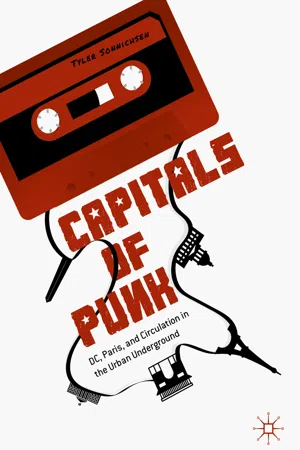
Capitals of Punk tells the story of Franco-American circulation of punk music, politics, and culture, focusing on the legendary Washington, DC hardcore punk scene and its less-heralded counterpart in Paris. This book tells the story of how the underground music scenes of two major world cities have influenced one another over the past fifty years. This book compiles exclusive accounts across multiple eras from a long list of iconic punk musicians, promoters, writers, and fans on both sides of the Atlantic. Through understanding how and why punk culture circulated, it tells a greater story of (sub)urban blight, the nature of counterculture, and the street-level dynamics of that centuries-old relationship between France and the United States.
Frequently asked questions
Yes, you can cancel anytime from the Subscription tab in your account settings on the Perlego website. Your subscription will stay active until the end of your current billing period. Learn how to cancel your subscription.
No, books cannot be downloaded as external files, such as PDFs, for use outside of Perlego. However, you can download books within the Perlego app for offline reading on mobile or tablet. Learn more here.
Perlego offers two plans: Essential and Complete
Essential is ideal for learners and professionals who enjoy exploring a wide range of subjects. Access the Essential Library with 800,000+ trusted titles and best-sellers across business, personal growth, and the humanities. Includes unlimited reading time and Standard Read Aloud voice.
Complete: Perfect for advanced learners and researchers needing full, unrestricted access. Unlock 1.4M+ books across hundreds of subjects, including academic and specialized titles. The Complete Plan also includes advanced features like Premium Read Aloud and Research Assistant.
Both plans are available with monthly, semester, or annual billing cycles.
We are an online textbook subscription service, where you can get access to an entire online library for less than the price of a single book per month. With over 1 million books across 1000+ topics, we’ve got you covered! Learn more here.
Look out for the read-aloud symbol on your next book to see if you can listen to it. The read-aloud tool reads text aloud for you, highlighting the text as it is being read. You can pause it, speed it up and slow it down. Learn more here.
Yes! You can use the Perlego app on both iOS or Android devices to read anytime, anywhere — even offline. Perfect for commutes or when you’re on the go. Please note we cannot support devices running on iOS 13 and Android 7 or earlier. Learn more about using the app.
Yes, you can access Capitals of Punk by Tyler Sonnichsen in PDF and/or ePUB format, as well as other popular books in Social Sciences & Music. We have over one million books available in our catalogue for you to explore.
On January 20, 1969, a little-known band led by Yardbirds guitarist Jimmy Page played a hastily booked show a few miles north of Washington, DC, at the Wheaton Youth Center. Or, they didn’t. Accounts of this apocryphal early Led Zeppelin show are still contested. Filmmaker Jeff Krulik, known for his 1986 guerilla-style documentaryHeavy Metal Parking Lot, investigated the alleged show in his 2012 documentary Led Zeppelin Played Here. He suggests that the show did happen, but several DC-area baby boomers cast reasonable doubt. After all, nobody has found any surviving flyers for the show. Nobody has any ticket stubs. Nobody, even the biggest Zeppelin fans Krulik could find, had any autographed items from that night.
All of these curiosities had reasonable explanations. Led Zeppelin’s first album had been released stateside one week prior to the show and with relatively little promotion. Nobody in the audience would have known any of the songs Page’s new band played. One or two people featured in Krulik’s documentary claimed that the band was promoted as “the new Yardbirds.” While rock ‘n’ roll had been a global phenomenon for almost two decades, the concert industry of established clubs, promoters (flyers), and distributors (tickets) was embryonic at best. The well-documented excesses of the musicians, coupled with their rigorous touring and recording schedule, did not lend much credence to their accounts. When Krulik asked Page about it at the 2012 Kennedy Center Honors, the gracious guitarist said it was possible, but he had not thought about it in decades.
Led Zeppelin Played Here may not conclusively answer the question, but it does explain to the contemporary viewer why one of the first shows by one of rock’s most popular bands has faded from memory. While Krulik’s justifications are valid, I would argue that they are more matters of time and, even more significantly, place. Look at the date. As the caravan bringing the British rock stars wound its way down to DC through blinding snow from the Midwest, Richard Nixon was swearing in as President. The local press and populace were understandably distracted from the goings-on at a suburban youth center. Americans were fighting a highly contentious war both abroad in Vietnam and at home against one another. The recent assassinations of Martin Luther King, Jr., and Robert Kennedy had sparked cycles of solemn mourning and raucous rioting, especially in a heavily scarred capital city.
In 1969, the US capital found itself in a precarious position, a button-down city licking its wounds after being torn to shreds the previous April. Across the pond, the French, whose colonial occupation of Southeast Asia had stirred into a multinational war effort, watched Parisian student protests flare into a national shutdown the previous May, the events of which theorists still analyze, celebrate, and condemn in similar breaths. It was understandable that popular culture—film, television, and music especially—was not dominating the mainstream discussion of either town. DC native Marvin Gaye, who would register one of the most beautiful screeds against the Vietnam Era in 1971, had left for Detroit over a decade earlier. Though both cities had produced a handful of noteworthy (if not commercially successful) bands over the prior decade, neither possessed anything that amounted to the status of a “rock ‘n’ roll town.” To most of the world’s population, even many native or transplanted Washingtonians and Parisians, they still don’t.
* * *
On May 6, 2010, a four-piece from Northern Holland named Rush’n Attack played a bar basement show at Le Pix, a charming bar on Rue Pixérécourt in Paris’ Belleville neighborhood. The Parisian band Kimmo, whose members booked and promoted the show, opened for them. A friend of mine from back in DC put me in touch via email with Mathieu Gélézeau, one of Kimmo’s two singer-guitarists. I was scheduled to land at Beauvais airport far outside of Paris on the evening of their gig. I had never been to Paris before, and I would not have an active phone while I was in France. This would require some strategy. On April 21, I emailed the band:
I’m a punk fan from Washington DC who wants to come check out your show at Le Pix on May 6. My buddy Ryan (who’s lived in France for a little while) told me about your show, and it’s happening a weekend when I’m visiting Paris, so, awesome.
I’m landing at Beauvais airport at 1840h so I’ll hopefully be getting to Paris around 2000h? If I get right on the metro and come out to Telegraphe should I be able to make it in time to see enough of the show?
A few days before the show, I got a reply from Mathieu:
Hi Ty,
Mathieu fromKimmohere. Happy to know we have a fan in DC!
So, for the show at Le Pix, I think we will play at 21:30h.
If you are in Beauvais at 18:40h, maybe you can be at Le Pix at 21:30 but you have to be speed! If you are in Paris at 20:00 or 20:30, it will be OK.
We play 45 minutes I think.
Hope to see you at this show.
I did not reply and admit that I’d never actually heard his band’s music, but his friendliness and eagerness for me to see them perform made me ready to be a fan. After catching a well-timed shuttle from Beauvais to Porte Maillot in eastern Paris, I hopped on the Metro and navigated to Télégraphe station, the closest one to the venue. At the time, I knew nobody in Paris and spoke no French. My bulging backpack gave me away as a stranger, especially on that quiet Thursday night in what appeared to be a gentrifying neighborhood (a suspicion that eventual research and better acquaintance with Paris would later verify). At the time, I was working full-time at a public relations firm in Washington, DC, enjoying one of my two luxurious weeks of paid vacation in Europe that my Parisian counterparts would likely have either laughed at or pitied. I was disenchanted with, to lift from The Clash, “working for the clampdown.” I had been thinking about going to graduate school for geography, but I still did not have a comprehensive grasp on the eclectic subject, much less how prominently geography would play into what I was about to experience, tucked away on a Paris side street.
Kimmo guitarists Mathieu Gélézeau and Natasha Herzock sound check before a gig at Le Pix bar, May 6, 2010. (Photo by the author)
I arrived as the first of the three bands were finishing their set. I asked for Mathieu, and we were able to chat for a few minutes before Kimmo went over to the small stage to set up. For the few minutes leading up to their first song, I wandered over and thumbed through the items on the merchandise table, got a beer at the bar upstairs and brought it down, and stood against the back wall, trying to blend in. Listening to a cacophony of French for the first time in my life thrilled my tourist brain.
Kimmo opened their set with a song off their new album Bolt and Biscuit. I had never heard the song or even anything by Kimmo before, and I was thousands of miles from DC. But even before their first song ended, I felt surprisingly at home. The reason hit me surprisingly quickly: Wow… this band seriously sounds like they’re from DC.
* * *
You may be wondering (understandably so) why a story about hardcore punk would begin with an anecdote about Led Zeppelin. Two key yet heavily contrasting reasons come to mind. First, the idea that any show could happen this apocryphally in DC predates the strong sense of community and the archive that would come to characterize the city’s underground scene. Second, it provides a case study on the dearth of “rock ‘n’ roll culture” in the US capital that eventually gave rise to such a vibrant punk underground, as much as DChardcore (or, “harDCore”) did not develop in a vacuum. Bands integral to what mainstream radio would later tag as classic rock may not have actively participated in punk culture, but they formed the adolescent soundtrack to many who would build punk scenes. A pack of teenage skateboarders at Wilson High School in northwest DC listened to artists like Ted Nugent and Foghat because, until the Ramones and Sex Pistols showed up, their arena rock was the hardest, fastest, and loudest music available (see Andersen and Jenkins 2001).
Punk rock, given the cultural sea-change that it introduced, added little to the canon fundamentally. The bluntest evaluations of punk cite how the movement hit the reset button on rock music, dialing it back to its raw roots. Many characteristics of punk that become standardized after the late-1970s explosion were not revelatory. In certain respects, the mores of DIY (Do-It-Yourself) and underground, alternative music venue promotion have always existed. Punk just mollified the concept and brought it more to the forefront of the discussion on cultural production. It sought to break down the hierarchy associated with artistic creation as well as the socially and corporately constructed divisions between the artist and the performer. A short list of DC artists and bands across numerous scenes—hardcore, Go-Go, salsa/merengue—all lived up to that ethos. DIY also sought to operate outside of the culture industry, not conforming their output to satisfy major labels’ expectations.
Before rock clubs became more common in the late 1960s, rock ‘n’ roll bands played wherever shows could be set up. Early rock ‘n’ rollers performed in high school auditoriums, grange halls, bowling alleys, and ballrooms. The pre-fame Beatles honed their chops playing at seedy bars in Hamburg’s Reeperbahn district (see Inglis 2012; Fremaux and Fremaux 2013), a highly valued chapter in their anthology and mythology. As Led Zeppelin and their ilk ushered in a more proficient club industry in the 1970s, punk and the associated underground emerged as a cosmic equal-and-opposite reaction. Ian MacKaye, one of those Wilson High School skaters who would eventually help grow the city’s punk scene to global recognition, told the fanzineComet in 2001:
Punk has no single definition... but to me it has always meant the underground, the place where conventional approaches to life can be taken to task. I don’t think of it as so much of a ‘movement,’ rather a constant parallel world that has been around for as long as there has been an ‘overground.’ There has to be a place where profit and popular tastes don’t dictate creation, otherwise we would never go forward.
MacKaye’s sentiments, which he has echoed consistently for over three decades in his roles as punk musician and head of Dischord Records, reflect central theses on the “culture industry” which theorists like Antoni Gramsci, Theodor Adorno, and Max Horkheimer set forth...
Table of contents
Cover
Front Matter
1. Introduction: A Tale of Two Cities and Scenes
2. DC and Paris: Capitals of Punk
3. A Brief History of Franco-American Circulation in the Twentieth Century
4. Washington Geography and the Birth of HarDCore, 1979–1983
5. Hardcore Vient à Paris, 1983–1987
6. This Is Not a Fugazi Book: HarDCore Comes of Age
7. Earthquakes Come Home: French Punks Visit DC
8. “We Were Fucking Tourists, in the End”: Punk, Tourism, and Gentrification
9. Ian MacKaye Is Alive and Well and Living in DC: Concluding Thoughts