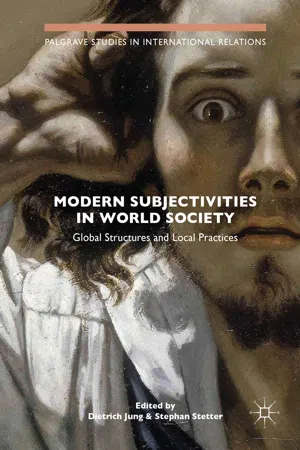
This book brings together theories of world society with poststructuralist and postcolonial work on modern subjectivity to understand the universalising and particularising processes of globalisation. It addresses a theoretical void in global studies by attending to the co-constituted process through which modern subjectivities and global processes emerge and interact. The editors outline a key problem in global studies, which is a lack of engagement between the local/particular/individual and the 'universalising' processes in which they are situated. The volume deals with this concern with contributions from historical sociologists, poststructuralist and postcolonial scholars and by focusing in the Middle East, religion in global modernity and non-human subjectivities.
eBook - ePub
Modern Subjectivities in World Society
Global Structures and Local Practices
- English
- ePUB (mobile friendly)
- Available on iOS & Android
eBook - ePub
Modern Subjectivities in World Society
Global Structures and Local Practices
About this book
Information
© The Author(s) 2019
Dietrich Jung and Stephan Stetter (eds.)Modern Subjectivities in World Society Palgrave Studies in International Relationshttps://doi.org/10.1007/978-3-319-90734-5_11. Why Study Modern Subjectivities in World Society? An Introduction
Dietrich Jung1 and Stephan Stetter2
(1)
Centre for Contemporary Middle East Studies, University of Southern Denmark, Odense, Denmark
(2)
Faculty of Social Sciences and Public Affairs, Bundeswehr University Munich, Munich, Germany
From Globalization to World Society: Global Horizons, Local Practices
At the change of the millennium, in a special issue of Third World Quarterly Clive Kessler named globalization a “scholarly monster.” With respect to the analysis of global affairs, Kessler considered the academic debate about globalization to be a part of the problem rather than offering a solution. According to him, countless academics across the world “have produced literally hundreds of books and thousands of articles probing the question of globalization” (Kessler 2000, 932). Almost twenty years later, this proliferation of academic writings on globalization has only continued, accelerating in speed and, following Kessler and others, only increasing the general confusion around this term. Indeed, the study of global phenomena, processes, and events, both historical and contemporary, summoned under the umbrella term ‘globalization’ marks a meanwhile gigantic body of research in the social sciences and the humanities (see Stetter 2016 for an overview on the concept of globalization and its academic and societal evolution). Indeed, and somewhat qualifying Kessler’s and others’ skepticism about globalization as a meaningful social sciences concept, the globalization debate itself should be taken as an expression of the ongoing complex restructuring of social and discursive spaces in a global dimension (Scholte 2000, 3).
In other words, rather than getting rid of the concept of globalization because it is all too often used in an amorphous manner and, at times, intellectually shady ways, the ambiguous academic debate on globalization should not, at first place, be viewed as an allegedly objective description of a phenomenon out there, but as an inherent feature of the very phenomenon that it aims to study. This entails, in our view, a plea not to avoid the concept of globalization but to devote instead more rigor to adequately defining it. We therefore suggest drawing from the concept of world society in broader social theory, in particular in a combination of theories of world society and post-structuralism (see below). At the same time, and here Kessler is right, the debates revolving around the omnipresent buzzword globalization are often accompanied by a lack of theoretical foundations. Studies on globalization have developed into a body of literature that often contains a multiplicity of ill-defined and contradictory normative and analytical approaches. While pretending to be an analytically usable category, globalization thus in many accounts has declined into a randomly used term. An interesting case here is the discipline of International Relations (IR), which is devoted to the study of the global from the outset. Scholars in this field ask themselves on which mutually intelligible theoretical language the ever-growing field of global studies in IR and beyond could rest, in particular given that the long-used notion of the “international” is at least as contested as the term globalization (Bigo and Walker 2007).
In this volume, we start from the assumption that globalization is somehow “out there” and affects social life from the level of the individual to macro-processes. Therefore, the question about theorizing globalization has major implications from both intellectual and practical perspectives. Rather than giving up the term globalization, we have to specify its theoretical, analytical, empirical, and normative content. As already alluded to, this book makes a suggestion to answer this question by conceiving globalization as a process of world society formation. The book thereby wants to make a significant contribution to addressing this problem in current studies of IR and global affairs, both theoretically and empirically. The editors argue that theories of world society such as Niklas Luhmann’s Modern Systems Theory or the Stanford School of Sociological Institutionalism associated in particular with John W. Meyer might be obvious candidates for both theorizing on global phenomena as instances of world society formation and building bridges between these two and other schools of thought that approach global issues from a comprehensive social theory perspective, in particular post-structuralist lines of thought. Understanding the global level from the theoretical vantage point of society as world society, system theory, and sociological institutionalism conceptualize the social as global from the outset. Since natural, political, cultural, and economic borders mediate but never fully prevent the flow of information, knowledge, technologies, and goods, the ultimate horizon of human society is world society. Yet by usually highlighting macro-structures and cross-cultural generalizations, concepts of world society have been exposed to often justified criticism. A particularly important criticism highlights individual and collective particularities in contradistinction to the universalistic claims of theories of world society. That is why in various academic disciplines’ debates on globalization there is an emerging and innovative discussion on the local as well as on forms of individual/collective resistance to globalization, and how this shapes the global (Yüksel et al. 2016).
Against this general background, our volume attempts to circumvent the conventional but rather artificial opposition of top-down and bottom-up approaches in the study of global phenomena. Instead, the editors of this anthology asked its authors to conceiving of world society—each author in her and his own way—as the worldwide interplay between global horizons on the one hand and local practices that give meaning to, transform, confirm, or challenge these global horizons on the other. This focus on local practices directly steers attention toward the role of individuals (and the all-powerful modern idea of the individual) in mediating, reinforcing, and transforming global structures. Following this rationale, the contributors to this book consider the formation of modern subjectivities, i.e., the way modern individuals construct their status as subjects in social orders, to be the point of departure from which we try to understand this interplay between global horizons and local practices.
In light of the homogenizing tendencies of classical modernization theory and early interpretations of globalization from the 1960s until the 1990s, the hesitation to employ universalizing schemes in order to account for societal developments from the global to the local has its merits. The world is, maybe increasingly, fragmented and polarized on many scales, such as in terms of levels of governance, diverse political ideologies, differences in wealth, or cultural and religious identifications, and even more so, on the level of individual identities and practices. While one result of this fragmentation is the persistence of inequality, another is the increasing centrality of the ‘category of the person,’ as sociologist Marcel Mauss once argued (see the chapter by Stetter in this volume), in global modernity, or individual actorhood in modern sociological speak (Jepperson and Meyer 2000). Thus, in the allegedly homogenizing globalized order but against the background of fragmentation, differences, and inequalities, cherishing individual particularities has become a popular way of expressing oneself. Yet, how can these particularities be studied and understood if not by applying a more general standard to which the practice and observation of such particularities constantly relate? In other words, there is no particular without some universal against which the notion of particularity can unfold.
In this book, we suggest addressing these dynamics between the global and the local, and between the universal and the particular, on the basis of a novel conjuncture between theories of world society on the one hand and notions of modern subjectivities developed inter alia in post-structuralist writings on the other. Both world society theories and post-structuralism are quite distinct from one-dimensional, over-simplistic concepts of globalization, and there has been ample literature highlighting the usefulness of a combination of these two strands of social theory (Andersen 2003; Busse 2017; Borch 2005; Jung 2017; Stäheli 2000). While world society theories challenge the linear and modernist liberal underpinnings of many globalization theories, and thereby address the ambivalence of world society’s macro-structures, post-structuralist theories on the modern subject provide an equally critical account of the universalities and particularities of local social practices, i.e., world society’s micro-structures. We are aware that not only is post-structuralism about subjects, but also, arguably, that the notion of subjectivities is a central tenet, most prominently in Foucault’s notion of modern technologies of the self. We claim that these two strands of social theory, theories of world society on the one hand and the post-structuralist focus on modern subjectivity formation on the other, can be fruitfully brought into dialogue with each other. In the following chapters of our book, our contributors will do so from different angles, thereby further developing the aforementioned branch of literature that has in the last two decades embarked on identifying common grounds between these theories. Starting from this conceptual vantage point, we want to explore ways in which the complementary application of these theoretical perspectives can further the understanding of our contemporary world. In short, through the prism of how individuals construct their status as subjects in a modern global order we can not only understand key dynamics of globalization, but also arrive at more nuanced understandings of the interlacements between global horizons and local practices that shape, in our view, the fragmented yet universal global social reality we as modern subjects have to live in.
Contributors, Theme, and Aim of the Book
The book presents analyses from ten scholars who have strong research interests related to our two conceptual sign posts of world society and modern subjectivity formation. Importantly, however, these various contributors do not represent one school of thought. This volume brings together a group of authors with different theoretical backgrounds who are willing to engage with each other in a joint debate about a common theme. Instead of discussing this theme within a group of completely like-minded peers, the authors of this volume engage in the necessary bridge-building among different schools of thought to further our understanding of the complexity in the constitutive interdependence between the macro-structures of world society and the rather idiosyncratic construction of modern subjectivities. The theoretical approaches in this book, therefore, do not represent a well-oiled “theoretical machine” meant to develop a unified conceptual take on this topic. That is why this introductory chapter does not aim to present an overarching analytical framework to be slavishly applied from chapter to chapter. Instead, we take the dualistic nature of the global system, its universal structures, and their diverse local enactments as the mutual starting point for each individual contribution. The book is, thus, not based on a theoretical straightjacket, but is the result of more than two years of research and continuous exchange among its authors, who met twice for extended workshops at which various drafts of the chapters were discussed.
In contrast to this relative theoretical diversity of our group, however, the contributors to this volume do share a central research interest, namely an interest in how the interplay between global structures and local practices plays out in contemporary world society. There are many different empirical angles addressed in the various chapters, but a particular focus of the contributions to this volume is the role of religion in the global system on the one hand and the Middle East as a world societal region of great relevance to such processes of world society formation on the other. With a view to religion, there is a growing strand of literature once again making religion a topic of globalization studies. However, these studies often have a tendency to take the proclaimed global resurgence of religion for granted. They often neglect to offer definitive evidence for their statements about a religious revival (Haynes 2006, 536). In the more general globalization debate, the role of religion basically appears in juxtaposing discourses of a “fundamentalist” religious resurgence with the plurality of growing religious markets (Vásquez and Friedmann Marquardt 2003, 4).
When it comes to the Middle East, it predominantly is the discourse on fundamentalist resurgence that has characterized the discussion about religion and globalization in this part of the world. Thereby, the debate often replaced theoretically informed explanations by “banal platitudes about a reified ‘Islam,’ the specificities of the ‘region,’ and the atavistic and irremediable ways of its inhabitants” (Halliday 2005, 6). Already years before the so-called Arab Spring, the series of popular uprisings in the Arab Middle East between 2010 and 2012, scholars therefore demanded ways of generating a cross-fertilization between studies of the global, IR in particular, and Middle East Studies (cf. Valbjørn 2017). In making both the Middle East and religion prominent cases in some of the chapters in this book, the editors aim to make a contribution toward a theoretically informed understanding of contemporary Middle Eastern affairs and the global role of Islam. Moreover, in putting our empirical focus partly on the Middle East and Islam, the book wants to go beyond the Eurocentric bias of so many case studies on world society and modern subjectivities. We think that the focus on religion and the Middle East is helpful in better understanding how and why world society and modern subjectivities are not in any way limited to Western experiences and practices, but become enacted around the globe.
The book’s group of authors consists of 10 scholars. Six of them represent different approaches to world society and four scholars provide complementary views to these world society approaches from other theoretical angles. Dietrich Jung heads, the Modern Muslim Subjectivities Project at the University of Southern Denmark (SDU) and has been working on a theory of world society that is informed by the work of classical historical sociology, in particular by Norbert Elias, Karl Marx, and Max Weber (Jung 1995, 2001, 2004). Stephan Stetter, from the University of the Bundeswehr in Munich, has a strong research record on Luhmann’s Modern Systems Theory and is an associate member of the Institute of World Society Studies at Bielefeld University. His current research focuses on evolution theories of world society (Stetter 2016). George Thomas from Arizona State University adds the perspective of world society that has been developed by the Stanford School of Sociological Institutionalism associated with John W. Meyer (Thomas 2004, 2009; Meyer et al. 1997). These three scholars are complemented by three colleagues who have been working together with them at the same institutions, in this way sharing the same discursive environment without necessarily following identical theoretical approaches. Similar to Jung, Martin Ledstrup takes his theoretical point of departure in classical sociology, however, in going back to another sociological founding figure, namely Georg Simmel. In his concept of world society Jan Busse, also from the University of the Bundeswehr in Munich, combines theories of governmentality with the framework of the Stanford School, and Thomas Puleo, who was a colleague of George Thomas at Arizona State University, breaks out of the conventional confines of social theory by putting his take on modern subjectivity into the ...
Table of contents
- Cover
- Front Matter
- 1. Why Study Modern Subjectivities in World Society? An Introduction
- Part I. World Society and Modern Subjectivity: Conceptual Reformulation
- Part II. The Politics of Modern Subjectivities in World Society
- Part III. World Society, Modern Subjectivity, and Religion
- Part IV. Alternative Subjectivities: Technology and the Anthropocene
- Back Matter
Trusted by 375,005 students
Access to over 1.5 million titles for a fair monthly price.
Study more efficiently using our study tools.
Frequently asked questions
Yes, you can cancel anytime from the Subscription tab in your account settings on the Perlego website. Your subscription will stay active until the end of your current billing period. Learn how to cancel your subscription
No, books cannot be downloaded as external files, such as PDFs, for use outside of Perlego. However, you can download books within the Perlego app for offline reading on mobile or tablet. Learn how to download books offline
Perlego offers two plans: Essential and Complete
- Essential is ideal for learners and professionals who enjoy exploring a wide range of subjects. Access the Essential Library with 800,000+ trusted titles and best-sellers across business, personal growth, and the humanities. Includes unlimited reading time and Standard Read Aloud voice.
- Complete: Perfect for advanced learners and researchers needing full, unrestricted access. Unlock 1.5M+ books across hundreds of subjects, including academic and specialized titles. The Complete Plan also includes advanced features like Premium Read Aloud and Research Assistant.
We are an online textbook subscription service, where you can get access to an entire online library for less than the price of a single book per month. With over 1.5 million books across 990+ topics, we’ve got you covered! Learn about our mission
Look out for the read-aloud symbol on your next book to see if you can listen to it. The read-aloud tool reads text aloud for you, highlighting the text as it is being read. You can pause it, speed it up and slow it down. Learn more about Read Aloud
Yes! You can use the Perlego app on both iOS and Android devices to read anytime, anywhere — even offline. Perfect for commutes or when you’re on the go.
Please note we cannot support devices running on iOS 13 and Android 7 or earlier. Learn more about using the app
Please note we cannot support devices running on iOS 13 and Android 7 or earlier. Learn more about using the app
Yes, you can access Modern Subjectivities in World Society by Dietrich Jung, Stephan Stetter, Dietrich Jung,Stephan Stetter in PDF and/or ePUB format, as well as other popular books in Politics & International Relations & Globalisation. We have over 1.5 million books available in our catalogue for you to explore.