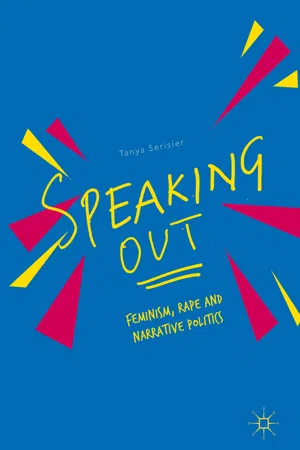
This is the first critical study of feminist practices of 'speaking out' in response to rape. This book argues that feminist anti-rape politics are characterised by a belief in the transformative potential of women's personal narratives of sexual violence. The political mobilisation of these narratives has been an incredibly successful strategy, but one with unresolved ethical questions and political limitations. The book explores both the successes and the unresolved questions through feminist archival materials, published narratives of sexual violence, and mass media and internet sources. It argues that that a rethinking of the role and place of women's stories and the politics of speaking out is vital for a rethinking of feminist politics around sexual violence and key to fresh approaches to combating this violence.
- English
- ePUB (mobile friendly)
- Available on iOS & Android
eBook - ePub
About this book
Information
© The Author(s) 2018
Tanya SerisierSpeaking Outhttps://doi.org/10.1007/978-3-319-98669-2_11. Introduction: The Political Promise of Personal Narratives
Tanya Serisier1
(1)
School of Law, Birkbeck, University of London, London, UK
Tanya Serisier
Against Our Will: Men, Women and Rape, published in 1975 by Susan Brownmiller, became a New York Times bestseller and saw its author feature as one of Time magazine’s 12 ‘Women of the Year’ in the magazine’s official tribute to feminism (Time 1976). The mainstream success of this feminist polemic is generally understood as ‘the beginning of an era’ in which feminist understandings of rape as a social problem and political issue entered the public sphere (Horeck 2004, p. 17). Brownmiller’s (1976, p. 15) description of rape as ‘nothing more or less than a conscious process of intimidation by which all men keep all women in a state of fear’ is developed through an epic historical narrative of rape as a core feature of women’s oppression. The story begins with an imagined ‘first rape’ by ‘prehistoric man’ and concludes with the birth of 1970s’ feminist activism in the USA. Despite compelling criticisms of its racial politics (Davis 1983) and its historical accuracy (Porter 1986), the book remains, as Tanya Horeck (2004, p. 17) argues, important as ‘a point of origin’ for feminist anti-rape politics. It is a useful tool to ‘inquire into the kind of work rape has done for feminism’, as well as the work that women’s narratives of sexual violence perform for feminism. This analysis is crucial to understanding the development, successes and limitations of feminist responses to rape and the impacts of feminist politics on cultural understandings of sexual violence, and sexuality, gender and political authority more broadly.
This is a book about the foundational role that personal stories play in feminist responses to sexual violence, from the writing of Against Our Will to contemporary hashtag activism such as #MeToo and #YesAllWomen. I argue that feminist anti-rape politics is founded on the belief that producing and disseminating a genre of personal experiential narratives can end sexual violence. It is a belief, in the words of the well-known slogan, that ‘breaking the silence’ through telling personal stories can and will ‘end the violence’. The production of this genre of stories is one of the key legacies of second-wave feminist politics, as is the widespread cultural acceptance of the political and ethical necessity of speaking out as a response to rape. Speaking Out is concerned with the consequences, both intended and unintended, of this commitment to the transformative political potential of experiential storytelling. I suggest that understanding the ‘narrative politics’ of speaking out necessitates examining the relationships between survivors of sexual violence, the stories they tell and the feminist movement that has enabled these stories to be told. In this introduction, I draw out the complex relations between personal narratives and feminist politics through an exploration of the story of Susan Brownmiller and how she came to write her foundational feminist work on rape.
The ‘Personal Statement’ that opens Against Our Will makes immediately clear that the book does not arise from a direct experience of sexual violence:
The question most often asked of me while I was writing this book was short, direct and irritating: ‘Have you ever been raped?’My answer was equally direct: ‘No’.
Brownmiller attributes the prevalence of this mutually dissatisfying exchange to a ‘curious twist of logic’ on the part of her interlocutor: ‘A woman who chooses to write about rape probably has a dark personal reason, a lurid secret, a history of real or imagined abuse, a trauma back there somewhere, a fixation, a Bad Experience that has permanently warped her or instilled in her the compulsion to Tell the World’. She is not a survivor, although she ‘may have been shortchanged here and there’, and the text is not a survivor’s story (Brownmiller 1976, p. 7). It is, instead, the result of five years of archival, academic and journalistic research, and draws on the traditional and impersonal authority of these discourses to tell its story.
There is, however, another story hidden within and behind the sweeping historical narrative that constitutes the majority of the book. It is the story, told briefly in the ‘Personal Statement’, and in greater detail in Brownmiller’s (1999) memoir, In Our Time: Memoir of a Revolution, of how she ‘changed her mind about rape’ (1976, p. 9). This personal narrative provides the origin and the core of Against Our Will’s analysis and politics. It begins when members of Brownmiller’s consciousness-raising group, ‘West Village I’, first suggested discussing rape in 1970. In response, Brownmiller ‘fairly shrieked in dismay’:
I knew what rape was, and what it wasn’t. Rape was a sex crime, a product of a diseased, deranged mind. Rape wasn’t a feminist issue. (Brownmiller 1976, p. 8, emphasis in original)
After the group over-ruled her objections, Sara Pines, ‘married, a professional psychologist, and the calmest woman in our group’, volunteered to begin and told her story of having been raped while hitch-hiking (Brownmiller 1999, p. 198). To Brownmiller’s (1976, p. 8) surprise, Pines was followed by other women, women who, ‘when their turn came to speak, quietly articulated their own experiences’ and showed that ‘they understood their victimisation whereas I only understood that it had not happened to me’. She would later summarise the effects of this meeting in her memoir: ‘Listening to Sara Pines was the moment when I started to change my mind about rape’ (Brownmiller 1999, p. 198).
Following this meeting, ‘West Village I’ proposed to the larger ‘New York Radical Feminists’ (NYRF) collective that they hold a speak-out and conference organised around the theme: ‘Rape is a political crime against women’ (Brownmiller 1999, pp. 198–199). NYRF organised ten women, including Sara Pines, to tell their stories at the speak-out to an audience of about 300 women and reporters from Vogue and New York magazines. To Brownmiller’s (1976, p. 9) surprise, 30 other women from the audience also spoke and what they said ‘blew her mind’. The conference, held three months later, was a ‘moment of revelation’ where Brownmiller (p. 7) was ‘forced by my sisters in feminism’ to face ‘a new way of looking at male-female relations, at sex, at strength and at power’. While the conference was designed to prioritise ‘objective information, statistics, research and study’ (p. 9), Brownmiller’s experience of it was dominated by the personal accounts that underwrote and informed this political analysis. In addition to Against Our Will, these stories would inspire several significant feminist texts of the 1970s. Among these was Phyllis Chesler’s (1972) story of being raped by her therapist, a topic she would revisit in Women and Madness, a now classic text on the pathologisation of women by the psychiatric establishment. Germaine Greer (1970), in New York to promote her book, The Female Eunuch, spoke about being raped at the age of 18. Florence Rush (1980) recounted her experience of childhood incest, a topic on which she would later publish one of the first feminist accounts, The Best Kept Secret. The speak-out and conference demonstrated the epistemological primacy and political power of women’s experiential knowledge around sexual violence and solidified the central tenets of feminist belief in speaking out: it promises to produce cultural change by shifting public understandings of rape to more closely reflect the experience of survivors; it assists the collective liberation of survivors by chipping away at the stigma and shame of rape; and it produces individual empowerment for the speaker by having her story heard and herself recognised as an expert on the basis of her experience.
But these events also demonstrated that speaking out is a more complex form of politics than is often presumed. While feminist politics around rape traditionally emphasises the act of speech, perhaps the most important element in constructing a new understanding of rape was through practices of collective listening or ‘witnessing’. Narrative requires both an individual to speak and a collective to listen, and, ultimately, storytellers are reliant on what Walter Benjamin (2002, p. 149) describes as the ‘community of listeners’ who act as the ‘web in which the gift of storytelling is cradled’. Women did not begin to speak of rape in 1970, but at that time their speech found new collective and political practices of listening that made their speech meaningful in new ways. Feminism did not give women the ability to speak where previously they had been silent. It provided them with an environment and a discourse in which their stories could be heard and verified through creating a community that was able to receive these stories (Plummer 1995).
This reception was in direct contrast to the failure of witnessing that has historically greeted women’s stories of rape, legally and socially. As Sara Pines explained, this failure compounded, extended and could even surpass the harms of the act of sexual violence:
The worst part of her ordeal had been at the police station. “Aww, who’d want to rape you?” an officer teased. Another said she was too calm to be credible – in his view she should have been crying hysterically. (Brownmiller 1999, p. 198)
The responses of the police officers render Pines’ story untellable rather than simply untrue. As I discuss in more detail in Chap. 4, they subject her to what Jean-François Lyotard (1988) describes as a differend, a social process of silencing that refuses the victim of a wrong a legitimate speaking position. As feminist critics have shown, the law places contradictory and unfulfillable demands on women which prevent their stories from being heard (e.g. Smart 1998). Pines is pronounced too unattractive to be raped, where if she was labelled attractive she would be guilty of provoking the assault. She is too calm to be credible, where if she was crying she would be too hysterical to be reliable. In granting truth and authority to women’s narratives of sexual violence in the 1970s, feminists not only generated a collective discursive politics that opened up new ways of speaking about and understanding sexual violence (Young 1997). It simultaneously exposed the history of legal and social suspicion of women’s narratives as a form of political and social silencing that Leigh Gilmore (2017) has described as the ‘tainting’ of survivors and their testimony.
By providing a space in which women’s stories of sexual violence could be told, feminists demonstrated how social storytelling can contest power relations and create a stream of further action and storytelling (Plummer 1995). The narratives told in forums such as the ‘West Village I’ consciousness-raising group and the NYRF speak-out and conference became part of a feminist ‘web of stories’ that could call new narratives into being by creating a space in which they could be told, heard and validated (Benjamin 2002). It is almost impossible to trace a clear beginning to this web just as it is impossible to locate an end-point. For instance, while the ‘West Village I’ conversation was a point of origin for Brownmiller, the group made the decision to speak about rape after reading a personal account, ‘Anatomy of a Rape’, in the San Francisco zine, It Ain’t Me Babe (Brownmiller 1999, pp. 196–197). It is in this sense that I argue that speaking out needs to be understood as a form of genre creation, enabling new modes of telling, understanding, hearing and reading women’s accounts of rape.
This new genre of feminist stories of rape was able to change women’s understandings of their experiences by providing a new discursive framework for making the experience and its articulation politically meaningful (Scott 1992; Phipps 2016). Brownmiller initially objected to rape as a topic of discussion on the basis that it was a ‘sex crime’ and therefore ‘not a feminist issue’ (Brownmiller 1976, p. 8). It belonged under the authority of criminal justice discourse and was understood as an act of pathological and deviant individuals. On the basis of the stories she heard, she came to see it as belonging rightfully under feminist discourse and a universal gendered logic that saw her pronounce ‘police blotter’ rapists the ‘shock troops’ of patriarchal rule (Brownmiller 1976, p. 209). To use the language of Mikhail Bakhtin (1981), whom I draw on throughout this book, Brownmiller was one of the major figures in a discursive struggle by feminism to move rape and sexual violence out of the discursive orbit of criminal justice and into the domain of feminism and the politics of gender (Serisier 2005). This also redefined women who spoke about rape from objects of legal suspicion and silencing who the ‘women’s movement had nothing in common with’ to heroic survivors whose narratives of experience were foundational to fe...
Table of contents
- Cover
- Front Matter
- Part I. Speaking Out, Building a Genre
- Part II. The Politics of Speaking Out
- Back Matter
Trusted by 375,005 students
Access to over 1.5 million titles for a fair monthly price.
Study more efficiently using our study tools.
Frequently asked questions
Yes, you can cancel anytime from the Subscription tab in your account settings on the Perlego website. Your subscription will stay active until the end of your current billing period. Learn how to cancel your subscription
No, books cannot be downloaded as external files, such as PDFs, for use outside of Perlego. However, you can download books within the Perlego app for offline reading on mobile or tablet. Learn how to download books offline
Perlego offers two plans: Essential and Complete
- Essential is ideal for learners and professionals who enjoy exploring a wide range of subjects. Access the Essential Library with 800,000+ trusted titles and best-sellers across business, personal growth, and the humanities. Includes unlimited reading time and Standard Read Aloud voice.
- Complete: Perfect for advanced learners and researchers needing full, unrestricted access. Unlock 1.5M+ books across hundreds of subjects, including academic and specialized titles. The Complete Plan also includes advanced features like Premium Read Aloud and Research Assistant.
We are an online textbook subscription service, where you can get access to an entire online library for less than the price of a single book per month. With over 1.5 million books across 990+ topics, we’ve got you covered! Learn about our mission
Look out for the read-aloud symbol on your next book to see if you can listen to it. The read-aloud tool reads text aloud for you, highlighting the text as it is being read. You can pause it, speed it up and slow it down. Learn more about Read Aloud
Yes! You can use the Perlego app on both iOS and Android devices to read anytime, anywhere — even offline. Perfect for commutes or when you’re on the go.
Please note we cannot support devices running on iOS 13 and Android 7 or earlier. Learn more about using the app
Please note we cannot support devices running on iOS 13 and Android 7 or earlier. Learn more about using the app
Yes, you can access Speaking Out by Tanya Serisier in PDF and/or ePUB format, as well as other popular books in Social Sciences & Criminology. We have over 1.5 million books available in our catalogue for you to explore.