Theatre Library Association's Wall Award Finalist
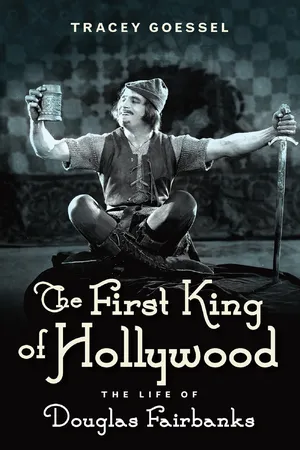
Silent film superstar Douglas Fairbanks was an absolute charmer. Irrepressibly vivacious, he spent his life leaping over and into things, from his early Broadway successes to his marriage to the great screen actress Mary Pickford to the way he made Hollywood his very own town. The inventor of the swashbuckler, he wasn't only an actor—he all but directed and produced his movies, and in founding United Artists with Pickford, Charlie Chaplin, and D. W. Griffith, he challenged the studio system.
But listing his accomplishments is one thing and telling his story another. Tracey Goessel has made the latter her life's work, and with exclusive access to Fairbanks's love letters to Pickford, she brilliantly illuminates how Fairbanks conquered not just the entertainment world but the heart of perhaps the most famous woman in the world at the time.
When Mary Pickford died, she was an alcoholic, self-imprisoned in her mansion, nearly alone, and largely forgotten. But she left behind a small box; in it, worn and refolded, were her letters from Douglas Fairbanks. Pickford and Fairbanks had ruled Hollywood as its first king and queen for a glorious decade. But the letters began long before, when they were both married to others, when revealing the affair would have caused a great scandal.
Now these letters form the centerpiece of the first truly definitive biography of Hollywood's first king, the man who did his own stunts and built his own studio and formed a company that allowed artists to distribute their own works outside the studio system. But Goessel's research uncovered more: that Fairbanks's first film appearance was two years earlier than had been assumed; that his stories of how he got into theater, and then into films, were fabricated; that the Pickford-Fairbanks Studios had a specially constructed underground trench so that Fairbanks could jog in the nude; that Fairbanks himself insisted racist references be removed from his films' intertitles; and the true cause of Fairbanks's death.
Fairbanks was the top male star of his generation, the maker of some of the greatest films of his era:
The Thief of Bagdad,
Robin Hood,
The Mark of Zorro. He was fun, witty, engaging, creative, athletic, and a force to be reckoned with. He shaped our idea of the Hollywood hero, and Hollywood has never been the same since. His story, like his movies, is full of passion, bravado, romance, and desire. Here at last is his definitive biography, based on extensive and brand-new research into every aspect of his career, and written with fine understanding, wit, and verve.
- 560 pages
- English
- ePUB (mobile friendly)
- Available on iOS & Android
eBook - ePub
About this book
Information
Print ISBN
9781613734049
Subtopic
Film History & Criticism1
The Father of the Man
IT IS A TALE TOLD in every history of Douglas Fairbanks, the all-purpose story to encapsulate the essence of the man in the activities of the child.
The setting was a middle-class section of Denver in the mid-1880s, the midst of the Gilded Age. A sturdy, nut-brown boy of three (some place the event on his birthday) had once again climbed onto the roof of an outbuilding on his parents’ property. Up until now, his cheerful, look-at-me flips and graceful leaps had always served to extricate him from great heights. But this time, something went wrong. He fell.
He cut a gash that extended full across the left side of his forehead—an imposing, semi-lunar flap that would be visible in close-ups for the rest of his days. The human scalp is well vascularized, and children’s heads are disproportionately large; the bleeding must have been impressive. The family version of the story included a brief loss of consciousness—with a twist. The boy, they claimed, had always been taciturn and unsmiling. But upon coming to, and being told what had happened (“You fell off the roof, darling!”), he did the unexpected. He laughed, joyously. He had fallen off the roof! How delightful!
It seemed to capture the nature of the man the world would come to know—or at least the construct he was to present: the dashing cavalier, enduring risks and injuries while performing his dazzling stunts, laughing at fate. “A smile at the right time has won many a battle in the prize ring and in the warfare of life,” he once said. The anecdote is irresistible.
The reality, as recalled by the leaper in question almost forty years later, was a little more realistic. “I was three years old,” he wrote:
In company with my brother Robert, I was climbing along the edge of a roof that projected from a dug-out which was used as a sort of barn at our home in Colorado. Disaster overtook me and I fell from the dizzy height of possibly seven feet.
I recall now the shrill cries of my nurse and the warm glow of satisfaction that mingled with my pain when I found myself the central figure of a thrilling drama. I think that occasion decided my future, for as soon as it became apparent that the eyes of the world, so to speak, were upon me for the moment, I began to act.
Although I had a considerable gash on my forehead, the injury was not nearly so serious as it looked. Realizing, however, that this was my great moment, I set up a howl that kept me the center of attraction for quite a while. . . . I managed to put on such a dramatic performance that I all but sent my mother into hysterics.
This rings truer to human behavior. Children hit their heads; they cry.
But we want to see Douglas Fairbanks as he presented himself, or packaged himself, really: the man who, whatever tempests life (and a host of pesky villains) would throw at him, would come up smiling.
But the reality rarely matches the myth. The awful truth remains: while he often would arise, teeth and eyes glittering, showing a defiant smile and laugh to the world and its villains, there were other times when he simply cried. But even then—and this is characteristic of the man—he found a certain satisfaction in being the center of a great drama.
This same mythmaking challenges the examination of his family story. So shaded and decked in self-imposed myth are his forebears that we cannot even unearth some of them. But his paternal grandfather’s story can be found. Lazarus Ulman was approximately twenty-five years old when he arrived through the port of Philadelphia in 1820 from Baden, Germany. Little is known of him except that he was registered as a servant and was Jewish. He must have been a man of extraordinary initiative, intelligence, and luck. A mere ten years later he was the owner of 560 acres of land north of Harrisburg, Pennsylvania, and the head of a household that included wife Lydia, children, and servants. His occupation was listed variably on the national census as “merchant” and “butcher.” The former seems more likely. Family history describes him as a major mill owner in the central part of Pennsylvania. The fourth of his nine children, Hezekiah Charles, was born in Berrysburg on September 15, 1833.
Williamsport, to the north, offered better schools, to Lazarus’s mind, so he moved the family there. His oldest child, Joseph, became a merchant like his father. Edwin, older than Hezekiah Charles by two years, became a dentist. H. Charles, as the younger brother preferred to be called, began at fifteen as a clerk in his father’s business, progressing at seventeen—at least according to his family—to a two-year stint founding and running a small publishing business in Philadelphia.*1 After this, he studied law in New York City under one James T.*2Brady.† Four years later, in 1856, he was admitted to the Pennsylvania bar. By 1860, H. Charles was approaching twenty-seven, living in Lycoming County, Pennsylvania, and married to twenty-one-year-old Lizzie. He was the father of two daughters, one-year-old Kate and newborn Alice. The household even had a servant. Lizzie was Christian, and H. Charles now was as well, having been baptized the same day he was married. But his five years of peaceful—and evidently lucrative—law practice were interrupted by the Civil War.
Demonstrating the sort of leadership that would later characterize his youngest son, H. Charles organized Company A of the Fifth Regiment of Pennsylvania Reserves and marched them 108 miles to Harrisburg, arriving in early May 1861. By the end of June he had been commissioned as a captain, and within a matter of weeks the company was involved in the occupation of Piedmont, Maryland. They were attached to the Army of the Potomac in March 1862 and saw action at Manassas, the Battle of Mechanicsville, and Bull Run. Had he not been mustered out in December 1862 for a service-related injury, Ulman would have been in the Battle of Gettysburg. This, of course, is presuming he would have survived to see it; before the unit was disbanded, it had lost 14 officers and 127 enlisted men to war wounds, and another 68 to disease. Disease killed more than soldiers; he and his wife buried their nine-month-old son, Jonathan, in March 1863.
But postwar H. Charles’s fortunes improved, and by 1870 he was living with his wife and two daughters in Middleton, an affluent community in the New York borough of Richmond, now known as Staten Island. His estate was valued at $20,000—a highly respectable sum at that time. The household was up to three servants now, and an 1873 passport application states that he was traveling to England for reasons of health “and to join my family there.” The document attests that he was five feet seven and a half inches tall, with black hair and dark eyes. Contemporary photographs suggest a figure of Byronic romanticism: long, flowing locks of hair; steely eyes with an intelligent gaze over a Roman nose; and—in later pictures—a hint of the double chin that his son would sport for all his days. His leadership abilities were still in play, and by 1876, he was the first president of the American Law Association, the precursor to the American Bar Association.
Ulman’s trajectory appeared to be headed in a comfortably upward direction. No one could have reasonably predicted that within four years he would have abandoned his family, his home, and his law firm and be bigamously married to a beautiful young widow fifteen years his junior. Her name was Ella Adelaide Marsh Fairbanks Wilcox (no small story there), and she was very, very unlucky in love.
Of all the figures in Douglas Fairbanks’s life, his mother is the hardest to pin down. She was probably born April 15, 1846, but she had a feminine tendency to move the year forward with each subsequent census—and each marriage. Information concerning her parentage is vague. She claimed to have been born and raised in the South, but Douglas Fairbanks Jr. declared that she was born outside of New York City. Neither her mother nor father can be tracked down with any certainty. Family histories are silent on the subject, although all agree that she had a younger sister, Belle. Ella’s story only comes into focus with her first marriage, to John Fairbanks III on May 6, 1867, in New York City. He reportedly was the holder of not-inconsiderable property in New Orleans, where they moved after their marriage and where their only child, John, was born in 1873. They lived at 494 Jackson Avenue, a block from the Mississippi River.
Their fortunes declined precipitously, however, when a partner cheated the elder John out of his portion of the business. Worse, he contracted tuberculosis. Appeals for help were made to Fairbanks’s New York attorney, who happened to be H. Charles Ulman. He was evidently unable to do much. John Fairbanks’s health declined along with his fortune.
Sister Belle, meanwhile, had married one Edward Rowe of the mercantile trade, and in 1871 the Rowes joined the wave of northern carpetbaggers and moved to Macon, Georgia. Thus, when in 1874 Ella decided she needed family support, she elected to take her ailing husband and their infant son to Macon, to join her sister. The locals, almost sixty years later, still remembered the pair as striking. “The most distinguished looking man I have ever seen,” recalled one. “And a woman, petite, dainty . . . exceedingly.” The kind attentions of the local church ladies were unable to save the day, however. Not only did Ella’s husband die within a few months, but also Edward Rowe would end up dead that same year.*3
The two widowed sisters were now alone with their children, John (“a beautiful blond boy”) and his cousin Adelaide. But Ella was not to be alone for long. Enter thirty-four-year-old Edward Wilcox.
Little is known of Edward A. Wilcox of Macon, Georgia, other than a local’s recollection that he was a “fascinating personality, a successful man, and rather a dandy in dress.” Some claim he was a judge, but evidence suggests he was a cotton broker with an estate valued in 1870 at $7,000. He was not a native Georgian, having been born in South Carolina. But one thing is certain: he was a fast mover. He and Ella exchanged vows in Bibb, Georgia, on January 4, 1875, less than eight months after John Fairbanks’s death. If she married in haste, she had evident cause to repent at leisure. Mr. Wilcox, according to family whispers, drank. And when he drank, he “was probably abusive.”
Ella gave birth to a son, Norris, on February 20, 1876. According to her family, it was shortly after the birth that she contacted the only attorney she knew: H. Charles Ulman. She was desperate to get a divorce—so desperate to get away that she willingly turned the newborn over to Wilcox’s sister, Lottie Barker, and took little John to New York City. Norrie, as the baby was called, was supposed to be fetched by his mother once her situation stabilized. That day never came. In 1879 she was living with six-year-old John at 203 West Fifty-Second Street in Manhattan. The following year’s census documents four-year-old Norrie still living with Lottie in the Georgia home of her cousin, Julia Jones. The intervening century (and the fire that destroyed most of the 1890 census) leaves the rest of Norris’s youth a mystery, but it is of note that he eventually made it to Denver and forged some relationship with his jigsaw puzzle of a family.*4
But before young Norris Wilcox could arrive in Denver to reunite with his mother, Ella herself had to get there, and her route was by way of her divorce attorney. Clearly, impulsiveness was one of her characteristics; having extricated herself from one bad marriage*5 she entered another. Most surviving photographs of Ella were taken later in her life, when she was as redoubtable a figure as Mary Pickford’s Mama Charlotte, her counterpart in the stage-mother universe: stout, heavy browed, formidable. But a picture taken in her youth reveals a woman who was quite lovely, by the standards of both her era and today’s. Her skin was flawless, her eyes wide spaced and clear, her mouth full, her nose classically perfect, her gaze direct. It is not hard to imagine that she would attract three spouses in her life and sire a matinee idol. Ulman, evidently, was besotted. In 1880 he abandoned his family and home and set up housekeeping with Ella and little John in Orangetown, New York. There was a slight hitch in the proceedings: there is no evidence Ulman obtained a divorce from his first wife.
After selling his interest in his Broadway-based law firm (Ulman & Remington), he decided to pull up stakes and move to Colorado. There was money to be made in the silver rush, certainly. But the fact that Ella was now pregnant, and that he was not in a position to divorce and remarry before this inconvenient fact would become evident to local society, might have contributed to the decision. It would be near impossible to take on a new wife in the state where he was already married. But the distant West? Anything was possible there. They would go to Denver.
They had no way of knowing, of course, but they could not have chosen a better town from which to launch Douglas Fairbanks. Denver in the 1880s possessed that mix of characteristics that its most famous citizen came to personify: a blend of the wild and the civilized. It was a town that still harbored old pioneers and wide-open spaces, a place where a boy could learn to rope and ride, to explore abandoned mines and to camp under the proverbial blanket of stars. But it was also a town of mansions, of Molly Brown (later the “Unsinkable” of Titanic fame) and Horace Tabor, who built the city’s opera house. It was a city with social pretensions. Their famous son was to carry with him these opposing characteristics, that of the city and that of the wilderness. This charming polarity was a significant contributor to his success in the following century.
Ella likely had no knowledge that her husband was still married when she exchanged her vows with him on September 7, 1881, in Boulder, Colorado. But then again, perhaps she suspected that something was wrong—they exchanged vows twice. Marriage records show that they were also married three weeks earlier, on August 14, 1881, in Nebraska. Robert was born in March 1882; Douglas Elton Thomas Ulman followed in 1883 on May 23.
The earliest claim about Douglas Fairbanks is that as an infant he was very dark skinned. The assertion came from one source: Fairbanks himself. “I was the blackest baby you ever saw,” he told family members. “I was so dark even my mother was ashamed of me. When all the neighbors came around to look at the new baby, mother would say ‘Oh, I don’t want to disturb him now—he’s asleep and I’d rather not.’ She just hated to show such a dark baby.”
This is, of course, stuff and nonsense. Not only did his mother and aunt vehemently deny this story (he delighted in teasing them with this tale), but also photographs reveal that there was no truth to the claim. Ella Ulman may have had to suffer straitened circumstances throughout her t...
Table of contents
- Cover Page
- Title Page
- Copyright Page
- Dedication Page
- Contents
- Introduction
- 1 - The Father of the Man
- 2 - The Heroine’s Likable Younger Brother
- 3 - Stage Stardom
- 4 - Triangle (as in Company)
- 5 - Mary and Charlie
- 6 - Triangle (as in Love)
- 7 - Citizen Doug
- 8 - United
- 9 - Love and Marriage
- 10 - “Having Made Sure I Was Wrong, I Went Ahead”
- 11 - Prince of Thieves
- 12 - The Fairy Tale
- 13 - Buckling Down
- 14 - Death . . .
- 15 - . . . and Taxes
- 16 - Mischief and Music
- 17 - Around the World in Eighty Minutes
- 18 - Castaway
- 19 - “Felt Terribly Blue . . . Although I Was Laughing”
- 20 - A Living Death
- Acknowledgments
- Filmography
- Notes
- Bibliography
- Index
Trusted by 375,005 students
Access to over 1.5 million titles for a fair monthly price.
Study more efficiently using our study tools.
Frequently asked questions
Yes, you can cancel anytime from the Subscription tab in your account settings on the Perlego website. Your subscription will stay active until the end of your current billing period. Learn how to cancel your subscription
No, books cannot be downloaded as external files, such as PDFs, for use outside of Perlego. However, you can download books within the Perlego app for offline reading on mobile or tablet. Learn how to download books offline
Perlego offers two plans: Essential and Complete
- Essential is ideal for learners and professionals who enjoy exploring a wide range of subjects. Access the Essential Library with 800,000+ trusted titles and best-sellers across business, personal growth, and the humanities. Includes unlimited reading time and Standard Read Aloud voice.
- Complete: Perfect for advanced learners and researchers needing full, unrestricted access. Unlock 1.5M+ books across hundreds of subjects, including academic and specialized titles. The Complete Plan also includes advanced features like Premium Read Aloud and Research Assistant.
We are an online textbook subscription service, where you can get access to an entire online library for less than the price of a single book per month. With over 1.5 million books across 990+ topics, we’ve got you covered! Learn about our mission
Look out for the read-aloud symbol on your next book to see if you can listen to it. The read-aloud tool reads text aloud for you, highlighting the text as it is being read. You can pause it, speed it up and slow it down. Learn more about Read Aloud
Yes! You can use the Perlego app on both iOS and Android devices to read anytime, anywhere — even offline. Perfect for commutes or when you’re on the go.
Please note we cannot support devices running on iOS 13 and Android 7 or earlier. Learn more about using the app
Please note we cannot support devices running on iOS 13 and Android 7 or earlier. Learn more about using the app
Yes, you can access The First King of Hollywood by Tracey Goessel,Tracey Goessel in PDF and/or ePUB format. We have over 1.5 million books available in our catalogue for you to explore.