- 216 pages
- English
- ePUB (mobile friendly)
- Available on iOS & Android
eBook - ePub
About this book
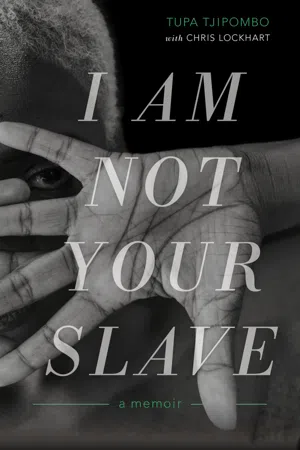
I am Not Your Slave is the shocking true story of a young African girl, Tupa, who was abducted from southwestern Africa and funneled through an extensive yet almost completely unknown human trafficking network spanning the entire African continent. As she is transported from the point of her abduction on a remote farm near the Namibian-Angolan border and channeled to her ultimate destination in Dubai in the United Arab Emirates, her three-year odyssey exposes the brutal horrors of a modern day middle passage. During her ordeal, Tupa encounters members of Africa's notorious gangs, terrifying witchdoctors, mysterious middlemen from China, corrupt police and border officials, Arab smugglers and high-ranking United Nations officials. And of course, Tupa meets her fellow trafficking victims, young women and girls from around the world. Tupa's harrowing experience, including her daring escape and eventual return home, sheds light on the most shocking aspects of modern day slavery, as well as the essential determination to be free.
Information
1
I WATCHED MY PURSUERS from my concealed position among the rocks. My stomach was so nervous that I was afraid it might somehow give me away. My grandfather once told me that he could always tell when people were nervous because it created visible ripples in the air around them. I swallowed hard and tried to remain calm. The two men I’d escaped from that morning leaned against their battered pickup truck, talking closely as they watched a third man. Though I had never seen him before, it was the third man who worried me the most. He was a slight, almost inconspicuous figure who moved in a soft, deliberate manner, his head bowed as he carefully scanned the ground before him. Occasionally, he squatted to get a closer look at the ocher-colored sand of the dry riverbed. He is reading the ground, I thought, and my heart dropped as I realized that the delicate frame and almost feline body language of this curious individual marked him as a Bushman. There was no point in trying to lose them now, I thought; it was just a matter of time. I remembered my father telling me stories of how the South African Defence Force had used Bushmen in this part of southeastern Angola during the war years to search for infiltration routes and water holes used by South West Africa People’s Organization rebels. He said they always feared the Bushmen trackers the most because they led the white soldiers straight to their camps. It was why they were known as flechas—arrows.
As I shifted my position, I winced from the pain in my hip. I had bruised it that morning when I dropped over the side of the truck and landed awkwardly on a rock. I guess my adrenaline had been pumping so hard that at the time I hardly noticed or cared. But now, as I lay still and watched my pursuers, I became conscious of a terrible throbbing in my right hip, as well as the razor-like torment from the many cuts and scratches on my legs and arms. This is what happens, I thought, when you run for your life across Angola’s unforgiving scrubland.
I had waited all night for the right moment to make my escape. After taking me the day before, the men had forced me to ride in the open bed of the pickup truck, exposing me to the full intensity of the African sun as I choked on stifling clouds of dust and exhaust and fought off swarms of nettling bush flies. I tried wrapping a torn piece of tarp around my head for protection, but it was too small to be of much use. As they snaked back and forth along dirt tracks that seemed barely passable, I was tossed about the truck bed with a collection of empty beer bottles, plastic soft drink containers, bits of cord, and an old, putrefied goat leg.
We had stopped once in the early evening. And though we were in the middle of nowhere, a ragged boy in a donkey cart sat waiting for us under the umbrellalike canopy of a large camel thorn tree. The cart held a drum of fuel, which the two men set upon with a rubber hose to siphon its contents into the truck. They barely acknowledged me as they spoke to each other in a language I could only assume was Portuguese. From his perch on top of the donkey cart, the boy feigned indifference, but his eyes betrayed him as they flicked with nervous curiosity to the somber, disheveled girl in the back of the truck. I remained completely still, partly out of fear but also because I did not want my abductors to suspect my intention to make a break for it the first chance I got.
I had been led to believe we were going to a farm located only a short two-hour drive away. I’d overheard Bernardo—a strange, intimidating man with a burn scar on his face—tell my father that the farm was located near a big town on a main road. But we drove all day on remote dirt tracks that skirted tiny villages and isolated homesteads—nothing that could be described as a town. I never once saw another car. As we drove into the night, I realized that something was terribly wrong. With each passing hour, my worst suspicions about Bernardo were confirmed. Nothing good was going to come from the arrangement he had made with my father.
An opportunity finally presented itself, but not until the horizon began to glow with the promise of another searing day. I repositioned myself to get a better view of the men in the cab as the truck, navigating a particularly dense patch of thorn bush, slowed to a crawl. I noticed the driver’s attention was fixed on the twisting path ahead. Meanwhile, the man in the passenger seat was clearly asleep—his head bobbed listlessly from side to side as we lurched forward. Then, when the driver jammed the truck into low gear as we slowed down a second time to make our way around a large termite mound, I quickly slid myself over the wheel well and dropped to the ground. I landed badly and had the wind knocked out of me for a brief moment, but I think my youthful energy kicked in as I dashed into the bush.
I ran as fast as I could, darting and weaving desperately to avoid the needlelike thorns of the acacia bushes, only dimly aware of the stabbing, ripping pain caused by the three-inch barbs. Finally, I stopped to catch my breath; I knew I had to be smarter while maneuvering through this environment—my limbs were already shredded. Standing on a rock, I made a half-hearted attempt to gauge my surroundings, but the bush was thick and the landscape toneless and flat. It was impossible to see or know with any certainty which way to go. I started in one direction before remembering something my father had told me: during the war they used to walk toward the sun whenever it was on the horizon because the light made it more difficult for the South African soldiers to spot them from behind. Walking directly into the sun was also said to be disheartening; people tended to veer away from it. So I decided to alter course and walk directly toward the glowing horizon.
For the next several hours, I jogged, walked, and stumbled across southern Angola’s harsh semiarid desert. I pinned my hopes on finding a walking path. During my short time in the country, I had seen few roads, and those that did exist were so broken down and pitted out that they seemed like mere suggestions of what may have once been a possible way forward. Even if I did find a road, I would probably have to avoid it; a road would attract the only moving vehicle in this part of the world—that of the men looking for me. No, no roads, I said to myself. A walking trail was the best option.
When I came across a dry riverbed, I decided to follow it, mostly because it offered some respite from the thorn bushes. But after an hour or so, I had a feeling it was leading me nowhere. I knew these dry riverbeds could be misleading; they often petered out in dusty plains of cracked, windswept earth with almost no vegetation. At least the bush offered some shade and, perhaps more importantly, camouflage. So I doubled back and climbed a rock outcropping. Back in my home country of Namibia, such rock formations were known as kopjes—one of those Afrikaans words that stuck with most Namibians no matter what language they spoke or which tribe they were from. I was glad to see that kopjes—though smaller and less numerous in this part of Angola—were still a distinctive part of the landscape. They were the only means of seeing above such a flatland of stunted bushes. This particular kopje happened to be one of those random piles of giant, oval-shaped granite rocks that tourists like to take photos of. My grandfather used to tell me that these were not rocks at all but petrified ostrich eggs from long ago when ostriches were as large as dinosaurs.
Now, squeezed in among the rocks and looking down upon my pursuers, I was glad I had had the forethought not to climb too high or too carelessly. I would have been spotted immediately if I had done so—the three men were only several hundred meters away. I kept my eyes on the Bushman tracker, knowing he was the only one I had to worry about. I clung to the hope that his skills would now work to my advantage and he would lead the men along the dry riverbed for the next hour or so before realizing that I had doubled back. After a few more minutes of observation, I looked over my shoulder in the opposite direction, and there, in the distance, I thought I spotted the slightest wisp of smoke rising above the bush. Were my eyes playing tricks on me? It was difficult to say, but it appeared to be a cooking fire. It was my only hope—in a few short hours, it would be too hot to walk around for long periods of time. And I did not have any water. They would easily catch up with me.
Hope was quickly replaced with horror when I turned back toward my pursuers. The Bushman had both hands raised above his eyes and was looking straight at me. Instinctively, I held my breath and pressed myself against the rocks, counting on the angle of the rising sun to work in my favor. But Bushmen are clever and are said to have magical powers that allow them to see and even sense things others cannot. That is what makes them such excellent trackers. I waited for him to turn away, but it took an agonizingly long time. Finally, I scrambled down from the kopje and set out toward the smoke, where I now spotted several vultures arcing slow circles against the bleached Angolan sky. I could only pray I had not been spotted.
Almost immediately, I came across a walking trail that led straight where I wanted to go. Alternately jogging and walking, I burst into a clearing containing a small mud-and-wattle hut. An old man with one leg sat by a firepit cooking meat in a kettle. I suspected he was one of the mutilado—mutiltated ones—individuals who’d lost a limb to one of the many unexploded land mines scattered across the country. There was said to be a whole generation of mutilados in this part of Angola. He will help me, I thought, though I could not explain exactly why I thought so. Instincts, I thought. Rely on your instincts.
The old man looked up with mild surprise as I approached. I spoke to him in Otjiherero, but he shook his head, so I tried English and then Afrikaans but received similar responses. He eyed me curiously now and, maybe seeing from my appearance that I was lost or in some kind of trouble, motioned for me to sit by the fire. He offered me some meat and goat’s milk, which I consumed so quickly that he laughed and gave me some more. As I finished that, the old man drew a map in the dirt and conveyed to me that I should continue down the path until I came to another household, which he represented with a stone. He tapped it with his stick and repeated “Inglês” several times. I hoped it meant they spoke English there. I thanked the old man profusely and, reinvigorated by the meat and goat’s milk, set out once again.
I must have gone another thirty minutes before hearing the sounds of an approaching vehicle. As far as I could tell, there were no roads in the area, so it must have been picking its way through the bush along the same footpath I was on. It sounded like it was coming directly from the old man’s place. My stomach dropped as I heard the distinctive clattering noises of my pursuers’ truck. But it seemed to be having a hard time at a point where the path intersected a deep gully; it might take them some time to find a suitable crossing. As I turned and began running again, I almost stepped on a pale black snake with faded white stripes. I recognized it immediately as a relatively harmless garter snake, but it was a snake nonetheless, and snakes are bad omens. For me, it had all started—everything I was experiencing now—when the zebra snake had bitten my brother Timo. That was the moment when everything seemed to change, when the safety and security of my life in the village gave way to the dangers of the wider world. It was when vulnerability and uncertainty came into my life.
“Tupa!” Timo yelled across the compound to me. “Come! We have work to do before the sun comes!” I knew my older brother would want me to help him graze the cows in the dry riverbed that lay to the west of the village. I was good at fetching calves that wandered into the middle of a thick bramble patch, a task that often demanded a young, nimble person who could crawl through the thorn bushes to retrieve them. It had been an especially bad season, and my family could not afford to lose any more livestock to jackals or other predators whose numbers seemed to grow with each passing year. And small calves that got separated from the herd were always easy prey.
I was not quite sure how many livestock my family had lost over the past several years. In fact, I really did not know how big the herd was. Among the people of my tribe—the Himba—it was bad luck to count cows or even family members, and few people ever came up with an exact number for anything. I always remembered the time when the government men came to our village and asked my grandfather how many cows we had. The Old One just shook his head—either because he did not know the answer or in disbelief that they would ask such a foolish question. “Ha, ta, ta, ta . . . ,” he exclaimed, a common refrain in my home area—the Kunene of northwestern Namibia—to let someone know that they just asked an impossible question. Yet if the men had asked my grandfather about an individual cow or goat, he would have told them every little detail about that animal, including where it was at that exact moment. Everything revolved around the movement of cattle, and my family—like every family in the area—grazed our animals and planted our maize gardens in accordance with a seasonal round that stretched back generations. Each morning, we milked and turned out our cows to graze. As okuni—the time of dryness—came on, the best pastures gradually got farther and farther out until it was time to pack up and move to the mountains. When the rains came again and the grasses returned to the low country, we came down from our dry season camps, planted our gardens, repaired our huts and kraals, and began another year. To each and every Himba, the herd represented everything: movement, wealth, social status, relationships, kinship obligations, blessings from the ancestors—life itself. It was wrong to put a number on such things.
After we had led the cows to the grazing area, I sat beside Timo in the shade of a large overhanging boulder. It was the hottest part of the afternoon, and the Namibian sun was at its apex, once again beating the land around us into a single rippling scar of pulverized red rock. To me, there was always an air of invulnerability to the Kunene, as if the only forces that could possibly work upon it were the slow, epochal pressures of geologic time. I always thought of it as a land of horizontals; even the mountains were flattened out into mesa-like ridges called etendekas. Dry riverbeds snaked their way in between the mountains and dispersed onto broad, windswept plains that, to most outsiders, must have looked exactly like the surface of Mars. The vegetation was sparse but tough, having adapted to its arid ecology in striking ways. While the various grasses lay dormant and unseen for years at a time, we all knew how they erupted into lush fields of green at the slightest hint of rainfall.
And that was why we had brought the herd to this particular valley—it had rained here the night before. To be more precise, a passing cloud had sprinkled a smattering of lonely drops for maybe ten or fifteen minutes. But in the Kunene, that was enough to encourage new shoots of grass to push through the parched veins of hardened earth.
After the herd feasted earlier in the morning, I could see that the animals were now sluggish; most squeezed themselves into what little shade was offered by the stunted mopani trees and scattered thorn bushes that competed for a foothold in the sandy riverbed. I enjoyed tending livestock with my eldest brother—he was always telling interesting stories or jokes that made me laugh. On that particular day, he was recounting the time he had spent in Swakopmund, the big town on the Atlantic Ocean just south of the Skeleton Coast. Trying in vain to describe the ocean, which I had never seen, he finally told me to imagine a second sky between the first sky and the land. When I asked him if it had clouds too, he laughed and said no but that it had rolling hills that came toward you from somewhere far away, maybe even as far away as America. Baffled, I asked my brother why the Americans were sending waves in our direction. But this just made Timo shake his head. He reminded me that I was still a girl of thirteen years, and such things were too big for me to understand. He yawned and said I would simply have to go see it for myself someday. Eventually, our conversation melted away and we both fell fast asleep.
The next thing I remember is being jolted awake by my brother’s cries. I sat up to find him rubbing his foot and cursing. From the corner of my eye, I caught the brisk, glissading retreat of a large zebra snake, its distinctive bands flashing in the sun as it skimmed across the sand. Zebra snakes are common throughout the Kunene and have a reputation for being both aggressive and quick to agitate. Scrambling to my feet, I flung several rocks at the snake to chase it away from the immediate vicinity. I knew that among the many poisonous snakes in our area, zebra snakes were especially dangerous because they could spit their venom at you from several meters away. They always aimed for a person’s eyes, and if they hit their target, the venom was potent enough to cause permanent blindness. They often went out of their way to sink their fangs into someone as the person slept—and they were known to return for a second attack.
I knew I had to get my brother back to the village as quickly as possible. But it was not going to be easy; his foot was already beginning to swell, and we would have to walk five or six kilometers through the middle of the desert during the hottest part of the day.
We inched our way along the dry riverbed that wound its way between the mountains north of us and the scorched, windswept plains to the south. Like every Himba, I understood at a very early age that even though this land was my home, it could be unforgiving and demanded care and respect, especially during emergencies like this.
We managed to get within a half mile or so of the village before Timo collapsed to the ground in agony. Terrified, I left him in the shade of a tree and ran as fast as I could the rest of the way home. Within minutes, I burst into our family compound, trying to catch my breath as I dashed from one hut to another looking for help.
Finally, I came upon my grandfather sitting by the Holy Fire. I should have known he would be there. As the oldest member of the patriclan, he was the keeper of the Holy Fire—or Okuruwo—a responsibility he took very seriously. He tended to the glowing embers every morning and evening, ensuring that they were always smoldering and at the ready. The Holy Fire was where he spoke with the ancestors and asked them to watch over our household. But today, I thought they seemed to be sleeping.
“What is it, girl?” the Old One snapped. Despite being blind, he always knew who was nearby from the distinctive sounds of their footsteps. He once told me that it was a special kind of wisdom he had learned from the desert elephants, claiming that they spoke to one another through the unique vibrations they made as they walked across the land.
For once, ...
Table of contents
- Cover Page
- Title Page
- Copyright Page
- Contents
- Preface
- Chapter 1
- Chapter 2
- Chapter 3
- Chapter 4
- Chapter 5
- Chapter 6
- Chapter 7
- Chapter 8
- Chapter 9
- Chapter 10
- Chapter 11
- Chapter 12
- Chapter 13
- Epilogue
Trusted by 375,005 students
Access to over 1.5 million titles for a fair monthly price.
Study more efficiently using our study tools.
Frequently asked questions
Yes, you can cancel anytime from the Subscription tab in your account settings on the Perlego website. Your subscription will stay active until the end of your current billing period. Learn how to cancel your subscription
No, books cannot be downloaded as external files, such as PDFs, for use outside of Perlego. However, you can download books within the Perlego app for offline reading on mobile or tablet. Learn how to download books offline
Perlego offers two plans: Essential and Complete
- Essential is ideal for learners and professionals who enjoy exploring a wide range of subjects. Access the Essential Library with 800,000+ trusted titles and best-sellers across business, personal growth, and the humanities. Includes unlimited reading time and Standard Read Aloud voice.
- Complete: Perfect for advanced learners and researchers needing full, unrestricted access. Unlock 1.5M+ books across hundreds of subjects, including academic and specialized titles. The Complete Plan also includes advanced features like Premium Read Aloud and Research Assistant.
We are an online textbook subscription service, where you can get access to an entire online library for less than the price of a single book per month. With over 1.5 million books across 990+ topics, we’ve got you covered! Learn about our mission
Look out for the read-aloud symbol on your next book to see if you can listen to it. The read-aloud tool reads text aloud for you, highlighting the text as it is being read. You can pause it, speed it up and slow it down. Learn more about Read Aloud
Yes! You can use the Perlego app on both iOS and Android devices to read anytime, anywhere — even offline. Perfect for commutes or when you’re on the go.
Please note we cannot support devices running on iOS 13 and Android 7 or earlier. Learn more about using the app
Please note we cannot support devices running on iOS 13 and Android 7 or earlier. Learn more about using the app
Yes, you can access I Am Not Your Slave by Tupa Tjipombo,Chris Lockhart in PDF and/or ePUB format, as well as other popular books in Social Sciences & Social Science Biographies. We have over 1.5 million books available in our catalogue for you to explore.