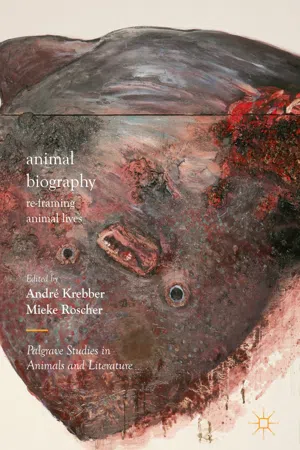
While historiography is dominated by attempts that try to standardize and de-individualize the behavior of animals, history proves to be littered with records of the exceptional lives of unusual animals. This book introduces animal biography as an approach to the re-framing of animals as both objects of knowledge as well as subjects of individual lives. Taking an interdisciplinary perspective and bringing together scholars from, among others, literary, historical and cultural studies, the texts collected in this volume seek to refine animal biography as a research method and framework to studying, capturing, representing and acknowledging animal others as individuals. From Heini Hediger's biting monitor, Hachik? and Murr to celluloid ape Caesar and the mourning of Topsy's gruesome death, the authors discuss how animal biographies are discovered and explored through connections with humans that can be traced in archives, ethological fieldwork and novels, and probe the means ofconstructing animal biographies from taxidermy to film, literature and social media. Thus, they invite deeper conversations with socio-political and cultural contexts that allow animal biographies to provide narratives that reach beyond individual life stories, while experimenting with particular forms of animal biographies that might trigger animal activism and concerns for animal well-being, spur historical interest and enrich the literary imagination.
eBook - ePub
Animal Biography
Re-framing Animal Lives
- English
- ePUB (mobile friendly)
- Available on iOS & Android
eBook - ePub
About this book
Information
© The Author(s) 2018
André Krebber and Mieke Roscher (eds.)Animal BiographyPalgrave Studies in Animals and Literaturehttps://doi.org/10.1007/978-3-319-98288-5_11. Introduction: Biographies, Animals and Individuality
André Krebber1 and Mieke Roscher1
(1)
University of Kassel, Kassel, Germany
André Krebber (Corresponding author)
Mieke Roscher
Keywords
BiographyProsographyNarrationSubjectivityIndividualityAnimal selfAnimal agencyPierre BourdieuTo observe dogs, say, in a park , interact with their kin, including their human kin, is a curious thing. We are not talking about the distant, dissecting, deterministic kind of observation here, but the kind that suspends rational correction and attempts to lose itself in its object. In these moments, it seems almost inescapable to recognize within their play individual personalities, tastes, characters and forms of waywardness. Yet, taking animals seriously as individuals, and even more, attempting to substantiate and portray such individuality in scholarly terms, proves a daunting exercise. As one approach, scholars have turned to reconstructing and shining light on animal biographies.1 The biography seems an obvious choice for the challenge. While history is dominated by attempts that try to standardize, de-individualize and automatize the behavior of animals, it also proves to be littered with records of the exceptional lives of unusual animals. Far from being just a (post)modern sentimental interest, individual animal lives, both real and fantastic, seem to have captivated the human imagination for a long time. Examples reach from Bucephalus, antiquity’s enduringly famous horse of Alexander the Great,2 to Greyfriars Bobby 3 and William Bingley’s four-volume Animal Biography, or, Popular Zoology; Illustrated by Authentic Anecdotes of the Economy, Habits of Life, Instincts, and Sagacity of the Animal Creation4 in more recent times. A biography, it is hoped, projects, almost by definition, the possession of emotions, personhood—a self. Moreover, the personal element of the biography proves popular and promises to tie a knot between the biography’s subject and its reader.
Hence, biographical writing surfaces both as an approach to capture the individuality of animals as well as make animals visible as individuals. Animal biographies are not meant to say—as one can hear the critics of such scholarship chuckle—that animals themselves would experience or even construct their lives in (auto)biographical terms. On the contrary, animal biography entails exactly the attempt to account for their individuality without having to read their minds, reconstruct their feelings or infer their intentions. As such, animal biographies remain external to the cognitive experience of the animals’ worlds and their relations to it. Rather, the animal biography responds to and tries to capture our experience of other animals as individuals, with their own personalities, idiosyncrasies and each and every one with a self of its own, as well as our desire to lend voice and recognition to these individual creatures. We understand this enterprise as an attempt to make animal subjects visible as each possessing individual traits of their own. It is an attempt to study and show cultural and local characteristics of both groups of animals and certain individuals within those groups, with the hope of breaking the mold of identity that lumps together all animals as principally the same. Finally, the writing of animal biography also points to the intimate interlacing of the lives of animals and humans. With this volume, we want to explore the practicalities of reframing animal lives through the biography, but also to evaluate the biography as theoretical frame for animal lives.
(Animal) Biography: A Historical Synopsis
Coming from the Greek words of bios for life and graphein for writing, biography has a long tradition. For historians, the method of biography has been a longstanding tool in recounting the past. By way of exemplifying a life history, one hoped also to reconstruct the historical possibilities of one person’s life in the past. Studying a human life in its entirety by considering the historical context and the interdependencies between the individual and society can therefore rightly be termed one of the master narratives in historiography. Looking as far back as antiquity, one cannot fail to notice that recounting the life of so-called great men is the most dominant and maybe one of the oldest forms of literary as well as historical narration. Over the centuries it has remained a widely used practice for recounting and interpreting historical processes. As such, it was not always clear what the genre of biography entails , as it was flexible enough to contain encyclopedic accounts, lyrical verses and memoirs. It was usually defined by its chronological narration , its sequencing and the presentation of important occurrences in the life presented. However, the literary tradition of biography from its beginning strayed from these rather rigid specifications, which led to a distinction between an esthetic and a scholarly biographical genre.5 That these differences have become significantly blurred following Hayden White’s critique of the distinction between facts and fiction has also impacted on the genre of biography.6
Biographical research may be much younger than biography itself, but here also there has been a considerable amount of disagreement on what the term implies. The research, depending on which discipline is consulted, was challenged and rejuvenated especially by advances in oral history and narration , as well as in women’s and gender studies.7 The sole focus on the so-called great man as the presumed only agent influencing the course of history has been called into question by these new perspectives. The “noteworthiness” of the biographical subject has been significantly altered, if not abolished, especially with the advent of the biographical method in sociology. Even if not explicitly addressed however , this “noteworthiness” is the central factor for why early attempts at animal biographies have been dismissed as banal or profane. Some say that the general denunciation of biography as a suitable tool was based on the assumption that all lives are inherently constructed. Likewise, the construction of certain lives as privileged over others has led to some historians questioning the suitability of biography as a tool for recreating the past in general.8 More to the point, however, is the fact that the influence of the social sciences, especially in the 1970s, and the linguistic turn have together had an immense effect on biographical research, also with regard to the innate interdisciplinary character of the biographical genre.9 Thus, what formerly had been characterized and described as a constant shift between the focus on the individual or on society was now being reread as a way of drawing attention to the abilities of the individual and the individual’s agency.10 The acting subject, his or her practices and dynamic interaction with the surroundings were to become central for the idea of the individual’s “making” of his or her biography. The question of animal agency can therefore be regarded as being closely linked to the question of animal biography without however being identical. In addition, biographical research has reacted to transformations in society. Historians have therefore taken to micro-historical approaches and the history of everyday life in their attempts to retell individual biographies, whereas the method of collective biography has been applied in ways that include social, political and structural historical dimensions. Additionally, and in the wake of new historicism and new criticism , the narrative structures of the biography as, for example, marked by its chronological sequencing have been questioned . Special emphasis is increasingly being placed on the narrative construction of both text and identities, but also the tension, interrelation and incongruence between individual and socio-historical context. Chronological approaches are giving way to thematic structures, closed unified images are surrendered for fragmentary sketches, and the interference of the representational means and forms of scholarly biographical accounts with the apprehension of the biographical subjects are taken into consideration.11 Pierre Bourdieu’s remarks on the “illusion of biography,” which famously questioned the sense of trying to recreate a life without taking recourse to its many defining relations and structures by comparing it to a subway map,12 serves here as a reminder, that the nature of biography is still to be regarded as undetermined. The question is whether this serves as an invitation to or a warning against trying to incorporate animals into these biographical frameworks.
Methodological Layouts
As such, animal biographies, like biographies in general, ultimately remain constructions that attempt to trace a more or less coherent image of the life of an individual, as Bourdieu pointed out. Within this framework, biographies come in a variety of shapes and forms. This might be truer for nonhuman animals still, who themselves most likely do not care much for casting their lives in terms of biographies. Biographies can be smooth and uneventful, but they can also be broken, fractured, fragmented and fragile. They can be collective and shared, yet they can also be deeply individual and isolated, distinct from any other biography. For some individuals or even groups of individuals, biographies can be comprehensively recoverable, but they can also be partial, interrupted and sketchy. As a consequence, within biographical writing, the real and the fictional always and necessarily pervade each other.13 It is the task of the biographer to organize the remnants into a coherent story; it is he or she who creates meaning through the organization of fragments and sources. This, of course, is not peculiar to animal biographies, but rather the standard mode of operation for historians and literary scholars alike.
Following from these thoughts, one of the most challenging methodological problems of biographies, regardless of whether their subjects are animals or humans, remains the question of what constitutes an individual life and whether it is the individual life at all that is to be the focus of a biography, as some definitions still hold.14 This stands in contrast to the many attempts at biographies that use the individual’s life to offer a narrative background for illustrating specific socio-spatial contexts, or that are interested in a whole social group, which they try to capture by using the sum of the fragments provided by individual biographies.15 The...
Table of contents
- Cover
- Front Matter
- 1. Introduction: Biographies, Animals and Individuality
- Part I. Explorations
- Part II. Reflections
- Part III. Constructions
- Part IV. Experiments
- Back Matter
Trusted by 375,005 students
Access to over 1.5 million titles for a fair monthly price.
Study more efficiently using our study tools.
Frequently asked questions
Yes, you can cancel anytime from the Subscription tab in your account settings on the Perlego website. Your subscription will stay active until the end of your current billing period. Learn how to cancel your subscription
No, books cannot be downloaded as external files, such as PDFs, for use outside of Perlego. However, you can download books within the Perlego app for offline reading on mobile or tablet. Learn how to download books offline
Perlego offers two plans: Essential and Complete
- Essential is ideal for learners and professionals who enjoy exploring a wide range of subjects. Access the Essential Library with 800,000+ trusted titles and best-sellers across business, personal growth, and the humanities. Includes unlimited reading time and Standard Read Aloud voice.
- Complete: Perfect for advanced learners and researchers needing full, unrestricted access. Unlock 1.5M+ books across hundreds of subjects, including academic and specialized titles. The Complete Plan also includes advanced features like Premium Read Aloud and Research Assistant.
We are an online textbook subscription service, where you can get access to an entire online library for less than the price of a single book per month. With over 1.5 million books across 990+ topics, we’ve got you covered! Learn about our mission
Look out for the read-aloud symbol on your next book to see if you can listen to it. The read-aloud tool reads text aloud for you, highlighting the text as it is being read. You can pause it, speed it up and slow it down. Learn more about Read Aloud
Yes! You can use the Perlego app on both iOS and Android devices to read anytime, anywhere — even offline. Perfect for commutes or when you’re on the go.
Please note we cannot support devices running on iOS 13 and Android 7 or earlier. Learn more about using the app
Please note we cannot support devices running on iOS 13 and Android 7 or earlier. Learn more about using the app
Yes, you can access Animal Biography by André Krebber, Mieke Roscher, André Krebber,Mieke Roscher in PDF and/or ePUB format, as well as other popular books in Literature & Literary Criticism Theory. We have over 1.5 million books available in our catalogue for you to explore.