- English
- ePUB (mobile friendly)
- Available on iOS & Android
eBook - ePub
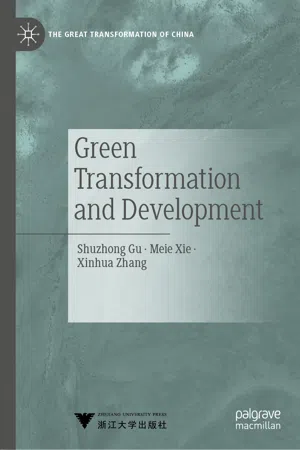
Green Transformation and Development
About this book
This book offers an insiders' view into Chinese plans for a green transformation of the economy of China. Analyzing the pressures, drive, and resistance to this green transformation in China, the book explores the key fields, from green finance and green banking to green consumption and green urbanization. Furthermore, it offers a guide on how government officials will be penalized or rewarded for their successful furtherance of green objectives. This book will be of interest to climate activists, China watchers, architects, and all those invested in a sustainable future.?
Information
© The Author(s) 2019
S. Gu et al.Green Transformation and DevelopmentThe Great Transformation of ChinaChina's Economic Transformation, Innovation and Development https://doi.org/10.1007/978-981-32-9495-0_11. The Origin and Connotation of Green Development
Shuzhong Gu1 , Meie Xie2 and Xinhua Zhang3
(1)
Development Research Center of the State Council (DRC), Beijing, China
(2)
Yunnan University of Finance and Economics, Kunming, China
(3)
Party School of Xinjiang Uygur Autonomous Region Committee of C.P.C, Urumqi, China
1 Start with Green
2 The Origin of Green Development
3 What Is Green Development
4 Ten Features of Green Development
5 The Relationship Between Green Development, Circular Development and Low-Carbon Development
6 Why Does China Need Green Development
7 Strategic Concept of Promoting Green Transformation and Development
1 Start with Green
1.1 The Broad Implication of Green
Between yellow and blue, and in the middle of the spectrum, green is a kind of balanced color. Today’s mainstream society gives a very broad meaning of green.
First, green symbolizes life. Green is the main hue of plants; plants cannot be separated from the photosynthesis of green. Without green, there can be no plants, there can be no animals and there can be no human beings. In this sense, green is the origin of all life and is the symbol of vitality.
Second, green symbolizes health. Associated with the previous moral, green is a symbol of both life (vitality) and health.
From a medical point of view, green does contribute to health, especially to the recovery of patients. People often use green to describe healthy and safe food, which is called green food.
Third, green symbolizes hope. The tender green of plants breaking through the soil is the hope of plants to grow, bloom and bear fruit, and is the hope of the value of life. Green symbolizes hope.
Fourth, green symbolizes peace. From the perspective of psychology, green can make people calm, quiet and peaceful, so that people can get along with each other better.
Fifth, green symbolizes peace. Based on the meaning and role of peace, as well as the meaning that the international mainstream society gives the meaning of peace to green, green is often used to represent peace, such as Greenpeace.
Sixth, green symbolizes balance. Green itself is the transition color, harmonic color or balance color between blue and yellow. At the same time, green is also a symbol of the earth’s vitality and the balanced development of man and nature.
Seventh, green symbolizes friendliness. Green is the good deeds of human beings to treat nature well, and the kindness to nature, which is the embodiment of kindness to nature; at the same time, green is often the embodiment of friendship between people.
Eighth, green is a symbol of tolerance. The green is full of vitality, and it is also an expression of all kinds of biological species. The green development, from the essence, is dynamic development, is respect for nature and the development of human tolerance.
Ninth, green symbolizes wealth. This is particularly true in Western countries such as the United States, which see green as wealth and tend to use green as the dominant color of money.
Finally, green symbolizes permission. When traffic lights are set, all countries set green to allow access, red lights to ban traffic, yellow lights as waiting lights to transition between red and green lights, so-called Stop at the red light and walk when it turns green. What’s more, many countries tend to call the unimpeded passage the green passage. In early warning systems, the risk-free zone is often set to green, the danger zone to red, and the zone or interval between safety and danger to yellow.
1.2 Wide Application of Green
As green has many positive connotations mentioned above, modern society is often keen on using green as a prefix and modifier, so more and more modern popular words have emerged, such as the green revolution, green plan, green design, green investment, green technology, green industry, green trade, green enterprises, green consumption and green logo, green culture, green sculpture, green literature, green software, green activity, green food, green architecture, green authentication, green finance, green finance, green investment, green production, green communities, green organization, green products, green transportation, green travel, green energy, green home, green economy, green politics and green culture.
All of the above “green” terms, in essence, can be summed up as green development.
2 The Origin of Green Development
2.1 Green Development Mainly Stems from the Unsustainability of Traditional Development
Green development is mainly caused by problems in traditional development concepts, paths and models, which are mainly manifested in resource waste and exhaustion, environmental pollution and damage, ecological deterioration and deficit, and social (distribution) injustice. In short, green development mainly stems from the unsustainability of traditional development, from the reflection on traditional development concepts, traditional development paths and traditional development models, and from the search for alternative development concepts, development paths and development models.
2.2 Green Development Mainly Stems from the Idea of Sustainable Development
Going back to the source, green development first originates from the concept and thought of sustainable development. In 1987, the report Our Common Future defined the connotation of sustainable development and elaborated the theory that sustainable development is the development to meet the needs of Future generations without compromising their ability to meet their own needs. Our Common Future was officially released in April 1987 by the World Commission on Environment and Development under the leadership of the then Prime Minister of Norway, Mrs. Brundtland. The report is divided into three parts, namely “common problem”, “common challenges” and “joint efforts”, focused on the world’s population, grain, species, energy, industrial and residential issues, clearly put forward that the development crisis, energy crisis and environmental crisis can’t be separated up, the earth’s resources and energy far cannot satisfy the needs of the development of human beings, and clearly put forward the concept of “sustainable development” through a series of distinctive judgments and viewpoints, such as the need to change the development model for the benefit of current and future generations.
2.3 Green Development Began with the Introduction of the Green Economy
Green development begins with the concept of green economy. The purpose of green economy is to promote the integration of economic development, social development and environmental protection. It is a new economic concept emerging under the influence of sustainable development theory. It was first proposed by the British economist Pierce (Pierce’s Blueprint for a Green Economy) in 1989. Also in 1989, the United Nations Environment Programme put forward the concept of “clean production”, and China introduced the idea of circular economy in the 1990s. At that time, the concept of green economy was only mentioned, but there was no in-depth study and no systematic theory. However, a series of viewpoints such as sustainable development, clean production and circular economy are intrinsically consistent with the green economy. The academic circles, countries and society of all countries have responded to the problems existing in human development.
Since the beginning of the twenty-first century, especially in recent years, a series of concepts such as circular economy, low-carbon economy, ecological economy and clean production have become increasingly difficult to cope with complex global economic, resource, energy and environmental problems. The development in the new era calls for the application of new economic theories. It was Ban Ki-Moon, the UN Secretary-General, who led the world’s economic activity. At the UN climate conference in Bali at the end of 2007, Ban Ki-Moon pointed out that “mankind is facing a great change in the era of green economy”. The green economy is providing a positive boost to development and innovation on a scale perhaps not seen since the “industrial revolution”. In September 2008, a new international financial crisis broke out. Under the circumstances of multiple crises, such as energy, food, climate change and the financial crisis, we should vigorously develop the green economy, create a new era of green economy and achieve sustainable development of human society in order to save costs and protect the environment. Responding to the global economic recovery has become a major issue to be solved in front of the world. In October 2008, the United Nations Environment Programme (UNEP) launched the global green New Deal and green economy plan, which calls on governments to establish a “green economy” growth model featuring low energy consumption, environmental friendliness and sustainability in order to revive and upgrade the world economy. The United Nations environment program’s initiative to develop a green economy and a new green deal has been well received by the international community. The United States, Japan, the European Union and other countries have put forward green economic development plans, implemented green new policies and taken the development of green industry as an important measure to promote economic restructuring, which has made green economy become a trend and trend in the field of global environment and development, so as to plan the development in the post-crisis era. In 2009, the United Nations held a special council to advocate the development of green economy: The theme is to make the world toward green economy, advocate green New Deal. The Rio +20 conference in 2012 focused on how to develop a green economy.
The new historical background and development stage endow green economy with new connotation and mission, making green economy a new economic concept emerging in the process of development mode innovation. The use of green economy as an important response to multiple crises, such as the financial crisis, energy crisis, environmental and resource crisis and climate change risk, has been recognized by all countries in the world.
2.4 Green Development Is the Sublation of China’s Traditional Concept of “Unity of Man and Nature”
China’s traditional culture of “the unity of man and nature”, which respects, complies with and protects nature, is the natural soil for the formation and dissemination of the concept of green development in China. The Taoist culture of “Human follows land, land follows sky, sky follows Taoism, Taoism follows nature” systematically explains the relationship between man and nature, and its core idea is to respect the laws of nature. Although the concepts of resources, environment, ecology and space are not clearly put forward, they focus on the fact that we cannot sacrifice nature to satisfy the endless desires and demands of human beings.
Of course, “the unity of man and nature” is not to blindly emphasize that human beings do nothing and do not know what to do in front of nature. Human beings should not be mere conservationists, but natural knower, protectors, improvers and adaptors aiming at the unity of man and nature. To this end, we need to study and respect the laws of nature, promote scientific and technological progress and institutional innovation, and achieve sustainable development with resource conservation, environmental friendliness, ecological conservation, social harmony and political inclusiveness at its core.
3 What Is Green Development
3.1 The Basic Connotation of Green Development
Green development is an all-embracing, dynamic, evolving and complex concept. At the same time, green development is a concept with clear connotation, clear hierarchy, clear objectives and specific requirements. The core idea of green development is to protect the natural resource base on which human beings live and develop, and to realize the sustainable use of natural resources. We should protect the natural environment that is closely related to us, including the atmospheric environment, the water environment and the soil environment, and strive to achieve the beauty of the natural environment. We must protect the ecosystem that has evolved with us and strive to ensure its continued stability and enhanced service functions. In short, green development is a development (concept, path and mode) characterized by resource conservation, environmental friendliness and ecological conservation. Green development consists of green economy, green society (green communities, green institutions, green schools, etc.), green politics (green assessment, nature protection, etc.), and green culture (culture that respects, complies with and protects nature).
3.2 The Core of Green Development Is the Green Economy
Green economy is an economic pattern characterized by resource conservation, environmental friendliness and ecological conservation. Green economy, composed of green industry, green finance, green fiscal, green investment, green consumption and green trade, is a complex giant system.
The first is green industry or green production system. Emphasis is placed on greening traditional industries, vigorously developing circular economy, promoting clean production and developing green enterprises. We will focus on developing industries related to energy conservation and environmental protection, new generation information technology, biotechnology, high-end equipment manufacturing, new energy, new materials and new energy vehicles. We will energetically develop ecological agriculture, ecological tourism, green producer services and living services. We will effectively raise the efficiency of resource utilization and ensure that resources are used economically. Green label, green product (green food, green building, etc.) and green service are the important connotation of green industry system.
The second is the green circulation or green logistics system. Emphasis should be laid on improving the level of transport services, minimizing the impact of volatilization, leakage, deterioration and loss of products and raw materials on the environment and human health in the process of storage and transportation, improving the mileage utilization rate and tonnage utilization rate of freight vehicles, as well as the actual load rate and transport efficiency of passenger vehicles.
The third is the green distribution system. It emphasizes that the government and society should shoulder the responsibility of environmental renovation, protection and restoration, and the construction of new ecological environment projects through redistribution. Through the form of redistribution, the income of all social strata is balanced to ensure the consumption of green products by low-income people.
Fourth is the green consumption system. We should stress the importance of building a sound ecological civilization, advocate the concept of civilized, economical, green and low-carbon consumption, and promote the formation of a green lifestyle and consumption pattern suited to China’s national conditions.
The fifth is the green market system. We will stress the importance of organizing and implementing major demonstration projects for the application of green products and technologies, support the expansion of green markets and innovation in business models and improve the green industry standard system and market access system.
The sixth is the green investment system, including green fiscal and green finance. Green investment will place greater emphasis on social investment, resource conservation, environmental conservation and ecological conservation. Among them, the green fiscal requires the government to give priority to saving water, land, energy, mineral, biological and other resources, giving priority to improving the environmental quality of water, atmosphere and soil, giving priority to the protection of natural and artificial ecosystems, and improving the service function of ecosystems. While adhering to the market orientation, green finance also adheres to the green development orientation and gives preference to green development projects in terms of loan interest rate, credit limit and repayment term.
4 Ten Features of Green Development
First, the characteristic of humanization. Green development emphasizes putting people first. Economic growth should be subordinated to and serve the needs and development of human beings. It emphasizes the harmonious development between human beings and nature to better realize the healthy development of human beings. Green development strives for social progress at a higher level. It believes that economic and social development should emphasize the equitable distribution of wealth, benefit education, health and employment, and promote human capital. Green development, which gives consideration to individual welfare, the interests of the present and future generations, is a concept of social development at a higher level.
Second, the ecological characteristics. Green development requires the establishment of a return to nature production and lifestyle, including natural, beautiful and comfortable living environment, safe and healthy food, green and environmentally friendly home, travel and their own sustainable development. Green development seeks sustainable utilization of the ecological environment and natural resources and intergenerational equity, emphasizes that healthy economic development should be based on ecological development and the harmony between man and nature, proposes to make full use of low-carbon ecological technology in industrial production, reduces energy and resource consumption and greenhouse gas and pollutant emissions, conducts climate-friendly, ecological and environment-friendly production, follows ecological laws in the agricultural production and carries out production layout out in accordance with the natural laws of biology, constantly develops and provides green, safe, efficient and harmless products and services to improve the overall and individual welfare of human beings.
Third, the characteristic of rationalization. Green development requires that the speed of economic development should be reasonable, the scale should be reasonable, the structure should be reasonable, the process should be reasonable, and the utilization of resources and environment should be reasonable. The whole process of economic and social development should be in harmony with nature and be compatible with society. Green development requires the internalization of resource and environment utilization to obtain the maximum economic benefits with the minimum resource consumption, so as to maximize the efficiency on the basis of green, health and safety, enhance the sustainability of resources and ecological environment, and finally achieve comprehensive, coordinated and sustainable development.
Fourth, the characteristics of economy. Green development requires to carry out the conservation priority strategy and promote economy in production, circulation, distribution, conservation and consumption, full implementation of total resource and energy utilization control, two-way supply and demand regulation, and differentiated management, strengthen the reuse and comprehensive utilization of resources, greatly improve the efficiency of energy resources and utilization, improve all kinds of resources.
Fifth, the characteristic of high efficiency. Green development requires the improvement of production efficiency, economic efficiency and the utilization efficiency of resources and environment. Green development not only contains the “green” but also includes the content of the development cycle and the content of people-oriented, sustainable development with economic development, comprehensive improvement of people’s living standard as the core, guaranteeing the harmonious coexistence of human and nature, human and environment, and maximizing social equity between people, and contains the content of the “economy”, namely the resources with the minimum cost to obtain the biggest economic benefits. Green development is the development that maximizes the efficiency and profit of sustainable utilization and protection of natural resources and ecological environment on the basis of green, healthy and more effective development. Only when the efficiency is maximized, the ecological system can achieve harmony under new conditions or at a higher level, and the goal of social system’s maximum fairness can be realized.
Sixth, the characteristics of cleanness. Green development requires cleaner production, circulation, distribution and consumption throughout the life cycle. It is required that in the whole process of production, processing, transportation and consumption of the product, there is no or little damage to human body and environment, and the product meets certain environmental protection standards. It includes clean products, new green products produced by major industrial technology innovation and ecological protection construction and service projects and works; It is required to reduce the consumption of non-renewable resources, extend the service cycle of products, adopt green design, adopt green energy, conduct green production and processing, apply green label and green packaging and implement green consumption.
Seventh, the characteristics of low carbonization. Addressing the challenge of climate change to mankind is one of the main causes of green development. Green development emphasizes the low-carbon features of social and economic development, so that social and economic development can reduce its dependence on carbon-based fuels as much as possible, real...
Table of contents
- Cover
- Front Matter
- 1. The Origin and Connotation of Green Development
- 2. Make Full Use of the Experience of International Green Development
- 3. The Pressure of Green Transformation and Development
- 4. The Driving Force of Green Transformation and Development
- 5. The Resistance of Green Transformation and Development
- 6. Government Finance and Green Transformation and Development
- 7. Finance and Green Transformation and Development
- 8. Consumption and Green Transformation and Development
- 9. Science and Technology and Green Transformation and Development
- 10. New-Type Urbanization and Green Transformation and Development
- 11. Assessment and Green Development Transformation
- Back Matter
Trusted by 375,005 students
Access to over 1.5 million titles for a fair monthly price.
Study more efficiently using our study tools.
Frequently asked questions
Yes, you can cancel anytime from the Subscription tab in your account settings on the Perlego website. Your subscription will stay active until the end of your current billing period. Learn how to cancel your subscription
No, books cannot be downloaded as external files, such as PDFs, for use outside of Perlego. However, you can download books within the Perlego app for offline reading on mobile or tablet. Learn how to download books offline
Perlego offers two plans: Essential and Complete
- Essential is ideal for learners and professionals who enjoy exploring a wide range of subjects. Access the Essential Library with 800,000+ trusted titles and best-sellers across business, personal growth, and the humanities. Includes unlimited reading time and Standard Read Aloud voice.
- Complete: Perfect for advanced learners and researchers needing full, unrestricted access. Unlock 1.5M+ books across hundreds of subjects, including academic and specialized titles. The Complete Plan also includes advanced features like Premium Read Aloud and Research Assistant.
We are an online textbook subscription service, where you can get access to an entire online library for less than the price of a single book per month. With over 1.5 million books across 990+ topics, we’ve got you covered! Learn about our mission
Look out for the read-aloud symbol on your next book to see if you can listen to it. The read-aloud tool reads text aloud for you, highlighting the text as it is being read. You can pause it, speed it up and slow it down. Learn more about Read Aloud
Yes! You can use the Perlego app on both iOS and Android devices to read anytime, anywhere — even offline. Perfect for commutes or when you’re on the go.
Please note we cannot support devices running on iOS 13 and Android 7 or earlier. Learn more about using the app
Please note we cannot support devices running on iOS 13 and Android 7 or earlier. Learn more about using the app
Yes, you can access Green Transformation and Development by Shuzhong Gu,Meie Xie,Xinhua Zhang in PDF and/or ePUB format, as well as other popular books in Business & International Business. We have over 1.5 million books available in our catalogue for you to explore.