This book outlines the various elements involved in ethical decision-making for nonprofit leaders, and whose rights to prioritize when facing complex situations. Nonprofit board members and employees are often placed in difficult situations, with no single stakeholder and an allegiance to mission statements whose outcomes can be difficult to measure. While nonprofit charitable organizations are generally considered more trustworthy than their counterparts in the public or for-profit sector, when scandals and wrongdoings are uncovered, they must be dealt with in ethical ways.
Through a case study approach, this book delivers clear ethical decision-making frameworks and promotes robust reflection on how to arrive at different decision points and throw light on elements that are often ignored or assumed. Ultimately, it offers students, researchers, and managers a practical approach to the ambiguous question, what is the ethical way?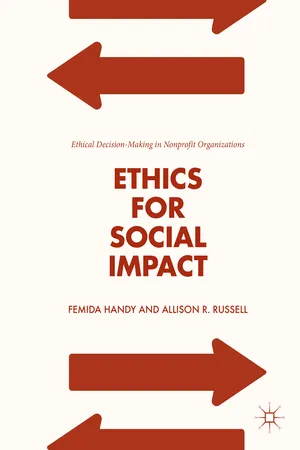
eBook - ePub
Ethics for Social Impact
Ethical Decision-Making in Nonprofit Organizations
- English
- ePUB (mobile friendly)
- Available on iOS & Android
eBook - ePub
Ethics for Social Impact
Ethical Decision-Making in Nonprofit Organizations
About this book
Trusted by 375,005 students
Access to over 1.5 million titles for a fair monthly price.
Study more efficiently using our study tools.
Information
© The Author(s) 2018
Femida Handy and Allison R. RussellEthics for Social Impacthttps://doi.org/10.1007/978-3-319-75040-8_11. Introduction: Why Ethics?
Femida Handy1 and Allison R. Russell2
(1)
University of Pennsylvania, Philadelphia, USA
(2)
University of Pennsylvania, Philadelphia, USA
What is ethics? Ethics is a discipline that deals with what is good and bad and with moral duty and obligation. It encompasses the principles and rules governing the standards of conduct of an individual or group, such as a community or a profession. Sometimes referred to as moral philosophy , it is the study of the general nature of morals and of the specific moral choices to be made by a person or group. Ethics is not only the “code [s] of conduct actually adopted by a group of people… [but also] the activity of appraising and perhaps revising these codes” (Jones et al. 1977, pp. 1–2).
Ethics, therefore, is not a static concept. It is a process of negotiation and interaction between individuals and their consciences, their gods, their impulses, their intentions, and their communities. All these relationships play a role in forming our personal and communal ethics, but the order in which they are prioritized varies across different ethical approaches . We see evidence of this when we study the evolution of ethics and ethical theories over time. The emphasis on man’s relationship with God evident in the writings of Thomas Aquinas and other medieval thinkers defines ethics in terms of the divine command , whereas Utilitarianism prioritizes interactions between members of groups or communities.
Why Should We Care? What is your personal view of ethics? You may feel very strongly that “right” and “wrong” are black and white concepts, and that you can recognize unethical behavior in others and even in yourself when you see it. But what happens when you step into a position of leadership, and your decisions begin to impact not only yourself but also others who depend on you? Would you feel prepared to defend your actions and your personal views on right and wrong to the public? These questions are difficult to answer but important to contemplate for anyone hoping to pursue a career in nonprofit management and leadership.
But you might also be thinking: Isn’t ethical behavior important in all other domains of our lives? Whether you work for a for-profit or the government, shouldn’t these organizations also instill ethical behaviors? Why, then, should we care about ethics specifically in the nonprofit context?
We chose to write this book for students and practitioners interested in the nonprofit world for several reasons. First, and foremost, just because an organization is a nonprofit, meaning that it cannot distribute its surplus to any individual and that it has a charitable mission , does not prevent it from performing unethical and corrupt behaviors. Nonprofit organizations frequently come under intense public scrutiny because of their tax-exempt status and socially driven missions . These social missions often sound good on the surface, but their impact is difficult to measure in practice. Issues can arise when the public demands that nonprofits hold themselves accountable to their missions and when organizations have not done an adequate job of documenting or justifying their decisions and actions. These issues intensify as the number and size of donations to specific organizations increase. Similarly, larger and older nonprofit organizations , with deeper roots in their communities or greater geographic scopes, are more likely to come under fire for mismanagement or questionable ethics. As we outline later in this chapter, numerous scandals take place in small and large nonprofits across the country each year, as the public demands greater accountability .
Second, despite the scandals , nonprofits are regarded by the general public as more trustworthy than their for-profit or public-sector counterparts. Although you may find it unfair, the reality is that nonprofits are typically held to a higher ethical standard than either for-profit or governmental organizations . On the one hand, this expectation is unrealistic and even damaging to the organization’s ability to satisfy its goals and purposes, especially when the public demands nonprofits abide by certain practices without a full understanding of the day-to-day operations and needs of the organization and its constituents. Some of these practices include capping executive salaries or using a certain proportion of donated funds for programmatic expenses. As authors like Doug White (2010) have noted, these realities are facts of life for nonprofit organizations and their leadership, whether they like it or not. On the other hand, the centrality of the public trust in the functioning and success of nonprofit organizations and the sector at large is one of the elements that makes them distinct from their for-profit and public-sector counterparts, and consequently, gives them unique advantages, opportunities, and positions in the fabric of civil society and social life.
As such, students of the nonprofit sector and current practitioners alike must consider the role that systematic, ethical decision-making plays in the establishment and maintenance of the public’s trust in their organization. The public, as well as donors , boards of directors , volunteers , employees , and clients , must continue to value the organization’s goods and services , as well as its contributions to society at large. They must buy into the work of the organization and the social good it represents. Their buy-in is demonstrated both directly through donations of money and time and indirectly through the opportunity cost of foregone tax revenues. Their trust, once damaged, is difficult to repair, and can have long-lasting and far-reaching effects on the nonprofit’s reputation and ability to carry out its work. Thus, it is even more imperative to keep up this reputation since nonprofits rely on public goodwill , and many of their resources come from voluntary donations of time and money.
Third, since 501(c)(3) charitable nonprofits , which are the focus of this book, are organized for the benefit of the public and often cater to a vulnerable population, unethical behavior robs those most in need of opportunities to get the goods and services they cannot afford. As we will see in the scandals described below and in the example cases provided in this volume, unethical decisions that lead to mismanagement in nonprofit organizations impact a variety of stakeholder groups, and can have particularly detrimental effects on the organization’s clients , those who are the direct recipients of the goods and services provided. In the case of health and human service organizations , for example, unethical decision-making can expose already vulnerable groups to even worse conditions. In the USA , as the government contracts with more and more nonprofits to provide social services to the public, the stakes around making the right decisions on behalf of clients , who cannot access what they need easily from another source or sector, increase. Likewise, in the realm of international aid and relief nonprofits , unethical decision-making can lead to catastrophic consequences.
Fourth, as nonprofits often have no single measurable bottom line and have multiple stakeholders , when a decision needs to be made in which one stakeholder (or one bottom line ) is privileged over another, it is not always clear which needs should be prioritized, and why. We elaborate on these issues more in Chapter 2. While we cannot provide a universal, “one size fits all” formula for prioritizing these competing interests and resolving the tensions that often arise, we can suggest approaches for thinking about these questions systematically, which will allow you to gain confide...
Table of contents
- Ethics for Social Impact
- Acknowledgements
- Contents
- List of Figures
- Part I: Ethics and Decision-Making
- Part II: Cases
- Index
Frequently asked questions
Yes, you can cancel anytime from the Subscription tab in your account settings on the Perlego website. Your subscription will stay active until the end of your current billing period. Learn how to cancel your subscription
No, books cannot be downloaded as external files, such as PDFs, for use outside of Perlego. However, you can download books within the Perlego app for offline reading on mobile or tablet. Learn how to download books offline
Perlego offers two plans: Essential and Complete
- Essential is ideal for learners and professionals who enjoy exploring a wide range of subjects. Access the Essential Library with 800,000+ trusted titles and best-sellers across business, personal growth, and the humanities. Includes unlimited reading time and Standard Read Aloud voice.
- Complete: Perfect for advanced learners and researchers needing full, unrestricted access. Unlock 1.5M+ books across hundreds of subjects, including academic and specialized titles. The Complete Plan also includes advanced features like Premium Read Aloud and Research Assistant.
We are an online textbook subscription service, where you can get access to an entire online library for less than the price of a single book per month. With over 1.5 million books across 990+ topics, we’ve got you covered! Learn about our mission
Look out for the read-aloud symbol on your next book to see if you can listen to it. The read-aloud tool reads text aloud for you, highlighting the text as it is being read. You can pause it, speed it up and slow it down. Learn more about Read Aloud
Yes! You can use the Perlego app on both iOS and Android devices to read anytime, anywhere — even offline. Perfect for commutes or when you’re on the go.
Please note we cannot support devices running on iOS 13 and Android 7 or earlier. Learn more about using the app
Please note we cannot support devices running on iOS 13 and Android 7 or earlier. Learn more about using the app
Yes, you can access Ethics for Social Impact by Femida Handy,Allison R. Russell in PDF and/or ePUB format, as well as other popular books in Business & Business Ethics. We have over 1.5 million books available in our catalogue for you to explore.