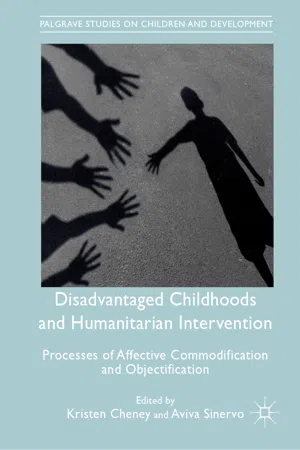
This book explores how humanitarian interventions for children in difficult circumstances engage in affective commodification of disadvantaged childhoods. The chapters consider how transnational charitable industries are created and mobilized around childhood need—highlighting children in situations of war and poverty, and with indeterminate access to health and education—to redirect global resource flows and sentiments in order to address concerns of child suffering. The authors discuss examples from around the world to show how, as much as these processes can help achieve the goals of aid organizations, such practices can also perpetuate the conditions that organizations seek to alleviate and thereby endanger the very children they intend to help.
Trusted by 375,005 students
Access to over 1.5 million titles for a fair monthly price.
Kristen Cheney and Aviva Sinervo (eds.)Disadvantaged Childhoods and Humanitarian InterventionPalgrave Studies on Children and Developmenthttps://doi.org/10.1007/978-3-030-01623-4_1
Begin Abstract
1. NGO Economies of Affect: Humanitarianism and Childhood in Contemporary and Historical Perspective
Aviva Sinervo1 and Kristen Cheney2
(1)
San Francisco State University, San Francisco, CA, USA
(2)
International Institute of Social Studies, The Hague, The Netherlands
In the fall of 2016, at tram and bus stops around the Netherlands, large placards filling the shelter walls read, “Saving children’s lives. That is what we do” (Fig. 1.1). These advertisements were for the international nongovernmental organization (INGO) Save the Children . The ads might seem to draw ironic attention to their mission, so blatant in the very title of their organization, but they were less clear about what exactly they save children from—and what exactly they wanted the ads’ viewers to do to support this apparently laudable goal of child saving . The words splashed across the top and bottom of a close-up picture of a child’s face. In most cases, this was an obviously foreign, brown child with disheveled hair, a face smudged with dirt, and imploring eyes. The ads sat comfortably alongside fashion promotions for H&M’s fall line of jackets or posters for new film releases. “Do something or give something,” read another Save the Children ad. Again, we were not given any indication about what it is we should “do”; the other nuances of this message, and any potential specificity of problem, population, or response seemed to require no articulation. All that we needed to know was that “children in need” were involved.
Fig. 1.1
Dutch advertisement for Save the Children (2016)
This volume explores how humanitarian interventions on behalf of children tend to objectify and commodify certain “disadvantaged” (nonideal, nonnormative) childhoods, often by leaning on circulating affects and universalized stereotypes of a globalized childhood . It has its origin in a panel that the editors organized for the 2015 meeting of the Interest Group on NGOs and Nonprofits of the American Anthropological Association in Denver, Colorado. The meeting’s theme, “NGO-graphies,” encouraged participants to use ethnography to examine broad patterns of NGO practices that constitute networks responsible for global flows of knowledge and resources. Our panel, comprised of a number of emergent scholars in the anthropology of humanitarianism, development , NGOs, and nonprofits , critically examined “how these networks are constituted through the personal interactions, cultural practices, and shifting discourses that give them meaning,”1 particularly where children are the targets of NGOs’ humanitarian interventions.
Commodification implies a marketable product, one that is being sold. Often it stems from processes of objectification in which a fluid, cross-culturally dynamic concept like childhood becomes fixed and seemingly unitary in its meaning. We argue that what is being commodified in NGOs for children are particular representations of universalized childhood need—indeed particular forms of disadvantage or vulnerability —that do not always line up with local perceptions of childhood, provision, charity , or development. In fact, such representations rely heavily on forms of sentiment that are cultivated to produce affective capital for donors . Affect is created in multiple subjective and temporal registers in the commodification process, entangling not just the intended consumer audiences (donors, volunteers, partner organizations, and the political arms of states) but also the producers of sympathetic childhoods (whether these are adult NGO staff, media, or children subjects themselves). For example , a donor’s “need to help” a particular suffering childhood demographic is enmeshed in the affective economy that discourses and images of childhood induce. However, the children targeted by affective economies are expected to conform to certain normative notions of childhood as a result (Stryker 2011). In that sense, affect’s “cultural underpinnings are as deep as the political stakes for understanding it are high” (White 2017, 178). Donors might think at once to their own childhoods, or their children’s childhoods, as well as feel a broad sense of responsibility for children as the future.
Child-focused humanitarian organizations—whether they run local programs, are international charities like Save the Children , or are multilateral organizations like UNICEF —thereby become nexuses of action shaped not just by political economy but also by emotion . Given the current awareness of the coupling of political economy and sentiment , and how it does violence to certain populations as an inherent aspect of late capitalism and its successes (cf. Adams 2013; Fassin 2013; Gibson-Graham 2006; Hochschild 2003; Williams 2013), we use cross-cultural and international humanitarian practices as a lens for critically examining how childhood is marketed in the aid and development spheres, weighing the benefits of such publicity and fundraising tactics against its sacrifices.
The significance of this task becomes clear as we focus on how childhood is constructed within aid discourse to include certain intrinsic “needs” specific to the developmental life-stage of the young. As Martin Woodhead noted, the idea of “need” often “conceals in practice a complex of latent assumptions and judgments about children” (Woodhead 1997, 63) based on children’s nature rather than their social environments. While building on a palette common to human rights initiatives (the basics of food, clean water, shelter, and health), children ’s needs are multiplied (education, care through kin relations , and protection) as their circumstance and exposure to vulnerability is amplified by their age . Informed by the United Nations Convention on the Rights of the Child (UNCRC), the imperative to help disadvantaged or at-risk children becomes a moral rallying cry and a global legal imperative that mobilizes circulations of wealth alongside feelings of outrage, pity , and sadness. Because it is easy to conflate experiences of childhood suffering with the emotionsthat stories about these experiences produce, we emphasize that “disadvantage” is not a given category, even as it might be essentialized and mobilized in the name of entangled capitalist affects that often do more harm than good. We therefore interrogate how categories of childhood are created and deployed in transnational humanitarian discourse, asking what gives them such power, and why they become so useful for organizations but potentially so damaging to the very peoples that these organizations seek to assist. We pay attention to the intersections of these categories of childhood—how they become variants of each other—but also to their specificities.
Humanitarian organizations find themselves in a complicated set of moral predicaments when they solicit funding for children using sympathetic portraits of need (Benthall 1993, 277–81; Slim 2015, 16). Considering that the effectiveness of such images is based on the affective currency of childhood and the emotional capital that they elicit, such projections of need can result in aid being provided in ways that do not necessarily respect affected populations, or accurately represent their concerns, challenges, or cultural frameworks (Burman 1994; Schuller 2012). Often, such discourses of need might not even correctly identify the children who are in danger, or the form of endangered childhood that most requires intervention (Shepler 2014). At other times, such interventions can create perverse incentives that in fact generate more of the very endangered childhoods that they hope to eliminate, as is the case, for example, when orphanages are built to help orphans but end up creating even more orphans by pulling children into unnecessary institutionalization (Cheney and Rotabi 2014). It is now estimated that 80% of children in institutions around the world are not in fact orphans—children whose parents have died—but are children placed in institutions to access resources and services that are otherwise inaccessible to their families.2 A key ethical challenge arises from the success of misconstrual: children’s lived “realities” (i.e., that “orphans” have living parents) may not sell as well as specially curated, staged, or sensationalized representations .
We find commodification to be a useful heuristic device for understanding such representations; a political-economic analysis of childhood as a billable good leads us to recognize how humanitarian practices may be simultaneously helping and hindering the children they seek to serve. Commodification is often necessarily accompanied by explicit forms of objectification and misrepresentation, and thereby misrecognition. Children’s need, victimhood , and disadvantage—rather than children themselves as persons, subjects, and agents—become the foci driving humanitarianism . Children as individuals are erased, and what takes their place are broad generalizations that are manipulable based on the demands of the market. It is not our intent to deny that child-focused NGOs “do good” (Fisher 1997; Hilhorst 2003; Lashaw et al. 2017) for certain communities and individuals, but our concern with practices of commodification and objectification is threefold. First, in creating a particular narrative of childhood need, organizations tend to focus on one childhood vulnerability (such as orphanho...
Table of contents
Cover
Front Matter
1. NGO Economies of Affect: Humanitarianism and Childhood in Contemporary and Historical Perspective
2. The Orphan Industrial Complex: The Charitable Commodification of Children and Its Consequences for Child Protection
4. Commodification in Multiple Registers: Child Workers, Child Consumers, and Child Labor NGOs in India
5. A Tale of Two NGO Discourses: NGO Stories of Suffering Qur’anic School Children in Senegal
6. The Right to Play Versus the Right to War? Vulnerable Childhood in Lebanon’s NGOization
7. Need Saving?/Saving Need: Intersecting Discourses on Urban Children, Families, and Need in a U.S. Faith-Based Organization
8. Flattening Need and Steepening Responsibility: Navigating Access to Islands of Care for Children Living with HIV in Uganda
9. Forming a Humanitarian Brand: Childhood and Affect in Central Australia
Correction to: The Right to Play Versus the Right to War? Vulnerable Childhood in Lebanon’s NGOization
Back Matter
Frequently asked questions
Yes, you can cancel anytime from the Subscription tab in your account settings on the Perlego website. Your subscription will stay active until the end of your current billing period. Learn how to cancel your subscription
No, books cannot be downloaded as external files, such as PDFs, for use outside of Perlego. However, you can download books within the Perlego app for offline reading on mobile or tablet. Learn how to download books offline
Perlego offers two plans: Essential and Complete
Essential is ideal for learners and professionals who enjoy exploring a wide range of subjects. Access the Essential Library with 800,000+ trusted titles and best-sellers across business, personal growth, and the humanities. Includes unlimited reading time and Standard Read Aloud voice.
Complete: Perfect for advanced learners and researchers needing full, unrestricted access. Unlock 1.5M+ books across hundreds of subjects, including academic and specialized titles. The Complete Plan also includes advanced features like Premium Read Aloud and Research Assistant.
Both plans are available with monthly, semester, or annual billing cycles.
We are an online textbook subscription service, where you can get access to an entire online library for less than the price of a single book per month. With over 1.5 million books across 990+ topics, we’ve got you covered! Learn about our mission
Look out for the read-aloud symbol on your next book to see if you can listen to it. The read-aloud tool reads text aloud for you, highlighting the text as it is being read. You can pause it, speed it up and slow it down. Learn more about Read Aloud
Yes! You can use the Perlego app on both iOS and Android devices to read anytime, anywhere — even offline. Perfect for commutes or when you’re on the go. Please note we cannot support devices running on iOS 13 and Android 7 or earlier. Learn more about using the app
Yes, you can access Disadvantaged Childhoods and Humanitarian Intervention by Kristen Cheney, Aviva Sinervo, Kristen Cheney,Aviva Sinervo in PDF and/or ePUB format, as well as other popular books in Social Sciences & Sustainable Development. We have over 1.5 million books available in our catalogue for you to explore.