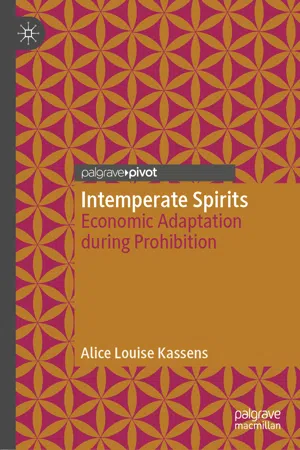
Using the basic economic principle of making decisions using a cost-benefit framework—and how changes in one or the other can result in a different decision—this book uncovers how various groups responded to incentives provided by the Prohibition legislation. Using this calculus, it is clear that even criminals are rational characters, responding to incentives and opportunities provided by the 18th Amendment and the Volstead Act. The book begins with a broad look at the adaptations of the law's targets: the wine, beer, and liquor industries. It then turns to specific people (Violators, Line Tip-Toers, Enablers, and Hypocrites), sharing their stories of economic adaptation to bring economic lessons to life. Due to its structure, the book can be read in parts or as a whole and is suitable for short classroom reading assignments or individual pleasure reading.
Trusted by 375,005 students
Access to over 1.5 million titles for a fair monthly price.
This chapter sets the table for the rest of the book, outlining the notion of using an economic lens, specifically rational choice, to examine individual behavior and adaptation during Prohibition. That is the unique contribution of this book. A brief history of alcohol prohibitions in the United States is provided, followed by a description of the evolution of the temperance movement into a push for prohibition. The introduction is crucial prior to reading later chapters.
Keywords
Rational choiceTemperanceProhibition
End Abstract
This is a story of the Prohibition Era in the United States between 1920 and 1933. It is a tale of hubris, failure, creative adaptation, survival, hijinks, manipulation, and thuggery. Many of the more colorful figures are already the subjects of blockbuster movies, books, and television. Names such as Al Capone and Eliot Ness. While the former is a part of this tale via a racket not heretofore detailed, there are many lesser known entities in this cast of Prohibition Era characters. The characters share an entrepreneurial1 and intemperate spirit, adapting to the 18th Amendment and Volstead Act, seeking opportunities for profit and power. For clarity and decency, the actors are separated into explicit groups based on apparent motivation and legitimacy. At times characters are created by the author to facilitate an explanation. Other sections require no such fiction.
This story, although told by an economist, does not focus on the economic theory or mathematics carefully crafted out by others.2 Rather it looks at the era through the lens of an economist and uses a less dismal storytelling methodology, albeit with a bit of cheek. Because prior work regarding the economics of crime and prohibition is so rich, interested readers are provided with various resources for reading more nuanced and sophisticated accounts. The fundamental and consistent theme used throughout the book is that of rational choice.3 Economists describe a rational choice as one that provides the greatest relative benefit. This economic viewpoint is useful when studying the effect of a law and the degree of enforcement on individual behavior and the overall economy, and there is much behavior to explain between 1920 and 1933.
Prohibition is defined as a government decree against the exchange of a good or service, a mandate that is all but impossible and extremely expensive to fully enforce. As with any law, there are unintended consequences making our cast of characters and stories in this book possible. The US government involved itself in the alcoholmarkets prior to the 1920–1933 Prohibition Era, although the 18th Amendment was the most invasive interference to date. The United States has a storied, and at times violent, history with government regulation of alcohol. Historical and current government involvement in the alcohol markets ranges from temperance to outright prohibition. Temperance aims to reduce or curb consumption via mechanisms such as guilt, taxes, minimum drinking age laws, and restricted sale and distribution. The thought behind these “nudges” is that they increase the cost of the good and reduce consumption. Another benefit of some temperance-based actions is increased government revenues from taxes and sales. In contrast, prohibition, frequently invoked loudly in the name of safety, morality, and health, seeks to cease consumption rather than temper it. Finding an alternative tax resource is imperative for prohibitionists at the local, state, and federal levels (Image 1.1).
Image 1.1
Must these go down a drunkard’s grave in order that we the streets may pave? (c.a. 1915–1919)
(Source The American Issue Publishing Company, Westerville, Ohio, Library of Congress)
The buildup to the passage of the 18th Amendment is often broken into three stages (Thornton, 1991). The first covers the years between Colonial times to the Civil War. Perhaps due to the lack of clean water (Benjamin Franklin allegedly noted that “in wine there is wisdom, in beer there is freedom, and in water there is bacteria”) or believed health benefits, drinking alcohol was commonplace among most colonists save the Puritans, slaves, servants, apprentices, and Georgians. The first group, primarily located in New England, avoided excessive drinking for moral reasons. Puritan minister Increase Mather of the Massachusetts Bay Colony opined that alcohol was a creature of God, noting his acceptance of its use in moderation, but quoted Isaiah when asking drunkards to tremble when they “see Hell gapping for you, and opening her mouth wide to receive your Souls” (Isaiah 5:14). Various laws prohibited the sale of alcohol to Native Americans, slaves, servants, and apprentices. Typically, the purpose of these laws was to maintain control and productivity of these individuals. Finally, Georgia’s origins were in an experimental society founded by James Edward Oglethorpe (1696–1785) with the aim of promoting temperance. He brought residents of British debtors’ prisons to what is now Savannah in 1733 and started a drycolony. Drinking booze was not generally tolerated in the early years of the Peach State.
Alcohol consumption is as American as apple pie. Colonialists brought both their adventurous and alcoholic spirits from Europe. By the late eighteenth century, the primary refreshments were distilled spirits including rum, gin, whiskey, and brandy. Those in Virginia and farther north also consumed a considerable amount of cider due to the abundance of apple trees (Rorabaugh, 1991). The daily quantity of alcohol consumed by a typical colonist might even impress modern-day fraternity partygoers on a Friday night. The typical colonist drank 7.1 gallons of alcohol per year, or about 2.5 fluid ounces per day. Today, a standard “drink” contains 0.6 fluid ounces of alcohol. Thus, colonists drank the equivalent of over four 5 oz. glasses of wine, cans of Budweiser, or 1.5 oz. shots of whiskey starting when their eyes opened for the day and ending just before they closed for the evening (Green, 2015). The first drink of the day for the colonists might have been hair of the dog, but for the non-crapulous, the day often began with an antifogmatic, or eye-opener, followed by a steady stream of beer, cider, and rum fortifying the hardworking revolutionaries until it was time to go to the local tavern, dinner, and a nightcap (Coleman, 2015). Toddlers joined in on the action, polishing off the remnants of their parent’s toddy. There were disparities in drinking. White males led the consumption rankings, drinking considerably more than the overall daily average.
Warnings about excesses were published during the colonial period, including some quips in Poor Richard’s Almanack, mostly penned by Benjamin Franklin. Some classic morsels include “When the wine enters, out goes the truth” and “Life with fools consists in drinking; with the wise man, living’s thinking.” The first item on his list of virtues was temperance, advising readers to “Eat not to dullness. Drink not to elevation.” Franklin also offered words of wisdom that suggested benefits of drinking, such as “There are more old drunkards than old doctors” (Fig. 1.1).
Fig. 1.1
Absolute per capita alcohol consumption, US gallons (1785–1940)
(Source Rorabaugh, 1991)
Fig. 1.2
“Temperance movement” versus “prohibition”, 1760–1939 newspapers
(Source Data from newspapers.com, analysis and graphic by author)
Colonists were more than warned about the dangers of alcohol. An early example of government intervention in the alcohol marketswas the excise tax suggested by Treasury Secretary Alexander Hamilton in 1790. The tax was designed to assist with President George Washington’sRevolutio...
Table of contents
Cover
Front Matter
1. Introduction
2. Targets
3. Violators
4. Line Tip-Toers
5. Enablers and Hypocrites
6. Conclusion
Back Matter
Frequently asked questions
Yes, you can cancel anytime from the Subscription tab in your account settings on the Perlego website. Your subscription will stay active until the end of your current billing period. Learn how to cancel your subscription
No, books cannot be downloaded as external files, such as PDFs, for use outside of Perlego. However, you can download books within the Perlego app for offline reading on mobile or tablet. Learn how to download books offline
Perlego offers two plans: Essential and Complete
Essential is ideal for learners and professionals who enjoy exploring a wide range of subjects. Access the Essential Library with 800,000+ trusted titles and best-sellers across business, personal growth, and the humanities. Includes unlimited reading time and Standard Read Aloud voice.
Complete: Perfect for advanced learners and researchers needing full, unrestricted access. Unlock 1.5M+ books across hundreds of subjects, including academic and specialized titles. The Complete Plan also includes advanced features like Premium Read Aloud and Research Assistant.
Both plans are available with monthly, semester, or annual billing cycles.
We are an online textbook subscription service, where you can get access to an entire online library for less than the price of a single book per month. With over 1.5 million books across 990+ topics, we’ve got you covered! Learn about our mission
Look out for the read-aloud symbol on your next book to see if you can listen to it. The read-aloud tool reads text aloud for you, highlighting the text as it is being read. You can pause it, speed it up and slow it down. Learn more about Read Aloud
Yes! You can use the Perlego app on both iOS and Android devices to read anytime, anywhere — even offline. Perfect for commutes or when you’re on the go. Please note we cannot support devices running on iOS 13 and Android 7 or earlier. Learn more about using the app
Yes, you can access Intemperate Spirits by Alice Louise Kassens in PDF and/or ePUB format, as well as other popular books in Economics & Economic History. We have over 1.5 million books available in our catalogue for you to explore.