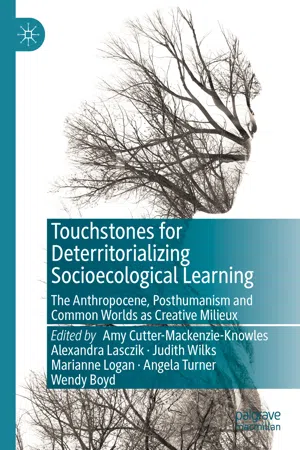
This book focuses on socioecological learning through the touchstone concepts of the Anthropocene, the Posthuman and Common Worlds as Creative Milieux. The editors and contributors explore, situate and interrogate social learning through transdisciplinary positionings, exemplars and theories. The eclectic and cohesive chapters unfold as a journey that may inspire innovative and unique understandings of the socioecological learner: insights that will surely be paramount as we careen towards the 22nd century and all of its as-yet-unknown challenges. Offering tangible and nuanced practice for educational leadership in socioecological learning, this pioneering book will be of interest and value to researchers and educators at all levels. This volume is sure to appeal to students and scholars of socioecological learning as well as the Anthropocene and the Posthuman.
Trusted by 375,005 students
Access to over 1.5 million titles for a fair monthly price.
A. Cutter-Mackenzie-Knowles et al. (eds.)Touchstones for Deterritorializing Socioecological Learninghttps://doi.org/10.1007/978-3-030-12212-6_1
Begin Abstract
1. Touchstones for Deterritorializing the Socioecological Learner
Amy Cutter-Mackenzie-Knowles1, Alexandra Lasczik1, Marianne Logan1, Judith Wilks2, 3 and Angela Turner2
(1)
School of Education, Sustainability, Environment and the Arts in Education (SEAE) Research Cluster, Southern Cross University, Bilinga, QLD, Australia
(2)
School of Education, Sustainability, Environment and the Arts in Education (SEAE) Research Cluster, Southern Cross University, Coffs Harbour, NSW, Australia
(3)
University of Notre Dame, Notre Dame, WA, Australia
The opening chapter of this book orients the reader through the introduction of the concept of the socioecological learner. In so doing the chapter clears the ground through a diffractive untangling of the socioecological learner drawing upon research vignettes and the touchstone concepts of the Anthropocene, Posthumanism and Common Worlds as Creative Milieux (In this collection, the authors engage the French plural of milieu: milieux, not milieus). This ‘clearing of the ground’ is an ontological and epistemological approach of de-territorializing the learner for a post-Anthropocene world. It opens up the space for de-learning and de-imagining (‘de’ meaning ‘from’ in Spanish) the learner as a socioecological learner.
Clearing the ground seems like anovertly ‘human’ endeavour, but this clearing is in fact an unhumanising process in an attempt to generate new ways of thinking and being as ‘a learner’. Some may describe this as a process of re-learning, but we see it as de-learning and de-imagining(‘de’ after the Spanish word for ‘from’) what it is to be human on a planet where humans are one of many species rather than ‘the superior dominant species’. This book embraces a flat ontology, which rejects human privileging and dominance over nonhuman subjects and objects. A flattened ontology requires humans to radically and actively live carefully, thoughtfully and ethically.
Snaza and Weaver (2015) argue that given the saturation of humanism “it is not even remotely possible at the present moment to conceptually or practically lay out a theory of posthumanist education or outline the contours of a posthumanist pedagogy” (p. 3). It is for this reason that the Editors resisted calling the book ‘The Posthumanist Learner’. By doing so though it is important to acknowledge the complexities between the theories of the socioecological and of posthumanism, indeed an enduring tension is provoked throughout this collection, which is purposeful and useful.
This brings us to the touchstone concepts of what it is to be a socioecological learner, for the purposes of this collection and the thoughts and actions that stem from it. By touchstones, we mean to work the concepts as an assaying apparatus. The notion, socioecological, in and of itself is problematic in that some may see it as saturated, disassembled, humanist. Yet we argue that at the centre of socioecological learning is a posthumanist ethos. There is a dualism automatically established between socio and ecological, but we believe it is crucial to dwell in these tensions and spaces as a process of dissembling human dominance in education. As such, this requires a deterritorializing of the socioecological, in the context of the Anthropocene. We now turn to a de-imagining of the socioecological, before presenting the touchstone concepts, namely the Anthropocene, Posthumanism and Common Worlds as Creative Milieux.
Vignette 1
Socioecological – A fluid yet intertangled mesh. (Image by Authors (Lasczik and Cutter-Mackenzie-Knowles). Reproduced with permission)
De-imagining the Socioecological
A socioecological framing is grounded in a post-anarchist theoretical orientation (Bookchin, 1994), yet supported by an experiential learning framework (Dewey, 1916, 1938; Merleau-Ponty, 1945). It is antidisciplinary whereby fields of research operate as collectives rather than as silos (Wattchow et al., 2014). In the book The Socioecological Educator, Brown, Jeanes and Cutter-Mackenzie (2014) identify four foundational concepts central to a socioecological framing, namely: (i) lived experience, (ii) place, (iii) experiential pedagogies/learnings, and (iv) agency and participation. These concepts are helpful in thinking through the complexity of the educator or pedagogue, although problematic insofar as these concepts retain an explicit focus on the human, albeit in place.
At the core, socio is thought of as ‘social, sociological or society’. Such concepts are readily human-saturated and imbued. Socio alludes to Latin etymologies of socius, which translate as companion, associate, ally – all very humancentric concepts. In our conceptualisations, we are expanding socio to embrace the nonhuman in subject and object, so that the ‘companions’, ‘allies’ and ‘associate’ relationalities transcend human boundaries.
Ecological is relating to or concerned with the relationship of subjects and objects to one another. Traditional definitions of ‘ecological’ however have tended to frame it through the connections of ‘living organisms’ and their relationship to the ‘physical environment’. In this chapter, and indeed in the collection, we view ecology as the entanglement of everything – common and uncommon subjects and objects.
Applying such a socioecological framing is fluid rather than developmental, and its components are not conceived as systems. Rather, they are approached as interpenetrating fields of relationships which come to shape emergent and dynamic processes of socioecological learning. Throughout this book we use the three touchstone concepts to illustrate the fluid and interrelational character of learning, viewed within this socioecological framing.
Of particular focus in the de-imaginings of the socioecological learner is the premise that the Anthropocene, Posthumanism and Common Worlds operate as Creative Milieux. By this we mean that these touchstone concepts reverberate and resonate as milieux – places, environments, conditions and events (Rousell & Cutter-Mackenzie-Knowles, 2019a) with and through which we put them to work in the assemblage of socioecologial learning. The touchstones are entwined, and do not necessarily have to be engaged evenly or simultaneously in socioecological learning. Rather, it is understood that as each touchstone is engaged it is implied that so do the others in lesser and greater ways implicit in their assemblage. This is how they engage as milieux creatively, affectively and in synergy with the Anthropocene, Common Worlds and Posthumanism. What follows is an exploration of these touchstone concepts and how they may be engaged.
Touchstone 1: Anthropocene
According to scientific estimates, the Earth is 4.5 billion years old and has undergone enormous change since its evolutionary beginnings (Gaffey & Steffen, 2017, p. 53). The universe is approximately 13.7 billion years old. The Earth’s age can be evidenced within the Earth’s crust ‘iridium layer’, which evidences the existence of fossilised plant and animal life over time. Figure 1.1 displays land and sea split into specific periods, rounded as time estimates (US Geological Survey Names Committee, 2010).
Fig. 1.1
The geological time spiral-A path to the past. The U.S. geologic...
Table of contents
Cover
Front Matter
1. Touchstones for Deterritorializing the Socioecological Learner
2. Posthumanist Learning: Nature as Event
3. The Socioecological (Un)learner: Unlearning Binary Oppositions and the Wicked Problems of the Anthropocene
4. The Risky Socioecological Learner
5. “It is not a question of either/or, but of ‘and … and’”: The Socioecological Learner as Learner-Teacher-Researcher
6. The Socioecological Learner in Big History: Post-Anthropocene Imageries
7. Site/Sight/Insight: Becoming a Socioecological Learner Through Collaborative Artmaking Practices
8. De-imagining and Reinvigorating Learning with/in/as/for Community, Through Self, Other and Place
9. Socioecological Learners as Agentic: A Posthumanist Perspective
10. Un/Folding Socioecological Learning: An Aesthetic Portrayal
Back Matter
Frequently asked questions
Yes, you can cancel anytime from the Subscription tab in your account settings on the Perlego website. Your subscription will stay active until the end of your current billing period. Learn how to cancel your subscription
No, books cannot be downloaded as external files, such as PDFs, for use outside of Perlego. However, you can download books within the Perlego app for offline reading on mobile or tablet. Learn how to download books offline
Perlego offers two plans: Essential and Complete
Essential is ideal for learners and professionals who enjoy exploring a wide range of subjects. Access the Essential Library with 800,000+ trusted titles and best-sellers across business, personal growth, and the humanities. Includes unlimited reading time and Standard Read Aloud voice.
Complete: Perfect for advanced learners and researchers needing full, unrestricted access. Unlock 1.5M+ books across hundreds of subjects, including academic and specialized titles. The Complete Plan also includes advanced features like Premium Read Aloud and Research Assistant.
Both plans are available with monthly, semester, or annual billing cycles.
We are an online textbook subscription service, where you can get access to an entire online library for less than the price of a single book per month. With over 1.5 million books across 990+ topics, we’ve got you covered! Learn about our mission
Look out for the read-aloud symbol on your next book to see if you can listen to it. The read-aloud tool reads text aloud for you, highlighting the text as it is being read. You can pause it, speed it up and slow it down. Learn more about Read Aloud
Yes! You can use the Perlego app on both iOS and Android devices to read anytime, anywhere — even offline. Perfect for commutes or when you’re on the go. Please note we cannot support devices running on iOS 13 and Android 7 or earlier. Learn more about using the app
Yes, you can access Touchstones for Deterritorializing Socioecological Learning by Amy Cutter-Mackenzie-Knowles, Alexandra Lasczik, Judith Wilks, Marianne Logan, Angela Turner, Wendy Boyd, Amy Cutter-Mackenzie-Knowles,Alexandra Lasczik,Judith Wilks,Marianne Logan,Angela Turner,Wendy Boyd in PDF and/or ePUB format, as well as other popular books in Pedagogía & Educación general. We have over 1.5 million books available in our catalogue for you to explore.