An Institutional History of Italian Economics in the Interwar Period — Volume I
eBook - ePub

An Institutional History of Italian Economics in the Interwar Period — Volume I

Adapting to the Fascist Regime

  1. English
  2. ePUB (mobile friendly)
  3. Available on iOS & Android
eBook - ePub

An Institutional History of Italian Economics in the Interwar Period — Volume I

Adapting to the Fascist Regime

About this book

Italy is well known for its prominent economists, as well as for the typical public profile they have constantly revealed. But, when facing an illiberal and totalitarian regime, how closely did Italian economists collaborate with government in shaping its economic and political institutions, or work independently? This edited book completes a gap in the history of Italian economic thought by providing a complete work on the crucial link between economics and the Fascist regime, covering the history of political economy in Italy during the so-called "Ventennio" (1922-1943) with an institutional perspective. The approach is threefold: analysis of the academic and extra-academic scene, where economic science was elaborated and taught, the connection between economics, society and politics, and, dissemination of scientific debate. Special attention is given to the bias caused by the Fascist regime to economic debate and careers.

This Volume I deals with the economics profession under Fascism, in particular in light of the political and institutional changes that the regime introduced, the restructuring of higher education, the restriction of freedom in teaching and of the press, and with respect to promoting its own strategies of political and ideological propaganda.

Volume II (available separately) considers the public side of the economics profession, the "fascistisation" of culture and institutions, banishment and emigration of opponents, and post-WW2 purge of Fascist economists.


Trusted by 375,005 students

Access to over 1.5 million titles for a fair monthly price.

Study more efficiently using our study tools.

Information

Year
2019
Print ISBN
9783030329792
eBook ISBN
9783030329808
© The Author(s) 2019
M. M. Augello et al. (eds.)An Institutional History of Italian Economics in the Interwar Period — Volume IPalgrave Studies in the History of Economic Thoughthttps://doi.org/10.1007/978-3-030-32980-8_7
Begin Abstract

Textbooks of Economics during the Ventennio: Forging the Homo Corporativus?

Riccardo Faucci1 and Nicola Giocoli1
(1)
University of Pisa, Pisa, Italy
Riccardo Faucci (Corresponding author)
Nicola Giocoli
The paper surveys forty textbooks of economics and related disciplines published in Italy during fascism. We try to understand to what extent those textbooks contributed to the regime’s goal of creating the ideal fascist citizen, the so-called homo corporativus . It is argued that, at least in their textbooks, a majority of Italian economists were rather unsupportive of that goal and endorsed corporatist ideas only superficially.
End Abstract

1 The Problem and the Labels

The purpose of this essay is to investigate the contribution of the textbooks of political economy and related disciplines used in Italian universities during the Ventennio to the project envisaged by fascist ideologues, Giuseppe Bottai and Giovanni Gentile, of creating the “new Italians” (cf. Barucci et al. 2015, 13). More specifically, we ask whether these textbooks really aimed at forging the homo corporativus in much the same way as the corresponding textbooks of the early decades of the Kingdom of Italy aimed at creating the classical homo oeconomicus, i.e., the “agent and facilitator of the self-government of society through economic mechanisms and economic motives” (Augello and Guidi 2012, 3). Our method will be to evaluate the content of the handbooks per se, in terms of what an average university student of political economy in the 1930s and early 1940s could draw from those pages, without inquiring into the specific political ideas of the author. This entails that, regardless of an author’s own commitment to fascism, what matters for our purposes is only the characterisation of individuals qua economic agents—and the related one of economics qua science—which his textbook proposed to readers. In short, the protagonists of our story are the textbooks, not the economists who wrote them.1
Building on the characterisation that one of us gave of the various approaches to the economic analysis of corporatism ,2 and in view of our goal in this essay, we will classify textbooks in four categories: supporters, experimenters, chameleons and neglecters. These labels deserve some explanation in order to properly frame them within the exceptional historical circumstances in which they are applied. Beginning in the early 1930s, the fascist government required, more or less formally, but always persuasively, that the adjective “corporative” be added to the name of the academic subject “Political Economy”.3 Accordingly, authors had also to modify their textbooks’ titles and, above all, content. No specific guidelines existed though as to what exactly the new subject of “Corporative Political Economy” should consist of. As our labels suggest, in some (indeed, many) cases the change was either purely superficial or entailed no real commitment to corporatist principles, let alone to the project of building the “new Italians”. That Italian economists could still enjoy such freedom should not sound surprising. The lack even among the highest political and intellectual ranks of the Regime of a clear and detailed characterisation of the corporatist project granted textbook writers substantial autonomy in filling with the most diverse contents what for the whole Ventennio remained the shapeless, and largely empty, vessel of corporatism .
We call “supporters” those textbooks that openly endorsed the “official version”—vague and informal as it might be—of corporatism and corporatist economics as radically different from, respectively, previous socio-economic orders and standard economic theory. Some common traits of those textbooks can be identified. First, the image of corporatism as a brand new economic order, not just a “third way” between socialism and laissez-faire. Students were taught that corporatism was something “beyond and above”, and, for this reason, irreducible in its essence to the principles underlying old socio-economic arrangements. Second, the idea that the individuals populating a corporatist economy are no standard economic agents, but, again, something truly different. The homo corporativus is modelled as a new kind of agent, whose aims are—or at least would programmatically become—identical to those of the State. Third, the notion of an “immanent” State, whose goals pervade the whole economy and prevail over—more exactly, coincide with, and so eventually replace—those of the individuals. Finally, the rejection of economics as a pure and separate science. In its stead, “supporting” textbooks offered a holistic approach to social sciences that mixed economics with politics, sociology and law. The eventual goal was to create new epistemological foundations for the social sciences and, through them, spread the new corporatist culture.4
The label “experimenters” is used in this essay for those textbooks that depicted corporatism as some form or another of a “third way”—both historically and analytically—between socialism and laissez-faire. Building on this premise, and on the related acknowledgement of the failure of the free market system to deliver maximum efficiency, the typical “experimenting” textbook presented readers with an (often innovative) analysis of how standard economic theory had to be modified to exploit the advantages of a corporatist order vis-à-vis capitalism’s and socialism’s drawbacks.5 “Overcome without reneging” was those textbooks’ catchword with respect to orthodox economics. By recognising the active role of the State in the price system—beginning with the most fundamental price of all, that of labour—as well as in the centralised management of the social conflict, those texts often undertook unexplored theoretical paths. Regardless of the author’s personal commitment to fascism, this elegant way out from the Regime’s diktat to change the teaching of economics had therefore a side benefit. It helped preserving the scientific reputation of Italian economists on themes, such as public intervention in the economy or imperfect competition, which occupied centerstage in 1930s economics debates worldwide. Textbooks in this group further vindicate the appeal one of us made long ago against adopting a dismissive attitude towards interwar Italian ...
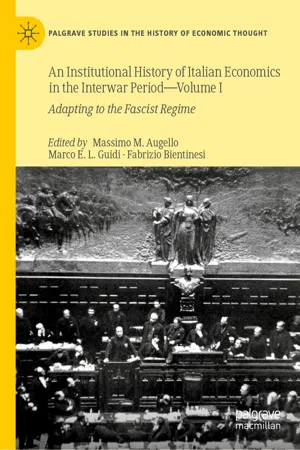
Table of contents

  1. Cover
  2. Front Matter
  3. Italian Economics and Fascism: An Institutional View
  4. Italian Economists and the Fascist Regime: Only an Ambiguous and Painful Continuity?
  5. The Persistence of Tradition: The Economists in the Law Faculties and in the Higher Institutes of Business Studies
  6. The Faculties of Political Sciences and Schools for Advanced Corporative Studies
  7. The Economic Culture of Academic Journals during Fascism
  8. “Generalist” Journals between Dissemination of Economics and Regime Propaganda
  9. Textbooks of Economics during the Ventennio: Forging the Homo Corporativus?
  10. Series of Economics and Encyclopaedias: Traditional Economic Theory and New Paths
  11. Correction to: “Generalist” Journals between Dissemination of Economics and Regime Propaganda
  12. Back Matter

Frequently asked questions

Yes, you can cancel anytime from the Subscription tab in your account settings on the Perlego website. Your subscription will stay active until the end of your current billing period. Learn how to cancel your subscription
No, books cannot be downloaded as external files, such as PDFs, for use outside of Perlego. However, you can download books within the Perlego app for offline reading on mobile or tablet. Learn how to download books offline
Perlego offers two plans: Essential and Complete
  • Essential is ideal for learners and professionals who enjoy exploring a wide range of subjects. Access the Essential Library with 800,000+ trusted titles and best-sellers across business, personal growth, and the humanities. Includes unlimited reading time and Standard Read Aloud voice.
  • Complete: Perfect for advanced learners and researchers needing full, unrestricted access. Unlock 1.5M+ books across hundreds of subjects, including academic and specialized titles. The Complete Plan also includes advanced features like Premium Read Aloud and Research Assistant.
Both plans are available with monthly, semester, or annual billing cycles.
We are an online textbook subscription service, where you can get access to an entire online library for less than the price of a single book per month. With over 1.5 million books across 990+ topics, we’ve got you covered! Learn about our mission
Look out for the read-aloud symbol on your next book to see if you can listen to it. The read-aloud tool reads text aloud for you, highlighting the text as it is being read. You can pause it, speed it up and slow it down. Learn more about Read Aloud
Yes! You can use the Perlego app on both iOS and Android devices to read anytime, anywhere — even offline. Perfect for commutes or when you’re on the go.
Please note we cannot support devices running on iOS 13 and Android 7 or earlier. Learn more about using the app
Yes, you can access An Institutional History of Italian Economics in the Interwar Period — Volume I by Massimo M. Augello, Marco E.L. Guidi, Fabrizio Bientinesi, Massimo M. Augello,Marco E.L. Guidi,Fabrizio Bientinesi,Marco E. L. Guidi in PDF and/or ePUB format, as well as other popular books in Économie & Histoire économique. We have over 1.5 million books available in our catalogue for you to explore.