This book examines the misuse of history in New Atheism and militant anti-religion. It looks at how episodes such as the Witch-hunt, the Inquisition, and the Holocaust are mythologized to present religion as inescapably prone to violence and discrimination, whilst the darker side of atheist history, such as its involvement in Stalinism, is denied. At the same time, another constructed history—that of a perpetual and one-sided conflict between religion and science/rationalism—is commonly used by militant atheists to suggest the innate superiority of the non-religious mind. In a number of detailed case studies, the book traces how these myths have long been overturned by historians, and argues that the New Atheism's cavalier use of history is indicative of a troubling approach to the humanities in general. Nathan Johnstone engages directly with the God debate at an academic level and contributes to the emerging study of non-religion as a culture and an identity.
eBook - ePub
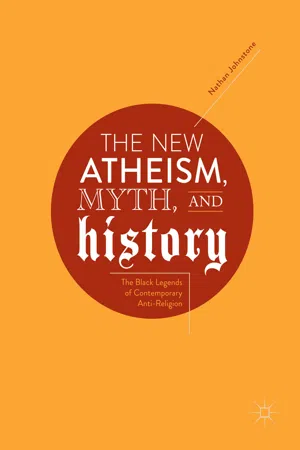
The New Atheism, Myth, and History
The Black Legends of Contemporary Anti-Religion
- English
- ePUB (mobile friendly)
- Available on iOS & Android
eBook - ePub
About this book
Trusted by 375,005 students
Access to over 1 million titles for a fair monthly price.
Study more efficiently using our study tools.
Information
© The Author(s) 2018
Nathan JohnstoneThe New Atheism, Myth, and Historyhttps://doi.org/10.1007/978-3-319-89456-0_11. Introduction: History and the New Atheism
What does it mean to live ‘in the shadow of God’? In his book, The End of Faith , the neuroscientist and anti-religious campaigner, Sam Harris , instructs us: to understand, look to history .
Look to the medieval Inquisition which systematically tortured and murdered vast numbers of people simply for doubting the Christian scriptures, or for the crime of being Jewish, or because they were believed capable of witchcraft . Look to the Holocaust : six million dead because of a religious hatred ingrained so deeply into European society that it poisoned even the secular cultures of the nineteenth and twentieth centuries. Look to history and understand that in the shadow of God resides ignorance and fear, hatred and oppression, violence and the implacable will to destroy on the basis only of what one thinks, but does not know, about the world. 1
To many secularists such an argument requires little more than an agreeing nod of the head. The image of the deranged inquisitor, or of the innocent ‘witch’ burning at the stake, are so fixed in our culture that we need only a single word to trigger a cascade of associations and moral judgements. Harris is elaborating upon a truth that we believe we already know. If we are surprised momentarily by his juxtaposition of the Holocaust with the Inquisition , he need only remind us that without religion there would be no Jews to murder, and that the pursuit of a racial utopia was an act pure unreasoning faith . It takes a mind (mis)shaped by the intellectual habits of religion to believe totalitarianism ’s ‘outlandish dogmas…working ineluctably like the gears of some ludicrous instrument of death .’ 2
But beneath the apparent familiarity this is, in fact, a remarkably assertive use of history . The Inquisition and the Holocaust , Harris explains, allow him to ‘intimate, in as concise a manner as possible, some of the terrible consequences that have arisen, logically and inevitably, out of Christian faith .’ 3 Religion ’s drive towards the ‘depths of human depravity’ is innate, inescapable and unparalleled. It is history that records the crimes perpetrated when faith was the dominant cultural force. It is history , then, that shows us religion in its natural state, not only what it can be, but what it will be unless acted on by some external restraining influence. We see what fundamentalism is, and what lurks within ‘moderate’ faith . The God debate is conceptualised as a literal battle between past and present, between a modernist secularism striving to fulfil humanity’s potential for rational progress and the leaden anachronism of the supernatural, philosophically impotent but still wielding enormous power. Understand Islam , then, ‘as though a portal in time has opened, and fourteenth-century hordes are pouring into our world.’ 4 Harris’ language is often the most intemperate of the ‘New Atheists’ , but his sense of history , of religion as history , and of its polluting the present, is quite typical.
What is also remarkable, then, given the scale of the historical claims being made here on their behalf, is how few secularists have seriously asked whether Harris or his colleagues are right.
A Question Only for Science ?
Harris’ book, along with others written by Richard Dawkins , Christopher Hitchens , Daniel Dennett and Victor Stenger , would introduce the ‘New Atheism .’ 5 It was greeted by many secularists as an encouragingly militant rejection of the cultural dominance of faith , and one that was long overdue. With the ensuing media ‘God debate’, and with the unprecedented growth of anti-religionism online, the position has become the most prevalent current expression of opposition to religion in North America and Great Britain. Yet, whilst objections to the New Atheism have been raised by non-believers, extensive and sustained investigations of many of its arguments remain rare, and a number of its most striking claims all but untested. This book is one such study, examining specifically the use—and, I will conclude, the misuse —of history in New Atheist polemic.
My emphasis might at first appear strange. The immediate impression taken from the New Atheists will likely be that their overriding concern is to subject religious belief to the negative scrutiny of science . The New Atheism , it would appear, rehearses and extends the contest between science and theology over where resides the most trustworthy base for our knowledge of the world and of our place within it. Science is to be imposed as the benchmark by which theological claims are to be conceded any credibility, with the result that they are conceded none. The more social and cultural aspects of the debate will appear, if not strictly secondary, then at least consequential. It is the authority of science that the New Atheists claim for their attacks on religion and so it is as scientists , or as lay promoters and defenders of science , that they should be judged.
Such an impression is deceptive. Whilst understandable, the focus of the God debate on scientific naturalism and justifications for belief has overshadowed the fact that much of the New Atheist critique of religion is actually based in areas such as politics, sociology, ethics , philosophy, cultural studies, education, criminology, literature and, of course, history . If science provides the yardstick for determining the extent of religion ’s factual inaccuracy, it is here that evidence will be found for the ways in which such false beliefs affect our lives. Politics, for instance, will chart the terrible artificiality of conflicts over ‘sacred’ space and ‘holy’ law . Sociology will show the oppression that results from giving the status of holy writ to castes, and to hierarchies of gender and sexuality. Ethics will expose the emptiness of claims that religion makes us more moral, criminology that it makes us more law -abiding, and both will reveal that such accolades ought properly to go to rationalist humanism and the secular communities it inspires.
In short, when the New Atheists turn their attention to making their case for the societal malevolence of religion , they turn from science to the humanities .
This is far from a secondary concern. For despite the New Atheists being able to communicate a sense that belief without scientific evidence is an offence to human dignity and a crisis in itself, it is the claim that such beliefs have uniquely destructive personal, social and even global consequences that gives their polemic a more convincing urgency.
Consider Harris’ ‘dangerous idea’, offered to the Edge web-salon in 2006, that atheistic intolerance should be the duty of every scientist. He assures us that the relationship between science and religion is ‘(very nearly) zero-sum’, and so our neighbours simply cannot be left to choose to believe that Jesus was born of a virgin or that Muhammad flew to heaven on a winged horse. Scientists must take these ‘hallowed travesties’ from believers, must lay claim themselves to the real experience of the transcendent (‘non-ordinary states of consciousness’) and wrest from religion the human need for ceremony , that we might mark out the profound moments in our lives ‘without lying to ourselves about the nature of reality.’ 6
Yet if the issue really were only virgin births and flying horses even those of us moved by the scientist’s cri de coeur might find the call to a cultural war over such things difficult to stomach. Would we not perhaps think the level of Harris’ belligerence to be disproportionate? Our impatience with supernaturalism is unlikely to move many of us to enlist in his campaign of proactive intolerance, because, as he tacitly admits, for most of us it is an irritation only, however keenly felt. But what might motivate us is the fear of the most extreme religious views gaining political and military power. The issue ceases to be one that can be met with detached perplexity when Harris can offer us, as he does here, images of theocrats banning life-saving medical research, of future US presidents making foreign policy with an eye to the End-Times and of jihadists armed with nuclear weapons . These, he assures us, are the inevitable consequences of allowing basic, even apparently inconsequential supernaturalism to go unchallenged. 7
The same technique shapes even the more positive expressions of New Atheism . In the opening to The God Delusion (2006) Richard Dawkins explains that the book’s purpose is to help faltering believers ‘break free’ of religion and so access a more enriched relationship with the world. He will guide them in abandoning the undignified mental habits that shield their faith...
Table of contents
- Cover
- Front Matter
- 1. Introduction: History and the New Atheism
- Part I. Black Legends
- Part II. Minds in Opposition
- Part III. The Innocence of Atheism
- Back Matter
Frequently asked questions
Yes, you can cancel anytime from the Subscription tab in your account settings on the Perlego website. Your subscription will stay active until the end of your current billing period. Learn how to cancel your subscription
No, books cannot be downloaded as external files, such as PDFs, for use outside of Perlego. However, you can download books within the Perlego app for offline reading on mobile or tablet. Learn how to download books offline
Perlego offers two plans: Essential and Complete
- Essential is ideal for learners and professionals who enjoy exploring a wide range of subjects. Access the Essential Library with 800,000+ trusted titles and best-sellers across business, personal growth, and the humanities. Includes unlimited reading time and Standard Read Aloud voice.
- Complete: Perfect for advanced learners and researchers needing full, unrestricted access. Unlock 1.4M+ books across hundreds of subjects, including academic and specialized titles. The Complete Plan also includes advanced features like Premium Read Aloud and Research Assistant.
We are an online textbook subscription service, where you can get access to an entire online library for less than the price of a single book per month. With over 1 million books across 990+ topics, we’ve got you covered! Learn about our mission
Look out for the read-aloud symbol on your next book to see if you can listen to it. The read-aloud tool reads text aloud for you, highlighting the text as it is being read. You can pause it, speed it up and slow it down. Learn more about Read Aloud
Yes! You can use the Perlego app on both iOS and Android devices to read anytime, anywhere — even offline. Perfect for commutes or when you’re on the go.
Please note we cannot support devices running on iOS 13 and Android 7 or earlier. Learn more about using the app
Please note we cannot support devices running on iOS 13 and Android 7 or earlier. Learn more about using the app
Yes, you can access The New Atheism, Myth, and History by Nathan Johnstone in PDF and/or ePUB format, as well as other popular books in Social Sciences & European History. We have over one million books available in our catalogue for you to explore.