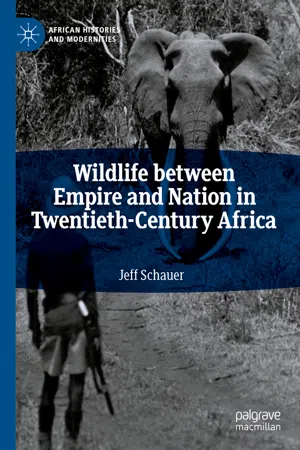
This book traces the emergence of wildlife policy in colonial eastern and central Africa over the course of a century. Spanning from imperial conquest through the consolidation of colonial rule, the rise of nationalism, and the emergence of neocolonial and neoliberal institutions, this book shows how these fundamental themes of the twentieth century shaped the relationships between humans and animals in what are today Kenya, Tanzania, Uganda, Zambia, and Malawi. A set of key themes emerges—changing administrative forms, militarization, nationalism, science, and a relentlessly broadening constituency for wildlife. Jeff Schauer illuminates how each of these developments were contingent upon the colonial experience, and how they fashioned a web of structures for understanding and governing wildlife in Africa—one which has lasted into the twenty-first century.
Trusted by 375,005 students
Access to over 1.5 million titles for a fair monthly price.
Jeff SchauerWildlife between Empire and Nation in Twentieth-Century AfricaAfrican Histories and Modernitieshttps://doi.org/10.1007/978-3-030-02883-1_1
Begin Abstract
1. Introduction
Jeff Schauer1
(1)
University of Nevada, Las Vegas, NV, USA
Jeff Schauer
End Abstract
In mid-2016, the first suggestion that an internet search for “cecil” yielded was not “Cecil Rhodes,” mineral magnate, privateer, and imperialist. Instead it was “cecil the lion.” Thisfeline“Cecil” died in July 2015 in the same part of Zimbabwe where its imperial namesake violently dismantled the Ndebele kingdom. Global audiences interpreted Cecil’s death as a tragedy. The lion was shot under questionable legal circumstances by a Minnesotan dentist.1 This event was remarkable not because an animal was killed for sport. The Epic of Gilgamesh and Arthashastra, ancient texts from the Middle East and South Asia, documented the cultural, status-affirming, and state-building character of hunting. Louis XVI’s diary before the French Revolution had less to say about politics than his participation in the chase.2 Many of us have seen Theodore Roosevelt’s toothy grin alongside animals he bagged on his Africansafari.
Cecil’s death was exceptional because of the international reaction. Celebrities and citizens around the world condemned the hapless dentist who received death threats and fled to his Florida vacation home.3 A Zimbabwean minister’s reply to international reporters’ queries was studiously nonchalant: “What lion?” One Zimbabwean interviewed by Reuters wondered, “Why are the Americans more concerned than us? We never hear them speak out when villagers are killed by lions andelephants in Hwange [National Park].”4 Despite the studied disdain of Zimbabwean ministers and the skepticism of some citizens, the country’s wildlife agency sought to placate global onlookers, reflecting safari operators’ calculations of the damage to their industry.5Cecil’s story involved global lobbies and sentiments claiming an animal in an African state in a fashion that left the government and citizenry of that state uneasy. Global advocates’ concern and Zimbabweans’ ambivalence were products of conflicts and negotiations about the place of wildlife in nation-states. These contestations originated in the colonial period in Africa and resonate into the present. Then as now, parks and other spaces where people encounter wildlife were political sites that shed light on local, national, and global power relations.
This book documents how major shifts in the twentieth century shaped the trajectory of wildlife policy in eastern and central Africa. In the early years of the twentieth century, wildlife policy was molded by a small but influential imperial lobby in London. Between the 1920s and 1950s, a period characterized by intensification of both colonial control and anti-colonial resistance, the policy arena was dominated by a much more complex and diverse colonial state and society. A drawn-out and incomplete process of decolonization between the 1950s and 1970s saw wildlife become contested by global publics, international organizations, and newly independent but not fully sovereign African states. In short, sites of policymaking and debate about wildlife shifted first from the imperial metropole to the colonies, and then to nation-states that struggled for control with international organizations, replicating and informing broader contestations of power unfolding amid decolonization.
The contest to control wildlife policy and resources bore the imprints of a general colonial experience, widely highlighted in existing literature on conservation in Africa. But it also reflects a set of contingent developments, best understood through five core themes: administration, militarization, nationalism, science, and a relentlessly broadening constituency for wildlife. Specific and competing colonial forms of bureaucracy structured the nature of wildlife departments at their founding, while colonial mentalities and methods of rule made particular forms of violence central to wildlife preservation at specific moments. Nationalist claims helped to determine the contested and contingent forms taken by national parks in the postwar and national eras, while the attachment of scientists to an international conservation regime that compromised the sovereignty of new states lent a political quality to work that those scientists believed to be neutral. Finally, as the array of interests contributing to the politics of wildlife in Africa recovered from the constriction imposed by the initial colonial conquest, it broadened, ensuring that African wildlife was claimed by a cast of characters not dissimilar to those who weighed in on the fate of Zimbabwe’scelebrity lion.
Wildlife between Empire and Nation in Twentieth-Century Africaranges across national and continental borders, involving a broad range of actors. British and international conservationists operated from Western headquarters, but most of the focus is on the African territories that began the twentieth century as colonies, and entered the twenty-first century as firmly established nation-states. The story encompasses, albeit unevenly, what are today Kenya, Tanzania, Uganda, Zambia, andMalawi. Imperial and globaladvocates, gamewardens, and park managers all exhibited abiding interest in wildlife, and emerge from the records of wildlife departments held by national archives or private collections in Kenya, Tanzania, Uganda, Zambia, and Britain. Buthunters, headmen, farmers, nationalists, and missionaries also shaped the politics of wildlife because of the intersections between animals and other spheres of colonial society. Their concerns with wildlife appeared in unintuitive corners of the archives: reports of mission stations and district officers, legal cases, and legislative debates. British archives, the records of cultural and scientific institutions, and journalism highlight the roles of international scientists, a British prince, and post-independence presidents. These diverse constituencies shaped colonial, national, and global trajectories of wildlife policymaking in Africa, illustrating points of connectivity and disjuncture between locales, claims, and periods.
The territory at the heart of this narrative of power and conservation is defined in geographic terms by the lakes, depressions, and highlands of the Great Rift Valley that runs from the north of Kenya to the Muchinga Escarpment in Zambia. It is also a region given coherence by colonial archives and by the people who crafted wildlife policy during the colonial era. These states were the object of surveys and reports that treated them as a unit, creating paths for the circulation of knowledge and methods and personnel. They also had similar trajectories toward independence, a common colonial ruler, and large wildlife populations. The region shared a moment of decolonization which proved crucial for states’, citizens’, and a global audience’s understanding of their wildlife and parks in ways that were not true of other regions in Africa, or of neighboring Zimbabwe to the south, not included here because of key chronological differences, its intense form of settler colonialism, and colonial frameworks for conservation. Conservation organizations frequently grouped them for fundraising and project-implementation purposes. A colonial experience and place in the global imagination, in other words, make these particular African states most crucial for understanding the connections between the imperial, national, and global spheres (Fig. 1.1).
Fig. 1.1
Africa amid the transition from empire to nation-state. (United States Central Intelligence Agency, Africa, May, [Washington, DC: Central Intelligence Agency, 1965], https://loc.gov/item/97687655/)
The book’s chapters provide additional detailed context for places and events as we encounter them, but for readers unfamiliar with eastern and central Africa’s history, a brief overview of the historical and scholarly background follows. Histories of the region that document lives and trajectories rich in meaning and achievement before the brief if influential colonial era also establish context for encounters with colonialism and African people’s paths to and through independence. The people of what were briefly Britain’s African colonies from Zambia to Kenya had different experiences of empire and independence. It is an important commonplace to stress that the nation-states of the national era were themselves colonial constructions, and comprised people who identified with many ethnicities, spoke a variety of languages, and had ancestors who lived in different precolonial states and societies.
Prior to colonization, the East African coast—including Kenya and Tanzania—was dominated by coastal entrepots and plantations built around cities and inland networks, defined by a cosmopolitan identity, the growing significance of KiSwahili, and economic orientation both toward inland states and the Indian Ocean. At the time of the British conquest, much of the Swahili coast was part of an Omani sphere of influence. The area around the Great Lakes—including Uganda—was defined by the presence of large, and during the nineteenth century, expansionist states, the complexity and ambition of which captured the imagination of British colonizers. The Buganda kingdom was perceived as a useful British ally, a...
Table of contents
Cover
Front Matter
1. Introduction
2. Imperial Ark: Imperial Preservationists and African Wildlife
3. Governing the Game: Expertise, Administration, and the Making of Colonial Wildlife Policy in Uganda and Northern Rhodesia
4. Government Cattle: Anti-Wildlife Politics in East and Central Africa
5. Deferring Uhuru: Decolonization and the Coming of the Global Wildlife Preservation Movement
6. Pachyderms and Parks: Ecological Politics and East Africa’s National Parks
7. National Conservation: Kenya, Britain, and World Bank and Global Entanglements
8. Conclusion
Back Matter
Frequently asked questions
Yes, you can cancel anytime from the Subscription tab in your account settings on the Perlego website. Your subscription will stay active until the end of your current billing period. Learn how to cancel your subscription
No, books cannot be downloaded as external files, such as PDFs, for use outside of Perlego. However, you can download books within the Perlego app for offline reading on mobile or tablet. Learn how to download books offline
Perlego offers two plans: Essential and Complete
Essential is ideal for learners and professionals who enjoy exploring a wide range of subjects. Access the Essential Library with 800,000+ trusted titles and best-sellers across business, personal growth, and the humanities. Includes unlimited reading time and Standard Read Aloud voice.
Complete: Perfect for advanced learners and researchers needing full, unrestricted access. Unlock 1.5M+ books across hundreds of subjects, including academic and specialized titles. The Complete Plan also includes advanced features like Premium Read Aloud and Research Assistant.
Both plans are available with monthly, semester, or annual billing cycles.
We are an online textbook subscription service, where you can get access to an entire online library for less than the price of a single book per month. With over 1.5 million books across 990+ topics, we’ve got you covered! Learn about our mission
Look out for the read-aloud symbol on your next book to see if you can listen to it. The read-aloud tool reads text aloud for you, highlighting the text as it is being read. You can pause it, speed it up and slow it down. Learn more about Read Aloud
Yes! You can use the Perlego app on both iOS and Android devices to read anytime, anywhere — even offline. Perfect for commutes or when you’re on the go. Please note we cannot support devices running on iOS 13 and Android 7 or earlier. Learn more about using the app
Yes, you can access Wildlife between Empire and Nation in Twentieth-Century Africa by Jeff Schauer in PDF and/or ePUB format, as well as other popular books in History & African History. We have over 1.5 million books available in our catalogue for you to explore.