- 46 pages
- English
- ePUB (mobile friendly)
- Available on iOS & Android
eBook - ePub
About this book
This publication suggests how Pakistan could strengthen solid waste management and in doing so reduce its greenhouse gas (GHG) emissions. It provides guidance on improving and expanding waste collection and disposal services for municipal, industrial, electronic, and hospital waste. It outlines waste management options and key considerations in setting up a waste management system. The publication also discusses consolidating data on the waste generated, developing a waste management strategy, calculating historical emissions from the waste sector and projections, and establishing an institutional framework.
Tools to learn more effectively

Saving Books

Keyword Search

Annotating Text

Listen to it instead
Information
1 Introduction
Pakistan generates 30 million metric tons1 of municipal solid waste2 (MSW) yearly, according to recent estimates. Moreover, a substantial increase in the coming years is foreseen due to rapid population growth, urbanization, and economic development. Overall, about 50% of this generated waste is collected. But the rate varies by locality, from 80% in larger cities to minimal in most rural areas (Mihai and Grozavu 2019). As for waste disposal, managed landfill sites are almost nonexistent. Urban waste is typically left uncollected or dumped on open ground. Pakistan urgently needs a waste road map for its policy makers, to make progress toward better health for its people, reduce the contamination of land and water sources, quantify greenhouse gas (GHG) emissions more effectively, and improve aesthetics.
GHG emission estimates for the waste sector are found in Pakistan’s National Communication (MOCC, Pakistan, 2018), and in the Nationally Determined Contribution (NDC) submitted by the government to the United Nations Framework Convention on Climate Change (UNFCCC) (Government of Pakistan 2016).3 Pakistan is a signatory to the Paris Agreement and has committed in its NDC to reducing 20% of anticipated GHG emissions in 2030,4 subject to the availability of international funding to meet the abatement cost. However, the emission estimates for the waste sector are marred by uncertainties and no mitigation actions have been devised. Improving the accuracy of historical and projected GHG emission estimates is a critical need, and so is instituting mitigation actions to reduce emissions from this sector.
2 Objectives of the Road Map
This road map for Pakistan’s solid waste management sector covers both the management of waste and assessment of GHG impact.
The road map has the following objectives:
• to reduce the negative impact of waste mismanagement on the environment, economy, and society;
• to minimize waste generation and maximize resource efficiency, across the product life cycle; and
• to promote synergy among local, provincial, and national efforts, plans, and programs in implementing waste management goals and objectives, including the NDC targets and United Nations Sustainable Development Goals (SDGs), among others.
3 Current Waste Management Situation In Pakistan
Municipal Waste
The country’s current system of municipal waste management is far from satisfactory. The services are, by and large, provided by municipalities and limited to partial collection and open dumping or burning. A snapshot is provided below to serve as baseline for the development of the road map and a more sustainable system. No reliable national study has been made to determine the overall quantity of waste generated in the country, but estimates drawn from various sources are shown in Table 1.
Table 1: Waste Generation, Treatment, and Disposal Estimates, Pakistan

kg = kilogram.
Note: Pakistan’s large cities had a total population of 52 million in 2017; medium-sized and small cities, 32 million; and rural areas, 126 million. Large cities and most medium-sized and small cities dispose of waste in uncontrolled dumpsites, away from the cities. In rural areas, waste is scattered or burned in the outskirts of villages.
a Recovery rates have been reduced following the closure or partial operation of refuse-derived fuel (RDF) plants in Lahore, Multan, and Wah Cantonment, and the composting facility in Lahore.
b A few intermediate-sized cities like Bahawalpur and Sialkot are exceptions, with collection rates of more than 80%.
Sources: Batool, Chaudhry, and Majeed (2008); Government of Pakistan (2017); authors’ compilation from waste analysis and characterization studies over the past decade, in around 15 cities in Pakistan; assessment of data collected in 2015–2020 from waste management/utility companies in Faisalabad, Gujranwala, Lahore, Multan, Peshawar, and Rawalpindi; and analysis of available data from the cities of Dera Ghazi Khan (2018), Hafizabad (2015), Okara (2015), and Sahiwal (2016–2017).
Waste analysis and characterization studies. Once waste is collected, data on the amounts of waste generated and its composition must be gathered. The data can then feed into the waste management strategy and provide GHG inventory compilers with the information they need to estimate historical and projected emissions from the waste sector. An estimate of the current composition of household waste is provided in Table 2.
Table 2: Estimated Waste Characterization Percentages

mm = millimeter.
Source: Authors’ compilation from waste analysis and characterization studies over the past decade in around 15 cities in Pakistan.
Industrial Waste
Industrial waste includes all wastes resulting from construction and demolition, manufacturing, agricultural operations, wholesale trade, mining, and other activities. A distinction should be made between scrap (materials that can be recycled at a profit) and solid wastes (those that are beyond economical reclamation) (Tchobanoglous and Kreith 2002).
Electronic Waste
According to an academic study, waste electrical and electronic equipment (WEEE), or e-waste, generated in Pakistan amounts to 1.68 kilograms per capita per year (Iqbal et al. 2015), or about 2% of the country’s municipal waste total.5 In addition, Pakistan receives a large amount of e-waste in various forms, less than 2% of which can be reused (Hashmi and Varma 2019). The unused material is recycled informally by workers, including women and children, without safety precautions. Although available information about the exposure of workers and impact on the environment is limited, the increasingly significant contribution of e-waste to health and environment concerns cannot be doubted. Formal recycling sites, similar to those in the People’s Republic of China (PRC) and India, must be developed in Pakistan to protect laborers and the environment, and health awareness programs should be carried out.
Health-Care Waste
The country generates hospital waste at a rate of about 0.667 kilograms per hospital bed per day, on average (Ali, Wang, and Chaudhry 2016). About 10%–25% of this waste (Hashmi and Varma 2019) is infectious, and hence hazardous. Owing to poor sanitation practices, the hazardous waste is mixed with general waste, potentially worsening the problem of waste management. Proper management of health-care waste is therefore vital for public health and the environment. Hospital waste in Pakistan is regulated by the Hospital Waste Management Rules, 2005 (HWMR), issued by the Ministry of Environment in August 2005 (Ministry of Environment, Pakistan, 2005).
4 Waste Management Hierarchy
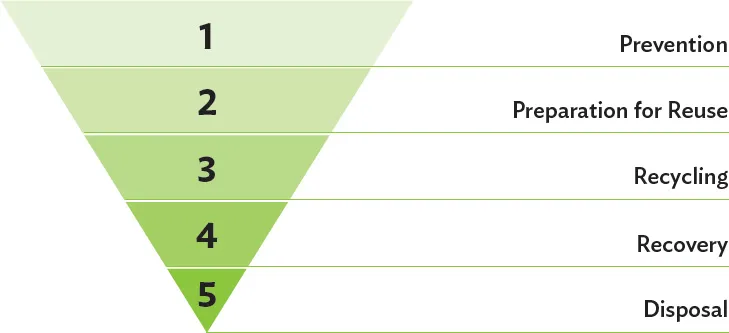
The waste management hierarchy provides an overarching vision for the Pakistan waste sector, to reduce the use of natural resource and impact on the environment. Waste prevention is of the highest priority, followed by reuse, recycling, recovery, and, as a last resort, waste disposal.
The aim is to move to a “circular economy,” where the value of products and materials is maintained for as long as possible, and waste and resource use are minimized (European Commission, n.d.[a]). But more than improved waste management, the transition toward a circular economy calls for creativity and innovation in design, reverse logistics, and innovative business models. Three essential ambitions will facilitate this shift: (i) designing products, components, and materials for longer use; (ii) enhancing reverse logistics, remanufacturing, parts harvesting, and recycling processes; and (iii) putting the right enabling conditions in place.
Without intervention, market conditions in Pakistan are unlikely to support the prioritization of the waste hierarchy outlined in Figure 1 and Table 3. For example, disposing of waste in an open/controlled dumpsite is generally cheaper than recycling waste or recovering energy from it (EEA 2009). The operational components must also be given priority. Investing limited resources in state-of-the-art systems in a few large cities, or providing at least a basic level of service across the board, would achieve this purpose.
Figure 1: The Waste Hierarchy
Source: European Commission (n.d.[b]).
Table 3: Waste Hierarchy Definitions
Stage | Includes |
Prevention | Using less material in design and manufacture; extending the life of products; using less hazardous materials |
Reuse | Checking, cleaning, repairing, refurbishing whole items or spare parts |
Recycling | Turning waste into a new product or substance. This includes composting. |
Recovery | Including anaerobic digestion; incineration with energy recovery, gasification, and pyrolysis, producing materials and energy from waste; and backfilling |
Disposal | Landfilling and incinerating waste without energy recovery |
* “Backfilling” refers to any recovery operation where suitable nonhazardous waste is used for reclamation in excavated areas or for landscape engineering.
Source: European Commission (n.d. [b]).
Japan and the European Union (EU) have reached an advanced stage in the development and application of environmental policies in the waste sector, an...
Table of contents
- Front Cover
- Title Page
- Copyright Page
- Contents
- Tables and Figures
- Foreword
- Acknowledgments
- Abbreviations
- Executive Summary
- 1 Introduction
- 2 Objectives of the Road Map
- 3 Current Waste Management Situation in Pakistan
- 4 Waste Management Hierarchy
- 5 Key Considerations in Developing the Road Map
- 6 Steps in Developing the Road Map
- 7 Waste Management and Greenhouse Gas Emissions
- 8 Capacity Building for the Implementation of the Road Map
- 9 Financing the Waste Management Road Map
- 10 Summary and Conclusions
- Appendix: Memorandum of Understanding Template
- References
- Footnotes
- Back Cover
Frequently asked questions
Yes, you can cancel anytime from the Subscription tab in your account settings on the Perlego website. Your subscription will stay active until the end of your current billing period. Learn how to cancel your subscription
No, books cannot be downloaded as external files, such as PDFs, for use outside of Perlego. However, you can download books within the Perlego app for offline reading on mobile or tablet. Learn how to download books offline
Perlego offers two plans: Essential and Complete
- Essential is ideal for learners and professionals who enjoy exploring a wide range of subjects. Access the Essential Library with 800,000+ trusted titles and best-sellers across business, personal growth, and the humanities. Includes unlimited reading time and Standard Read Aloud voice.
- Complete: Perfect for advanced learners and researchers needing full, unrestricted access. Unlock 1.4M+ books across hundreds of subjects, including academic and specialized titles. The Complete Plan also includes advanced features like Premium Read Aloud and Research Assistant.
We are an online textbook subscription service, where you can get access to an entire online library for less than the price of a single book per month. With over 1 million books across 990+ topics, we’ve got you covered! Learn about our mission
Look out for the read-aloud symbol on your next book to see if you can listen to it. The read-aloud tool reads text aloud for you, highlighting the text as it is being read. You can pause it, speed it up and slow it down. Learn more about Read Aloud
Yes! You can use the Perlego app on both iOS and Android devices to read anytime, anywhere — even offline. Perfect for commutes or when you’re on the go.
Please note we cannot support devices running on iOS 13 and Android 7 or earlier. Learn more about using the app
Please note we cannot support devices running on iOS 13 and Android 7 or earlier. Learn more about using the app
Yes, you can access Solid Waste Management Sector in Pakistan by in PDF and/or ePUB format, as well as other popular books in Technology & Engineering & Environmental Management. We have over one million books available in our catalogue for you to explore.