- 137 pages
- English
- PDF
- Available on iOS & Android
eBook - PDF
About this book
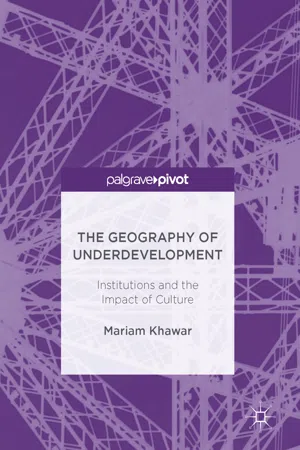
The central question at the heart of the book rests on why the differences in comparative development across the world have a geographical pattern. Past studies have argued for the primacy of geography or institutions as the reasons for these differences. The book will argue that there is a missing link in this puzzle the role of culture and its impact either directly on development or indirectly through the establishment of institutions. It will suggest that geography, which tends to be assigned a peripheral role through its influence on institutions, may be responsible for aspects of cultural evolution, which in turn have an effect on institutional development.
The relationship between geographical factors and economic development has historically been ignored by economists. However, views about the correlation between temperature and climate have been expressed in works dating as far back as Montesquieu (1748) and Huntington (1915). The first part of the book will present research that examines specific features of climate, namely temperature and rainfall, as possible factors that might influence productivity and hence income per capita across countries.
At the same time another group of researchers have argued that it is not geography per se that has dictated the fortunes of countries but the institutions that were in place in those countries that eventually determined whether they would succeed or not. The 'geography versus institutions' hypothesis has enjoyed a vigorous debate in the literature. A seminal paper in the field allows for an indirect effect of geography by arguing that those countries whose climates were more suited to settlement by white Europeans developed more participatory and democratic institutions whereas those countries in which Europeans had higher mortality rates due to diseases to which they had no immunity (the effect of an inhospitable climate), were exploited and thus the institutions that developed were reflective of that legacy (colonialism).
Thus, the second part of the book will visit the issues posed above, by examining the case of the United States and drawing parallels between regional disparities in the U.S. and global disparities between developing and industrialized countries. The U.S. is an excellent example of a geographically (and climatically) diverse area where there was considerable disparity amongst the states in income per capita 130 years ago. The book will explore what economists and historians have written, about the reasons for the divergence in income in the pre-1940 South and then build the case for a comparison of the South to contemporary developing countries. Using empirical data on labour productivity and climate, evidence will be discussed which shows that both geography (location and climate) as well as institutions played significant roles in shaping the economic successes of U.S. states, although the effects of these variables have dissipated over time.
However, the question of how institutions themselves are formed is still not satisfactorily answered. This is an issue that economists have consistently struggled with since it involves notions of culture which are not clearly defined in economic theory. Economists have also ignored the contributions of other disciplines, especially anthropology and sociology where more well-defined notions of culture exist.
The third part of the book will make a case for the link between geography, culture and institutions. Two questions are asked. First, does geography influence culture and secondly, does culture influence institutions? The importance of cultural beliefs and practices in influencing economic development is presented as a missing link in the chain of causality from geography to economic development. Neo-Darwinian theories of cultural evolution facilitate this explanation because of the findings that certain cultural traits are influenced by environmental conditions. In addition, recent studies by psychologists have traced cultural differences between individualist and collectivist societies to differences in agricultural practices in rice versus wheat growing societies.
Using anthropological data on cross-cultural traits obtained from the Standard Cross-Cultural Sample, evidence will be discussed to suggest a link between geography and culture. An additional contention will be that the existing studies which have found an indirect role for geography through its impact on institutions via colonisation still leave unanswered the question of what enabled the colonisers to be the aggressors and the native habitants of those regions to be colonised. The book will close the loop on that question by demonstrating that geography influences culture, which in turn can affect institutional development.
Trusted by 375,005 students
Access to over 1.5 million titles for a fair monthly price.
Study more efficiently using our study tools.
Information
Table of contents
- The Geography of Underdevelopment
- 1 Whither Geography? Reviewing its Impact on Economic Development
- 2 Pinpointing the Tropical Effect – The Relevance of Climate
- 3 North Versus South – An Examination of Regional Comparative Development in Italy and Brazil
- 4 Did Geography Influence the United States?
- 5 Untangling Cultural Evolution and Economic Development
- 6 Connecting the Arrows – Geography, Culture, Institutions and Economic Development
- Appendices
- Bibliography
- Index
Frequently asked questions
Yes, you can cancel anytime from the Subscription tab in your account settings on the Perlego website. Your subscription will stay active until the end of your current billing period. Learn how to cancel your subscription
No, books cannot be downloaded as external files, such as PDFs, for use outside of Perlego. However, you can download books within the Perlego app for offline reading on mobile or tablet. Learn how to download books offline
Perlego offers two plans: Essential and Complete
- Essential is ideal for learners and professionals who enjoy exploring a wide range of subjects. Access the Essential Library with 800,000+ trusted titles and best-sellers across business, personal growth, and the humanities. Includes unlimited reading time and Standard Read Aloud voice.
- Complete: Perfect for advanced learners and researchers needing full, unrestricted access. Unlock 1.5M+ books across hundreds of subjects, including academic and specialized titles. The Complete Plan also includes advanced features like Premium Read Aloud and Research Assistant.
We are an online textbook subscription service, where you can get access to an entire online library for less than the price of a single book per month. With over 1.5 million books across 990+ topics, we’ve got you covered! Learn about our mission
Look out for the read-aloud symbol on your next book to see if you can listen to it. The read-aloud tool reads text aloud for you, highlighting the text as it is being read. You can pause it, speed it up and slow it down. Learn more about Read Aloud
Yes! You can use the Perlego app on both iOS and Android devices to read anytime, anywhere — even offline. Perfect for commutes or when you’re on the go.
Please note we cannot support devices running on iOS 13 and Android 7 or earlier. Learn more about using the app
Please note we cannot support devices running on iOS 13 and Android 7 or earlier. Learn more about using the app
Yes, you can access The Geography of Underdevelopment by Mariam Khawar in PDF and/or ePUB format, as well as other popular books in Economics & Development Economics. We have over 1.5 million books available in our catalogue for you to explore.