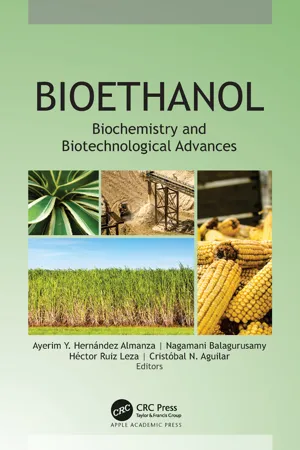
This new book, Bioethanol: Biochemistry and Biotechnological Advances, presents some insightful perspectives and important advances in the bioethanol industry. The volume goes into detail on the biochemical and physiological parameters carried out by the main bioethanol-producing microorganisms as well as the discusses the potential applications that bioproducts can have and the advantages they generate.
The chapter authors discuss a variety of issues, including the physiology of ethanol production by yeasts, by Zymomonas mobilis, and by Clostridium thermocellum. Other sources of biofuel, such as sweet sorghum, Agave americana L. leaves waste, and fungi are included as well. Chapters also discuss the genetic regulation and genetic engineering of principal microorganisms and then go on to address ways to increase ethanol tolerance in industrially important ethanol fermenting organisms, methods for developing sustainable fermentable substrates, and new strategies for ethanol purification. Chapters explore the design and engineering requirements for bioreactors, bioelectrosynthesis of ethanol via bioelectrochemical systems, and more.
The book will be a valuable resource for faculty and students in this area as well as for scientists, researchers, and managers in the biofuel industry in the area of biofuel production, fermentation process, environmental engineering and all other related scientific areas.
Trusted by 375,005 students
Access to over 1.5 million titles for a fair monthly price.
CHAPTER 1 Physiology of Ethanol Production by Yeasts
MIRIAM SOLEDAD VALENZUELA GLORIA,1 DIANA LAURA ALVA-SÁNCHEZ,1 M. P. LUÉVANOS ESCAREÑO,1 CRISTÓBAL N. AGUILAR,2 NAGAMANI BALAGURUSAMY,1 and AYERIM HERNÁNDEZ-ALMANZA1
1School of Biological Science, Autonomous University of Coahuila, Torreón–27000, Coahuila, Mexico, E-mail: [email protected] (A. Hernández-Almanza)
2Bioprocesses and Bioproducts Research Group, BBG-DIA, Food Research Department, School of Chemistry, Autonomous University of Coahuila, Saltillo–25280, Coahuila, Mexico
ABSTRACT
Yeasts have been gaining popularity due to their ability to produce a series of compounds of interest such as pigments, phenolic compounds, fatty acids, enzymes, and even under the right conditions, and they are ethanol producers. The latter is characterized by producing ethanol and carbon dioxide (CO2) under anaerobic conditions using fermentable sugars as substrates. To consider that yeast is suitable for the production of ethanol, it is desirable that it meets some characteristics of adaptability to the use of different sources of carbon and nitrogen, to acidity or low availability of glycerol, and even tolerance to high levels of ethanol concentration. In addition to these criteria, it is also important to consider that the fermenting strain must be able to use hexose and pentose and tolerate the inhibitory by-products of the pretreatment. In such a way that by manipulating both carbon and nitrogen sources, as well as environmental factors, it would be possible to increase or decrease ethanol production, which requires knowledge of the species to be used. This is widely used in the industry, in which over time, the use of ethanol has been diversifying more and more, so what began to be used in the food industry for the production of alcoholic beverages, today it is used for the production of sustainable alternative fuels, which have gained impact in recent years thanks to their profitable production thanks to the low cost of substrates and their efficient fermentation.
1.1 INTRODUCTION
Yeast can produce compounds of interest such as pigments, phenolic compounds, fatty acids, enzymes, among others. Also, yeasts have been used in various industrial fermentation processes due to their ability to convert high concentrations of sugars into ethanol and CO2; for example, Saccharomyces cerevisiae has been exploited for centuries for the production of alcoholic beverages. Currently, ethanol obtained from this via is an alternative to be used as a substitute for gasoline [1–3].
The ethanol that is produced through fermentation represents a positive alternative as fuel to petroleum, as a source of energy for batteries through electrochemical effects, as energy in the generation of energy by thermal combustion, etc. [4]. Ethanol is significantly less toxic to humans than is gasoline in such a way that it reduces air pollution thanks to its low volatility, photochemical, and waste activity [5]. Ethanol obtained from waste materials from biomass or renewable sources is called bioethanol, and it can be used as fuel, chemical raw material, and solvent in various industries.
The production of ethanol as liquid fuel is obtained by fermentation from biomass, sugar cane, cereal grains, and sugar beets, and it is gaining a lot of popularity around the world [4, 6]. If you have greater control of the fermentation conditions, this can contribute to the reduction of stress towards yeast cells and decrease contamination by bacteria and wild yeasts. Therefore, having large information gaps around the ethanol production processes, leading to large investigations in order to achieve the generation of higher quality products and more optimized processes [7].
1.2 PRINCIPAL ETHANOL-PRODUCING YEASTS
Ethanol-producing yeasts are characterized for producing ethanol and CO2 in anaerobic conditions using fermentable sugars as substrate [8]. The principal attributes for considering a good ethanol-producing yeast for their use in an industry are diverse as high tolerance levels of ethanol concentration, acidity, high temperature, low glycerol formation, capacity for use different sources of carbon and nitrogen. Also, it is important to observe the tolerance and inhibitors of the yeast in production about biomass hydrolyzed [9–12].
Saccharomyces cerevisiae is the more globally used yeast for industrial production of ethanol [13, 14]; Brazil, the United States, European Union (EU), and China being the main producers of ethanol (Renewable Fuels Association). Furthermore, S. cerevisiae is an ideal yeast for the industry due to easy manipulation with molecular methods such as genetic engineering since its genome has been extensively studied [15, 16]. The studies have been characterized for the improvement of the strains using by-products as substrate rich in sugars for the production of ethanol (Table 1.1). For example, yeasts such as Schizosaccharomyces pombe, Candida krusei, Kluyveromyces marxianus, Dekkera bruxellensis, Pichia striptis, Pichia kudriavzevii, Wickerhamomyces anomalous, among others; they have been isolated and identified as producing ethanol with good behavior and tolerant to high concentrations of alcohol (EtOH) [17–19].
The main factors that contribute to the low growth of yeasts in the process and that lead to high ethanol yields characterized in 90–92% of the theoretical conversion of sugar to ethanol are high cell densities, cell recycling, and high ethanol concentration [20–22].
1.3 BIOCHEMISTRY OF ETHANOL PRODUCTION
The generation of ethanol from lignocellulosic biomass (LCB) is possible through three stages. The first of them consists in allowing the biomass to have a better management through a treatment for the next stage, which consists of subjecting the treated biomass to an enzymatic hydrolysis process in order to improve the disposition of simple sugars, such as glucose and xylose. Finally, thanks to the availability of sugars, it is possible to carry out fermentation through the use of different microorganisms [9, 11, 24]. A generally simplified representation of the process for ethanol production from lignocellulosic materials by chemical hydrolysis is shown in Figure 1.1.
The treatment given to the biomass prior to enzymatic hydrolysis is nothing more than through different methods it is possible to modify its physicochemical properties in order to facilitate the enzymatic work. However, this can also bring consequences such as crystallization [24]. Parallel that, there is an increase in both the size of the internal surface and its pore volume; this being also an adjuvant for the enzymatic work [25]. In response to all of the above, there is a significant improvement in the yield rate of monomeric sugars [11].
TABLE1.1 Ethanol Production by Yeast Under Different Conditions
Yeast
Substrate (%)
pH
Temperature (°C)
Ethanol (%, v/v)
Condition
Reference
Saccharomyces cerevisiae (CDBT2)
Glucose (5)
5.5
30
19.8
Electrochemical cell (4V1)
[18]
Saccharomyces cerevisiae (UVNR56)
Molasses medium (28)
37
10.3
UV-C2 radiation
Saccharomyces cerevisiae UAF-1
Molasses media (27)
Adjusted 4.0-4.5
—
12.2
VHG3 technology
Wickerhamomyces anomalous (CDBT7)
Glucose (5)
5.5
30
23.7
Electrochemical cell (4V)
Kluyveromyces marxianus (YZB014)
Xylose (5)
-
45
5.2
Modified strain (recombinant)
Pichia stipitis (PXF58)
Xylose (11.4)
-
30
4.3
UV-mutagenesis4
[23]
1V = VOLTS;
2VGH = Very high gravity;
3UV-C = Ultraviolet-C;
4UV-mutagenesis = Ultraviolet mutagenesis.
FIGURE1.1 Rough diagram of the production of ethanol from lignocellulosic materials.
The complex and irregular reaction by which insoluble cellulose manages to defragment into solid-liquid interfaces thanks to the simultaneous action of cellobioses, exoglucanases, and endoglucanases, is better known as the enzymatic hydrolysis process. This primer reaction is accompanied by further liquid-phase hydrolysis of soluble intermediates, such as celluloli-gosaccharides and cellobiose, mainly, which through catalytic reactions are ungrouped in order to produce glucose through the action of ß-glucosidase [27]. In the short term, enzymatic hydrolysis is in charge to convert LCB to fermentable sugars through a series of biochemical processes.
Fermentation in this context comprises the action of submitting the LCB through a catabolic process of incomplete oxidation, which does not require oxygen, and which final product is an organic compound. Across this process, the pentoses and hexoses obtained from hydrolysis get fractioned thanks to the presence of fermenting microorganisms, such as some bacteria, algae, yeasts, and even some fungi, whether natural or recombinant [28].
In order to explain this complex process in a more comprehensible way we can say that central metabolism begins with the basic conversion of sugars to pyruvate, producing energy in the form of ATP and reduced NADH cofactors, where pyruvate divergence after glycolysis acts as an essential regulatory point in metabolism [11]. As a result of this process, pyruvate manages to have the choice of either following the fermentation route or breathing. In the case of eukaryotes, this depends on the presence of oxygen. That is, under aerobic conditions, pyruvate will be converted to acetyl-CoA by the actions of a pyruvate dehydrogenase and will be directed toward the citric acid cycle. In counterpart, under anaerobic conditions, pyruvate is diverted to fermentation [13]. Where, the ...
Table of contents
Cover Page
Half Title Page
Title Page
Copyright Page
About the Editors
Table of Contents
Contributors
Abbreviations
Acknowledgment
Preface
1 Physiology of Ethanol Production by Yeasts
2 Physiology of Ethanol Production by Zymomonas mobilis
3 Physiology of Ethanol Production by Clostridium thermocellum
4 Genetic Regulation of Principal Microorganisms (Yeast, Zymomonas mobilis, and Clostridium thermocellum) Producing Bioethanol/Biofuel
5 Metabolic Engineering of Yeast, Zymomonas mobilis, and Clostridium thermocellum to Increase Yield of Bioethanol
6 Increasing Ethanol Tolerance in Industrially Important Ethanol Fermenting Organisms
7 Challenges in Developing Sustainable Fermentable Substrate for Bioethanol Production
8 Emerging Strategies for Ethanol Purification
9 Design and Engineering Parameters of Bioreactors for Production of Bioethanol
10 Integrated Production of Ethanol from Starch and Sucrose
11 Conversion of Sweet Sorghum Juice to Bioethanol
12 Biotechnology Development of Bioethanol from Sweet Sorghum Bagasse
13 Bioethanol Production Using Agave americana L. Leaves Wastes from Coahuila
14 Sustainable Ethanol Production from Lignocellulosic Biomass: A Water Footprint Analysis over Pretreatment Technologies
15 Biodegradation and Biocatalysis Aspects of Direct Bioethanol Production by Fungi in a Single Step Named Consolidated Bioprocessing
16 Bioelectrosynthesis of Ethanol via Bioelectrochemical Systems: Future Perspectives
17 Challenges and Perspectives on Application of Biofuels in the Transport Sector
Index
Frequently asked questions
Yes, you can cancel anytime from the Subscription tab in your account settings on the Perlego website. Your subscription will stay active until the end of your current billing period. Learn how to cancel your subscription
No, books cannot be downloaded as external files, such as PDFs, for use outside of Perlego. However, you can download books within the Perlego app for offline reading on mobile or tablet. Learn how to download books offline
Perlego offers two plans: Essential and Complete
Essential is ideal for learners and professionals who enjoy exploring a wide range of subjects. Access the Essential Library with 800,000+ trusted titles and best-sellers across business, personal growth, and the humanities. Includes unlimited reading time and Standard Read Aloud voice.
Complete: Perfect for advanced learners and researchers needing full, unrestricted access. Unlock 1.5M+ books across hundreds of subjects, including academic and specialized titles. The Complete Plan also includes advanced features like Premium Read Aloud and Research Assistant.
Both plans are available with monthly, semester, or annual billing cycles.
We are an online textbook subscription service, where you can get access to an entire online library for less than the price of a single book per month. With over 1.5 million books across 990+ topics, we’ve got you covered! Learn about our mission
Look out for the read-aloud symbol on your next book to see if you can listen to it. The read-aloud tool reads text aloud for you, highlighting the text as it is being read. You can pause it, speed it up and slow it down. Learn more about Read Aloud
Yes! You can use the Perlego app on both iOS and Android devices to read anytime, anywhere — even offline. Perfect for commutes or when you’re on the go. Please note we cannot support devices running on iOS 13 and Android 7 or earlier. Learn more about using the app
Yes, you can access Bioethanol by Ayerim Y. Hernández Almanza,Nagamani Balagurusamy,Héctor Ruiz Leza,Cristóbal N. Aguilar in PDF and/or ePUB format, as well as other popular books in Technology & Engineering & Environmental Management. We have over 1.5 million books available in our catalogue for you to explore.