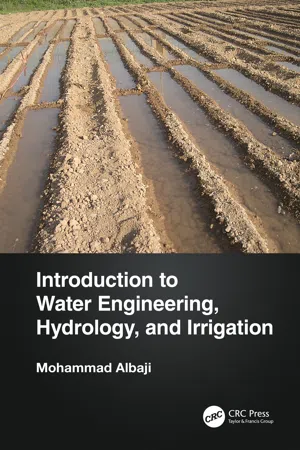
This book is designed as an undergraduate text for water and environmental engineering courses and as preliminary reading for postgraduate courses in water and environmental engineering- including introductory coverage of irrigation and drainage, water resources, hydrology, hydraulic structures, and more. The text and exercises have been classroom tested by undergraduate water and environmental engineering students and are augmented by material prepared for extramural short courses. It covers basic concepts of agricultural irrigation and drainage, including planning and design, surface intakes, economics, environmental impacts wetlands, and legal issues.
Features:
Numerous illustrations throughout to clarify the concepts presented
Examines and compares the advantages and disadvantages of several methods of irrigation practice
Explains the integral components including pumps, filters, piping, valves, and more
Considers fertilizer application and nutrient management
This comprehensive and well-illustrated book will be of great interest to students, professionals, and researchers involved with all aspects of water engineering, hydrology, and irrigation.
Trusted by 375,005 students
Access to over 1.5 million titles for a fair monthly price.
Hydraulic engineering as a sub-discipline of civil engineering is concerned with the flow and conveyance of fluids, principally water and sewage. One feature of these systems is the extensive use of gravity as the motive force to cause the movement of the fluids. This area of civil engineering is intimately related to the design of bridges, dams, channels, canals, and levees, and to both sanitary and environmental engineering.
Hydraulic engineering is the application of fluid mechanics principles to problems dealing with the collection, storage, control, transport, regulation, measurement, and use of water. Before beginning a hydraulic engineering project, one must figure out how much water is involved. A hydraulic engineer is concerned with the transport of sediment by the river, the interaction of the water with its alluvial boundary, and the occurrence of scour and deposition. “The hydraulic engineer actually develops conceptual designs for the various features which interact with water such as spillways and outlet works for dams, culverts for highways, canals and related structures for irrigation projects, and cooling-water facilities for thermal power plants” (Figures 1.1, 1.2, 1.3).
Figure1.2 View from Ahvaz cable bridge, Ahvaz, Iran (By Mohammad Albaji).
Figure1.3 Riprap lining a lakeshore; (https://en.wikipedia.org/wiki/Riprap).
Fundamental Principles
A few examples of the fundamental principles of hydraulic engineering include fluid mechanics, fluid flow, behavior of real fluids, hydrology, pipelines, open channel hydraulics, mechanics of sediment transport, physical modeling, hydraulic machines, and drainage hydraulics.
Fluid Mechanics
Fundamentals of hydraulic engineering define hydrostatics as the study of fluids at rest. In a fluid at rest, there exists a force, known as pressure, that acts upon the fluid's surroundings. This pressure, measured in N/m2, is not constant throughout the body of fluid. Pressure, p, in a given body of fluid, increases with an increase in depth. Where the upward force on a body acts on the base and can be found by equation:
where
ρ = density of water
g = specific gravity
y = depth of the body of liquid
Rearranging this equation gives you the pressure head p/ρg = y. Five basic devices for pressure measurement are a piezometer, manometer, differential manometer, Bourdon gauge, as well as an inclined manometer.
As Prasuhn states:
On undisturbed submerged bodies, pressure acts along all surfaces of a body in a liquid, causing equal perpendicular forces in the body to act against the pressure of the liquid. This reaction is known as equilibrium. More advanced applications of pressure are those on plane surfaces, curved surfaces, dams, and quadrant gates, just to name a few.
Behavior of Real Fluids
Real and Ideal Fluids
The main difference between an ideal fluid and a real fluid is that for ideal flow p1 = p2 and for real flow p1 > p2. Ideal fluid is incompressible and has no viscosity. Real fluid has viscosity. Ideal fluid is only an imaginary fluid as all fluids that exist have some viscosity.
Viscous Flow
A viscous fluid will deform continuously under a shear force, whereas an ideal fluid doesn't deform.
Laminar Flow and Turbulence
The various effects of disturbance on a viscous flow are stable, transition, and unstable.
Bernoulli's Equation
For an ideal fluid, Bernoulli's equation holds along streamlines.
Boundary Layer
Assuming a flow is bounded on one side only, and that a rectilinear flow passing over a stationary flat plate that lies parallel to the flow, the flow just upstream of the plate has a uniform velocity. As the flow comes into contact with the plate, the layer of fluid actually “adheres” to a solid surface. There is then a considerable shearing action between the layer of fluid on the plate surface and the second layer of fluid. The second layer is therefore forced to decelerate (though it is not quite brought to rest), creating a shearing action with the third layer of fluid, and so on. As the fluid passes further along the plate, the zone in which shearing action occurs tends to spread further outwards. This zone is known as the “boundary layer.” The flow outside the boundary layer is free of shear and viscous-related forces so it is assumed to act like an ideal fluid. The intermolecular cohesive forces in a fluid are not great enough to hold fluid together. Hence a fluid will flow under the action of the slightest stress and flow will continue as long as the stress is present. The flow inside the layer can be either viscous or turbulent, depending on the Reynolds number.
Applications
Common topics of design for hydraulic engineers include hydraulic structures such as dams, levees, water distribution networks, water collection networks, sewage collection networks, s...
Table of contents
Cover
Half Title
Title Page
Copyright Page
Contents
Preface
Author
Acknowledgments
Chapter 1 Hydraulic engineering
Chapter 2 River engineering
Chapter 3 Dams
Chapter 4 Hydroinformatics
Chapter 5 Hydrogeology
Chapter 6 Hydrology science
Chapter 7 Water resources science
Chapter 8 Aquatic ecosystem
Chapter 9 Water quality sciences
Chapter 10 Sewage treatment
Chapter 11 Surface irrigation
Chapter 12 Drip irrigation
Chapter 13 Sprinkler irrigation
Chapter 14 Water reuse for irrigation
Chapter 15 Irrigation system and structures
Chapter 16 Agricultural drainage
Index
Frequently asked questions
Yes, you can cancel anytime from the Subscription tab in your account settings on the Perlego website. Your subscription will stay active until the end of your current billing period. Learn how to cancel your subscription
No, books cannot be downloaded as external files, such as PDFs, for use outside of Perlego. However, you can download books within the Perlego app for offline reading on mobile or tablet. Learn how to download books offline
Perlego offers two plans: Essential and Complete
Essential is ideal for learners and professionals who enjoy exploring a wide range of subjects. Access the Essential Library with 800,000+ trusted titles and best-sellers across business, personal growth, and the humanities. Includes unlimited reading time and Standard Read Aloud voice.
Complete: Perfect for advanced learners and researchers needing full, unrestricted access. Unlock 1.5M+ books across hundreds of subjects, including academic and specialized titles. The Complete Plan also includes advanced features like Premium Read Aloud and Research Assistant.
Both plans are available with monthly, semester, or annual billing cycles.
We are an online textbook subscription service, where you can get access to an entire online library for less than the price of a single book per month. With over 1.5 million books across 990+ topics, we’ve got you covered! Learn about our mission
Look out for the read-aloud symbol on your next book to see if you can listen to it. The read-aloud tool reads text aloud for you, highlighting the text as it is being read. You can pause it, speed it up and slow it down. Learn more about Read Aloud
Yes! You can use the Perlego app on both iOS and Android devices to read anytime, anywhere — even offline. Perfect for commutes or when you’re on the go. Please note we cannot support devices running on iOS 13 and Android 7 or earlier. Learn more about using the app
Yes, you can access Introduction to Water Engineering, Hydrology, and Irrigation by Mohammad Albaji in PDF and/or ePUB format, as well as other popular books in Technology & Engineering & Hydrology. We have over 1.5 million books available in our catalogue for you to explore.