- 84 pages
- English
- ePUB (mobile friendly)
- Available on iOS & Android
eBook - ePub
Oil and Gas Engineering for Non-Engineers
About this book
Oil and Gas Engineering for Non-Engineers explains in non-technical terms how oil and gas exploration and production are carried out in the upstream oil and gas industry. The aim is to help readers with no prior knowledge of the oil and gas industry obtain a working understanding of the field.
- Focuses on just the basics of what the layperson needs to know to understand the industry
- Uses non-technical terms, simple explanations, and illustrations to describe the inner workings of the field
- Explains how oil is detected underground, how well locations are determined, how drilling is done, and how wells are monitored during production
- Describes how and why oil and gas are separated from impurities before being sent to customers
Aimed at non-engineers working within the oil and gas sector, this book helps readers get comfortable with the workings of this advanced field without the need for an advanced degree in the subject.
Tools to learn more effectively

Saving Books

Keyword Search

Annotating Text

Listen to it instead
Information
1 Introduction
DOI: 10.1201/9781003100461-1
1.1 What Is Crude Oil?
Oil is an integral part of our world today. It is in the clothes we wear, our cellphones, cosmetics, medication, and more. Let us not forget how important it is for transportation whether by land, air, or sea. It is the primary source of energy in the world, and as such, it is the most important commodity in the world.
Gas is usually produced alongside crude oil as a by-product. The composition of this associated gas can vary but often includes methane, also called natural gas, and propane. In some cases, associated gas is sold to help with the production of the crude oil. In other cases, it is an undesirable product so it is vented into the air, flared or burned in a controllable way, or re-injected into the reservoir. Flaring is increasingly being viewed as unsustainable and, of course, bad for the environment due to the global warming properties of methane. In some countries such as Nigeria, gas flaring is no longer allowed, leading to development of gas utilization projects. Natural gas can also be produced on its own from natural gas reservoirs. In this case, the gas is called non-associated gas.
Oil and gas are used to produce materials, fuels, electricity/heat, and petrochemicals. Materials include plastics and synthetic fabrics such as polyester, nylon, and rayon. Petrochemicals include fertilizers, medication, paint, and cosmetics. Fuels such as gasoline, diesel, and jet fuel are primarily used for transportation for cars, planes, and ships. In electricity generation, fuels such as natural gas, and heavy fuel oil, are combusted to generate steam. Uses of oil and gas are illustrated in Figure 1.1.

Figure 1.1 Products from oil and gas.
Crude oil is refined into different products by heating. At different temperatures, different fuels boiloff from the crude oil mixture. The typical products of refining are fuels, naphtha, and residue. The fuels include propane, butane, gasoline, jet fuel, kerosene, diesel, and fuel oil. Naphtha is used as a precursor for other chemicals in the petrochemical industry. The residual materials are asphalt, and lube stock which is used for lubricants, waxes, and polishes. Products of crude oil refining are illustrated in Figure 1.2.
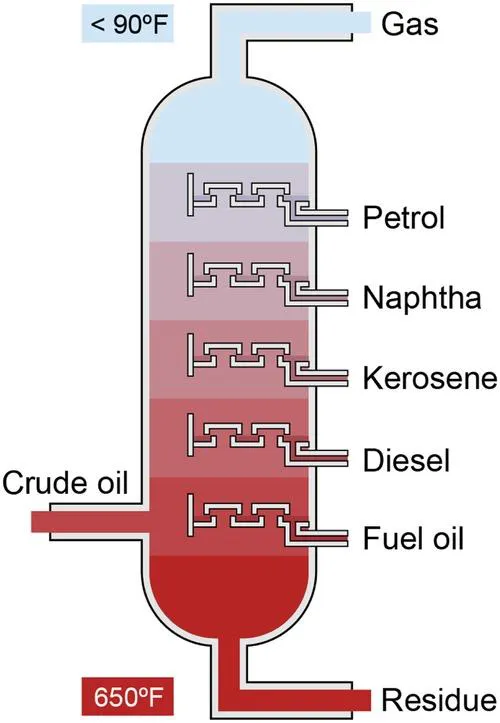
Figure 1.2 Products of crude oil refining.
1.2 How Oil Is Formed
Petroleum, or crude oil, is a liquid mixture of hydrocarbons formed underground from the remains of plants and marine life such as algae and plankton. It is a mixture of compounds called hydrocarbons which are made up of mostly carbon and hydrogen. The color of crude oil can vary from yellow to black depending on its composition: heavier hydrocarbons will lead to a darker colored crude.
The plankton remains are buried and subjected to high pressures and temperatures due to the depth of burial. The deeper the remains are buried, the higher the temperature and pressure. The longer the remains are subjected to these conditions, the more likely they will be converted to natural gas rather than crude oil. The hydrocarbons are formed in source rock and then migrate into shallower rock called reservoir rock. It is from reservoir rock that most crude oil is produced. The exception is shale oil and gas which are produced from source rock.
Wells are drilled into the reservoir as shown in Figure 1.3 to create a conduit through which oil and gas can be produced. In the reservoir, gas is usually found at the top because it is light, followed by oil in the middle and water at the bottom because it is heaviest. Reservoir depths may vary from as shallow as 3,500 ft to as deep as 12,000 ft.

Figure 1.3 Oil and gas production from hydrocarbon reservoirs underground.
1.3 Classification of Crude Oil
Crude oil may be classified in a number of ways either based on the physical characteristics of the crude or based on the reservoir it is extracted from. One classification method is on the density of the oil. API gravity is a measure of how dense a hydrocarbon is compared to water, and it is measured in degrees. The smaller the API of a petroleum liquid, the denser it is, with extra heavy crude oil being the densest.
Crude oil with an API of 10° has a density the same as that of water. Crude oil with an API less than 10° will sink in water while crude oil with an API greater than 10° will float on water. The viscosity of crude oil increases as temperature increases.
API and density are connected through the following equation.
1.1
where
1.2
and ρliquid is the density of the crude oil liquid in kg/m3, ρwater is the density of water, which is 999 kg/m3, and API is in degrees (°).
The API and density ranges for each type of crude vary for different countries and different sources. One set of ranges is given in Table 1.1.
Oil type | API (°) | Density (kg/m3) |
|---|---|---|
Extra heavy crude oil | <10 | >999 |
Heavy oil | 10–20 | 933–1000 |
Conventional oil | 20–40 | 824–933 |
Light crude oil | >40 | <824 |
Examples of extra heavy crude oil include bitumen and tar sands or oil sands. Light crude such as shale oil is easy to refine and is therefore more desirable and more expensive.
Another way of classifying oil is by sulfur content. The oil that contains less than 1% sulfur is called sweet crude. Sour crude is crude that contains greater than 1% sulfur. Sweet crude is more valuable because sulfur is undesirable and must be removed from sour crude. West Texas Intermediate (WTI) is a light sweet crude sourced from inland Texas’ Permian Basin. It is used as a benchmark or reference for crude oil pricing in North America. Brent crude is a light sweet crude from the North Sea between the United Kingdom and Norway which is used for benchmarking two-thirds of crude oil traded worldwide. It is less light and less sweet than WTI but is more widely ...
Table of contents
- Cover
- Half Title
- Title Page
- Copyright Page
- Contents
- List of Figures
- List of Tables
- Preface
- Author
- Abbreviations
- 1 Introduction
- 2 Exploration and Geology
- 3 Reservoir Engineering
- 4 Drilling Engineering
- 5 Completions Engineering
- 6 Production Engineering
- 7 Facilities Engineering
- 8 Oil Refining
- Glossary
- Index
Frequently asked questions
Yes, you can cancel anytime from the Subscription tab in your account settings on the Perlego website. Your subscription will stay active until the end of your current billing period. Learn how to cancel your subscription
No, books cannot be downloaded as external files, such as PDFs, for use outside of Perlego. However, you can download books within the Perlego app for offline reading on mobile or tablet. Learn how to download books offline
Perlego offers two plans: Essential and Complete
- Essential is ideal for learners and professionals who enjoy exploring a wide range of subjects. Access the Essential Library with 800,000+ trusted titles and best-sellers across business, personal growth, and the humanities. Includes unlimited reading time and Standard Read Aloud voice.
- Complete: Perfect for advanced learners and researchers needing full, unrestricted access. Unlock 1.4M+ books across hundreds of subjects, including academic and specialized titles. The Complete Plan also includes advanced features like Premium Read Aloud and Research Assistant.
We are an online textbook subscription service, where you can get access to an entire online library for less than the price of a single book per month. With over 1 million books across 990+ topics, we’ve got you covered! Learn about our mission
Look out for the read-aloud symbol on your next book to see if you can listen to it. The read-aloud tool reads text aloud for you, highlighting the text as it is being read. You can pause it, speed it up and slow it down. Learn more about Read Aloud
Yes! You can use the Perlego app on both iOS and Android devices to read anytime, anywhere — even offline. Perfect for commutes or when you’re on the go.
Please note we cannot support devices running on iOS 13 and Android 7 or earlier. Learn more about using the app
Please note we cannot support devices running on iOS 13 and Android 7 or earlier. Learn more about using the app
Yes, you can access Oil and Gas Engineering for Non-Engineers by Quinta Nwanosike Warren in PDF and/or ePUB format, as well as other popular books in Technology & Engineering & Sustainability in Business. We have over one million books available in our catalogue for you to explore.