A revealing tour of the opulent Newport Mansions where the Astors, Vanderbilts, and other Gilded Age families spent their summers.
At the turn of the twentieth century, the wealthy families of New York would vacation at their summer homes in Newport, Rhode Island. Where the salty air once mingled with the laughter of society women in ball gowns, the houses of the Newport Cliff Walk still preside in grandeur over the crashing waves below. From the grand majesty of the Breakers to the beautiful proportions of Rosecliff, these houses are enduring reminders of the architectural flowering of the Gilded Age.
Walking along the paved trail, it's easy to imagine the faintest hint of a waltz coming from the windows of Beechwood, or to envision the Duchess of Windsor's carriage arriving for a visit at Fairholme. Ed Morris takes you on a tour of twenty-four historic mansions and landmarks, entertaining along the way with tales of splendor and style, social maneuvering and matchmaking.
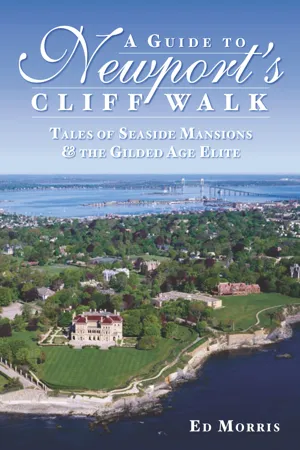
eBook - ePub
A Guide to Newport's Cliff Walk
Tales of Seaside Mansions & the Gilded Age Elite
- 131 pages
- English
- ePUB (mobile friendly)
- Available on iOS & Android
eBook - ePub
About this book
Trusted by 375,005 students
Access to over 1.5 million titles for a fair monthly price.
Study more efficiently using our study tools.
Information
Topic
Crescita personaleSubtopic
Storia nordamericanaSECTION III
BELLEVUE AVENUE WALK
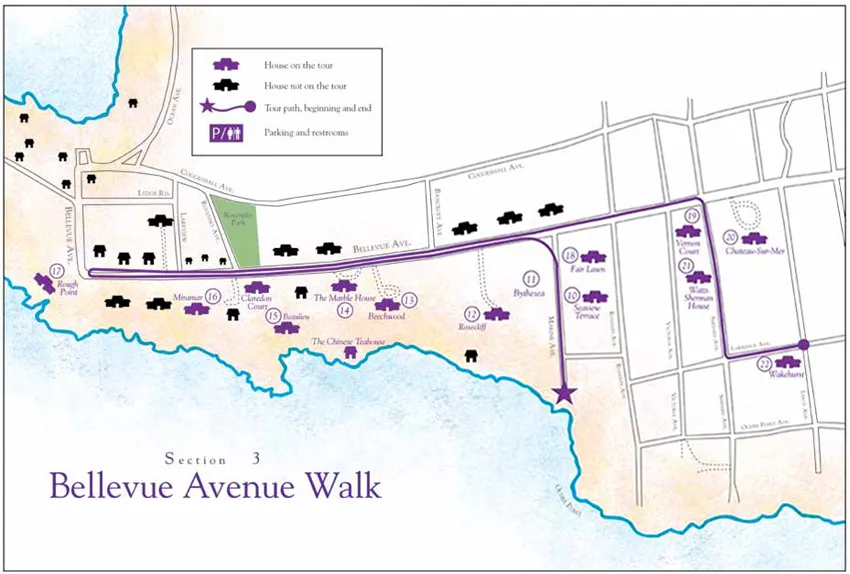
From Marine Avenue south to the end of Bellevue Avenue, this section is one mile long, not including the return trip back up Bellevue. From your stopping point on the Cliff Walk path, walk up a grassy hill to your right until you reach Marine Avenue. Follow this dirt road and you will pass MidCliff and Honeysuckle Lodge on your right, followed by Seaview Terrace. At the top of the hill, you will see the stone gates of Bythesea on your left. The mansion itself has been replaced by more modern houses, but the photo of the original Bythesea is included in this book.
Follow Marine Avenue to its intersection with Bellevue Avenue, then turn south on Bellevue and walk past the façades of Rosecliff, Astor’s Beechwood, Marble House, Beaulieu, Clarendon Court, Miramar and Rough Point. Several of these houses are open to the public, including Rosecliff, Beechwood, Marble House and the Chinese Teahouse and Rough Point. Photos of the houses included in this book should help you identify which is which. Walking this stretch of Bellevue takes about half an hour, and there is a trolley service available that can take you back up the road and drop you off near Marine Avenue.

Seaview Terrace
Coming up on the right is Seaview Terrace. The French Norman Renaissance–style manor house was completed at a cost of $2 million just four years before the 1929 Wall Street Crash.
The fifty-four-room limestone mansion with forty bedrooms and twenty bathrooms was built by architect Howard Greenley for Edson Bradley, who made a fortune in mining and distilling. It also has a chapel, seating 150, which was built for Bradley’s son-in-law, Bishop Shipman of New York. Shipman served as a chaplain at West Point and wrote the school’s anthem, “The Corps.”
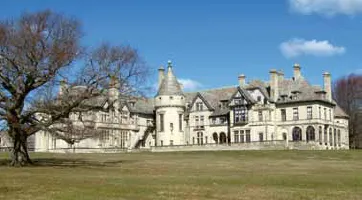
Seaview Terrace.
Later, the estate was bought by Martin Carey, brother of former New York governor Hugh Carey, as a headquarters for his oil company.
Dark Shadows Film Set
Carey’s dream of finding oil off George’s Bank never came true, and in 1949 he sold Seaview Terrace for a mere $8,000. (By the late 1960s, however, the mansion’s value had climbed back up to $240,000.) In recent years, it has been leased by Salve Regina University as a dormitory. It also served as the stage setting for the movie thriller Dark Shadows.

Bythesea
Continuing west along Marine Avenue and up a slight hill on the left side, you’ll notice two great stone gates bearing the inscription “Bythesea.” These gates were once an entrance to the estate, built in 1860 for Rothschild’s bank agent August Belmont, who is often credited with starting the high society tradition of building summer cottages in Newport.
Bythesea was the first of a number of houses built in the so-called “vernacular” style by George Champlin Mason, who, as editor of the Newport Mercury weekly and reporter for Providence and New York newspapers, teamed up with developer Alfred Smith in promoting this “Queen of Resorts” as the place where “the great ones of the earth” came to play.
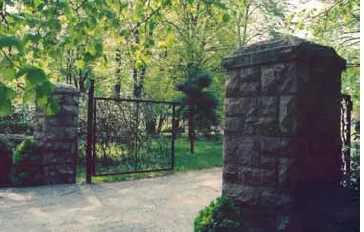
The gates to Bythesea mark the spot where the mansion once stood.
Belmont had served the banking house of the Rothschilds in Frankfurt am Main, Germany, and Naples, Italy, before arriving in New York in 1837 to represent them at the young age of twenty-three. Within three years, he had not only already earned $100,000 for himself, but he was also considered one of the three most important private bankers in the United States.
Last Gentlemen’s Duel
In 1841, Belmont was forced into a pistol duel with Edward Hayward in defense of a married lady’s honor and walked away with a silver bullet in his knee. It was once called the last gentlemen’s duel in New York. Of course, today’s New York businessmen continue to have duels, but they don’t use silver bullets, and they certainly aren’t gentlemen.
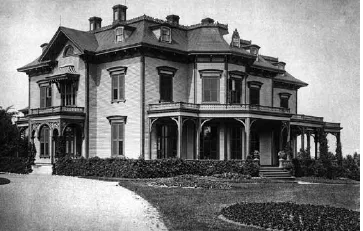
Bythesea mansion, no longer standing. Courtesy of the Redwood Library.
In 1849, Belmont married Caroline Perry, the daughter of Matthew Perry, whose treaty allowing American seamen to visit the port of Shimoda was an important first step in opening Japan to Western trade. Bythesea was one of the early large mansions in Newport, and Belmont was the first to introduce ten-course dinners with a staff of sixteen inside and ten outside dressed in full livery.
Caroline was the leader of New York society before Mrs. Astor arrived. Her hopes for her daughter Fredrika to succeed Mrs. Astor were dashed, however, when their third son, Oliver Hazard Perry Belmont, married Sarah Swan Whiting against their wishes.
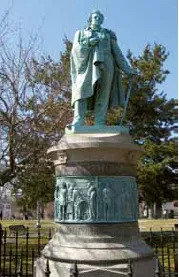
This statue of Matthew Perry was made by John Quincy Adams Ward. It is now located in Newport’s Touro Park near the Viking Mill on Bellevue Avenue, opposite the Griswold House (built by Richard Morris Hunt in 1862). That house now functions as the Newport Art Association’s museum.
Mother Moves into Bridal Suite
The newlyweds moved into the bridal suite on Paris’s Champs Élysées, but the following day, Sarah’s mother and two unmarried sisters moved in, too! Oliver couldn’t get them out and ran off in a huff to Spain, where he was rumored to have taken up with a French lady.
The Belmonts’ attempts to salvage the marriage failed, and in the subsequent divorce, they also lost custody of the couple’s unborn daughter. The girl was named Natica Caroline after Caroline Astor, her godmother, and not after her grandmother, Caroline Belmont.
August Belmont was a famous horse breeder, first and longtime president of the American Jockey Club—sponsor of the Belmont Cup—and national chairman of the Democratic Party, both before and after the Civil War. He died in 1890 at the age of seventy-seven.
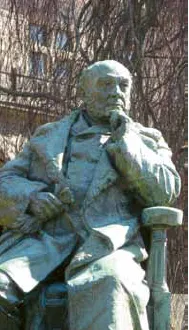
This statue of August Belmont was made from a death mask some twenty years after he died by the noted sculptor John Quincy Adams Ward. It is now located in front of the headquarters building of the Preservation Society of Newport County at 424 Bellevue Avenue to commemorate his role in bringing high society to Newport.

Rosecliff
Rosecliff’s Beautiful Proportions
Turn left from Marine onto Bellevue Avenue, and on the left you will see the gates of Rosecliff, which some claim—with its harmonious proportions—to be Newport’s most beautiful house.
It was built of white-glazed terra cotta (to look like marble) between 1898 and 1902 by Stanford White for Mrs. Herman Oelrichs and her younger sister, Virginia Fair, both of whom played prominent roles in Newport (and New York) high society after Mrs. Astor retired to only giving tea parties.
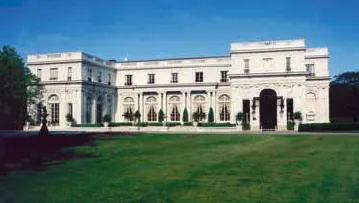
Rosecliff.
The H-shaped mansion, with its great French-style arched windows interspersed with Ionic half columns or pilasters, is modeled after the Grand Trianon, built as a garden retreat for Louis XIV by Jules Hardouin Mansart in 1690. Between the wings in the elongated bar of the H is the eighty- by forty-foot, Rococo-style ballroom with its ocean-view terrace on one side and a formal French-style parterre garden terrace on the other. The house is surrounded on all sides by extensive lawn vistas.
Insisted on Giving Parties
The $2.5 million mansion might have been completed much sooner had not Mrs. Oelrichs insisted, as early as 1900, on giving parties in it—she covered up unfinished areas with masses of flowers!
Great Gatsby Movie Set
You may already have seen parts of the interior, used as a stage set in the movies The Great Gatsby, with Robert Redford and Mia Farrow; The Betsy, with Sir Laurence Olivier, Katharine Ross and Robert Duvall; and True Lies, with Arnold Schwarzenegger.
Mrs. Oelrichs’s husband, Herman, was the North American agent for the North German Lloyd shipping lines. He died of a heart attack on one of his ships only four years after the mansion was finished. Mrs. Oelrichs’s sister Virginia, known as Birdie, married William K. Vanderbilt Jr., the oldest son at Marble House, in a great matchmaking coup.
Society Matchmakers
The match was made by Mrs. Oelrichs with the help of the former “Tessie” (Theresa) Fair and Alva Vanderbilt-Belmont, who, along with Mamie Fish (Mrs. Stuyvesant Fish) of Crossways Mansion, had become known as the Great Triumvirate and succeeded Mrs. Caroline Astor in ruling high society.
These new society queens were very different birds of a feather than Mrs. Astor. Alva once accused Mamie of telling Tessie that she (Alva) looked like a frog (she was a little stout). Mamie said, “I never told Tessie you looked like a frog. I told her you looked like a toad!” With friends like that, who was worried about enemies?
$200 Million in Silver
Tessie and Birdie were daughters of James Fair, one of four Irish partners in the discovery of the Comstock Lode, or vein of silver, in Virginia City, Nevada—said to be the richest ever found in this country, worth eventually up to $200 million.
James Fair gave Tessie $ 1 million on her marriage to Herman Oelrichs but wasn’t invited to the wedding because of his generally antisocial behavior and character. And because of his many wills and illicit affairs, Tessie went through years of legal battles to win the bulk of his estate after his death in 1894.
Developed the American Beauty Rose
Tessie and Birdie bought the original Rosecliff, a large wooden house, from the noted historian and diplomat George Bancroft in 1891 and demolished it to build the present structure. Bancroft, also a noted horticulturist, developed the American Beauty rose in large rose gardens here—hence the name Rosecliff.
Mrs. Oelrichs’s new Rosecliff was later owned by J. Edgar Monroe of New Orleans, who made a fortune in sugar plantations and oil wells and later gave this property to the Preservation Society. It is now, along with Marble House and the Breakers, one of the seven major mansions open to the public.
While Stanford White was beginning work designing Rosecliff, he was also building the Gould Library on the Bronx Campus of New York University, which he completed in 1899 and which some critics consider his greatest work.
Architect Spots Spanish Dancer
A year later, in 1900, a new musical called Floridora opened at the Casino, at Broadway and Thirty-ninth Street, and there Stanford White first spotted actress Evelyn Nesbit playing the part of a Spanish dancer. White, in addition to being a great designer and party planner, had a reputation for secret liaisons with young actresses. He persuaded the mother of sixteen-year-old Evelyn to allow her daughter to attend a luncheon at his Twenty-fourth Street hideaway apartment, along with three other girls. The luncheon grew into a five-year secret romance, until 1905, when Evelyn married the mentally erratic, wealthy playboy Harry Thaw from Pittsburgh.
After Evelyn returned with her husband from Eu...
Table of contents
- Front Cover
- Title Page
- Copyright
- Dedication
- Contents
- Preface
- Acknowledgements
- Introduction
- Section I. Scenic Walk
- Section II. Mansion Walk
- Section III. Bellevue Avenue Walk
- Section IV. Adventure Walk
- Epilogue
- Bibliography
- About the Author
Frequently asked questions
Yes, you can cancel anytime from the Subscription tab in your account settings on the Perlego website. Your subscription will stay active until the end of your current billing period. Learn how to cancel your subscription
No, books cannot be downloaded as external files, such as PDFs, for use outside of Perlego. However, you can download books within the Perlego app for offline reading on mobile or tablet. Learn how to download books offline
We are an online textbook subscription service, where you can get access to an entire online library for less than the price of a single book per month. With over 1.5 million books across 990+ topics, we’ve got you covered! Learn about our mission
Look out for the read-aloud symbol on your next book to see if you can listen to it. The read-aloud tool reads text aloud for you, highlighting the text as it is being read. You can pause it, speed it up and slow it down. Learn more about Read Aloud
Yes! You can use the Perlego app on both iOS and Android devices to read anytime, anywhere — even offline. Perfect for commutes or when you’re on the go.
Please note we cannot support devices running on iOS 13 and Android 7 or earlier. Learn more about using the app
Please note we cannot support devices running on iOS 13 and Android 7 or earlier. Learn more about using the app
Yes, you can access A Guide to Newport's Cliff Walk by Ed Morris in PDF and/or ePUB format, as well as other popular books in Crescita personale & Storia nordamericana. We have over 1.5 million books available in our catalogue for you to explore.