This reference explores the science of signaling mechanisms associated with diseases like endocrine, metabolic and immune disorders which are linked to oxidative stress mediated disease mechanisms. The common diseases in these categories include diabetes mellitus and arthritis and conditions defined by inflammation and autoimmunity. These diseases involve metabolic pathways mediated by reactive oxygen species or free radicals. The pathways are targets in the mechanism of drugs which aim to treat related disorders. The book covers key topics in free radical biology that help to understand the nature of the pathways and the pharmacology of the drugs that are designed to target them.5 chapters elucidate the free radical biology of the diseases.1. Role of free radical biology in diabetes mellitus2. Role of GSK3 in regulation of insulin release and glucose metabolism3. Regulatory role of NRF2 in rheumatoid arthritis4. Role of free radical biology in Alzheimer's disease5. Regulatory role of immune cells mediated antibody on rheumatoid arthritis Key features: - Elucidates the key biochemical and pharmacological mechanisms that are mediated by free radicals in common endocrine, metabolic and immune diseases- Explains the activation of immunological factors (like RF and ACPA) that trigger inflammation and arthritis- Covers the role of free radicals in Alzheimer's disease and new interventions that target mitochondrial mechanisms- Systematically explains the molecular biology of free radicals with the help of schematic diagrams - Includes references for further reading The accessible and structured text in this reference make it a suitable resource for all biomedical scientists, faculty and postgraduate students in academia and industry.
- English
- ePUB (mobile friendly)
- Available on iOS & Android
eBook - ePub
Free Radical Biology of & Endocrine, Metabolic Immune Disorders
About this book
Information
Topic
MedicineSubtopic
Biochemistry in MedicineFree Radical Biology of Diabetes Mellitus
Bidita Khandelwal1, *, Chamma Gupta2, Levin Thomas3, Sonal Sekhar Miraj3, Mahadev Rao3, Rubi Dey4, Karma Gurmey Dolma5, Rinchen Doma Bhutia2, Vijay Pratap Singh6
1 Department of Medicine, Sikkim Manipal Institute of Medical Sciences, Sikkim Manipal University, Gangtok, Sikkim-737102, India
2 Department of Biochemistry, Sikkim Manipal Institute of Medical Sciences, Sikkim Manipal University, Gangtok, Sikkim-737102, India
3 Department of Pharmacy Practice, Manipal College of Pharmaceutical Sciences, Manipal Academy of Higher Education, Manipal, Karnataka-576104, India
4 Department of Physiology, Sikkim Manipal Institute of Medical Sciences, Sikkim Manipal University, Gangtok, Sikkim-737102, India
5 Department of Microbiology, Sikkim Manipal Institute of Medical Sciences, Sikkim Manipal University, Gangtok, Sikkim-737102, India
6 Department of Physiotherapy, Kasturba Medical College, Manipal Academy of Higher Education, Manipal, 576104 India
Abstract
Free radicals play a pivotal role in the etiology of different diseases, including diabetes mellitus (DM). In the past three decades, the understanding of the fundamental role of free radicals in the etiology and disease progression of DM was studied broadly. This chapter aimed to enumerate the recent progress in the areas of free radical biology for the management of DM. Free radicals, as well as reactive oxygen species (ROS), having extra electrons in their outer orbitals, react with all biomolecules, including “protein, lipids, and DNA,” causing oxidative stress and damage. DM is also associated with oxidative stress induced by the elevated production of free radicals or reduced antioxidant activity. Recently, the importance of an antioxidant rich diet, yoga, and exercise has been well documented for the management of DM. Studies confirmed that exercise-induced ROS is an acute effect, while the chronic effect of exercise produces endogenous antioxidant defences and promotes a state of endogenous antioxidant defence mechanism. Therefore, regulating oxidative stress will lead to a significant future area of research for DM disease management.
Keywords: Antioxidant, Diabetes Mellitus, Oxidative damage, Oxidative stress, Reactive oxygen species.
* Corresponding author Bidita Khandelwal: Department of Medicine, Sikkim Manipal Institute of Medical Sciences, Sikkim Manipal University, Gangtok, Sikkim-737102, India; E-mail: [email protected]
INTRODUCTION-FREE RADICALS
Free radicals have acquired a significant momentum in biology along with other oxidants because of their crucial functions in numerous physiological states and pathological implications in a wide range of disorders [1]. Chemical entities like atoms, molecules, and ions with one or more unpaired electrons in their outer orbitals, are referred to as free radicals, which generally display remarkable reactivities and also show independent existence ability [1, 2]. The odd number of electrons in free radical has been attributed to its instability, short-life, and higher reactivity [2]. These radicals have the ability to remove the electrons from another compound or biomolecules to become stable due to their greater reactivity. Thereby, the molecule undergoing an attack gives up an electron and is subsequently converted to a free radical. This process sets off a chain of reactions that causes injury or kills the cell which is alive [3].
Free radicals act as both harmful as well as valuable substances [4]. Therefore, they might be recognized as a necessary evil for signalling in the regular differentiation and migration process [5]. These species are generated during normal cellular metabolism or external sources such as radiation, pollution, smoking, etc. [4]. When cells utilize oxygen to produce energy, these species are released by the mitochondrial adenosine triphosphate (ATP) synthesis pathway. As a by-product of the cellular redox process, reactive nitrogen species (RNS), as well as reactive oxygen species (ROS), are released. The vital aspect of life is maintaining a subtle equilibrium between these two species’ antagonistic effects. An adequate quantity of RNS and ROS exerts favourable actions on different cellular responses, signalling pathways, mitogenic responses, redox regulation, and immune function [6, 7]. However, at high concentrations, both the species exert oxidative stress as well as nitrosative stress, producing potential deleterious effects on the biomolecules like lipids, proteins, nucleic acids, and others [8-13]. Overload of ROS/RNS, as well as a deficit of antioxidants (enzymatic as well as non-enzymatic), can produce oxidative and nitrosative stress. These stresses play a significant role in aging as well as developing chronic and degenerative disorders (Fig. 1). On the other hand, both endogenous and exogenous antioxidants serve as “free radical scavengers” and subsequently inhibit or repair injuries produced by free radicals [14-16].
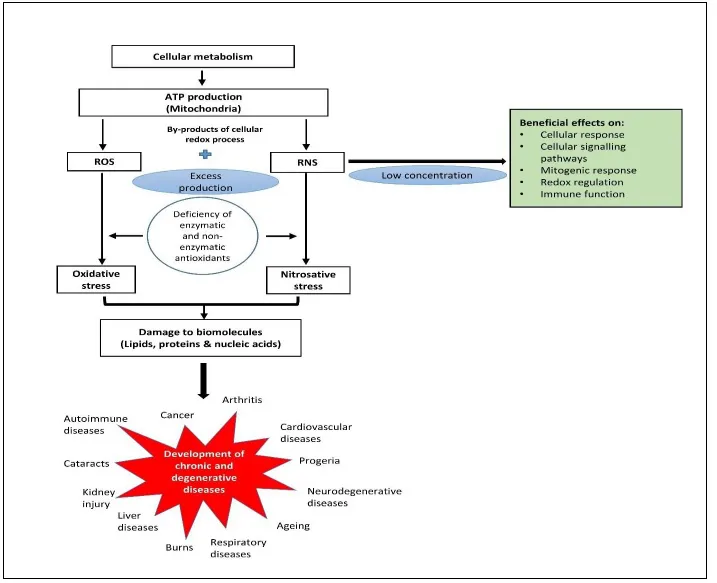
Physiological and pathological role of free radicals in the biological system.
HISTORY ON THE CONCEPT OF FREE RADICALS IN BIOLOGICAL SYSTEM
The word ‘radical’ was first introduced in 1786 by French chemist Louis-Bernard Guyton de Morveau. Later, Gay-Lussac, Justus von Liebig, and Jöns Jakob Berzelius used the term to denote clusters of atoms that remained unaltered in several compounds. Early works involving free radicals were oxidative degradation of organic substances by hydrogen peroxide (H2O2) in the p...
Table of contents
- Welcome
- Table of Content
- Title
- BENTHAM SCIENCE PUBLISHERS LTD.
- FOREWORD
- PREFACE
- ACKNOWLEDGEMENTS
- List of Contributors
- Free Radical Biology of Diabetes Mellitus
- Role of GSK-3 in the Regulation of Insulin Release and Glucose Metabolism
- The Regulatory Role of NRF-2 in Rheumatoid Arthritis
- Free Radical Biology in Alzheimer's Disease
- Regulatory Role of Immune Cell-mediated Antibodies in Rheumatoid Arthritis
Trusted by 375,005 students
Access to over 1.5 million titles for a fair monthly price.
Study more efficiently using our study tools.
Frequently asked questions
Yes, you can cancel anytime from the Subscription tab in your account settings on the Perlego website. Your subscription will stay active until the end of your current billing period. Learn how to cancel your subscription
No, books cannot be downloaded as external files, such as PDFs, for use outside of Perlego. However, you can download books within the Perlego app for offline reading on mobile or tablet. Learn how to download books offline
We are an online textbook subscription service, where you can get access to an entire online library for less than the price of a single book per month. With over 1.5 million books across 990+ topics, we’ve got you covered! Learn about our mission
Look out for the read-aloud symbol on your next book to see if you can listen to it. The read-aloud tool reads text aloud for you, highlighting the text as it is being read. You can pause it, speed it up and slow it down. Learn more about Read Aloud
Yes! You can use the Perlego app on both iOS and Android devices to read anytime, anywhere — even offline. Perfect for commutes or when you’re on the go.
Please note we cannot support devices running on iOS 13 and Android 7 or earlier. Learn more about using the app
Please note we cannot support devices running on iOS 13 and Android 7 or earlier. Learn more about using the app
Yes, you can access Free Radical Biology of & Endocrine, Metabolic Immune Disorders by Asis Bala in PDF and/or ePUB format, as well as other popular books in Medicine & Biochemistry in Medicine. We have over 1.5 million books available in our catalogue for you to explore.