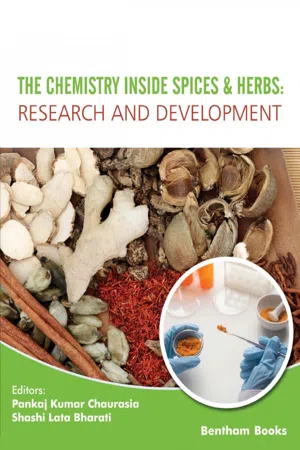
The Chemistry inside Spices & Herbs: Research and Development brings comprehensive information about the chemistry of spices and herbs with a focus on recent research in this field. The book is an extensive 2-part collection of 20 chapters contributed by experts in phytochemistry with the aim to give the reader deep knowledge about phytochemical constituents in herbal plants and their benefits. The contents include reviews on the biochemistry and biotechnology of spices and herbs, herbal medicines, biologically active compounds and their role in therapeutics among other topics. Chapters which highlight natural drugs and their role in different diseases and special plants of clinical significance are also included. Part I focuses on the general aspects of spice biotechnology, structure activity relationships and the natural products that can be used to treat different diseases - such as neurological diseases, inflammation, pain and infections. This part also covers information about phenolic compounds, flavonoids and turmeric supplements. This book is an ideal resource for scholars (in life sciences, phytomedicine and natural product chemistry) and general readers who want to understand the importance of herbs, spices and traditional medicine in pharmaceutical and clinical research.
eBook - ePub
The Chemistry inside Spices & Herbs: Research and Development: Volume 1
- English
- ePUB (mobile friendly)
- Available on iOS & Android
eBook - ePub
The Chemistry inside Spices & Herbs: Research and Development: Volume 1
About this book
Trusted by 375,005 students
Access to over 1.5 million titles for a fair monthly price.
Study more efficiently using our study tools.
Information
Topic
MedicineSubtopic
PharmacologyNaturally-derived Analgesics and Anti-Inflammatory Agents
Shaimaa Fayez1, #, Mariam I. Gamal El-Din1, #, Omayma A. Eldahshan1, 2, Abdel Nasser B. Singab1, 2
1 Department of Pharmacognosy, Faculty of Pharmacy, Ain-Shams University, 11566 Cairo, Egypt
2 Center for Drug Discovery Research and Development, Faculty of Pharmacy, Ain-Shams University, 11566 Cairo, Egypt
Abstract
Medications for the treatment of pain and inflammatory disorders, although effective, their chronic use and/or misuse can lead to serious side effects. In this regard, naturally-derived antinociceptive and anti-inflammatory agents have emerged as alternatives to synthetically marketed drugs. The current review covers all the nutraceuticals and phytochemicals – derived from medicinal plants– which have been reported to possess analgesic and/or anti-inflammatory effects over the period between 2018 up to June 2020.
Keywords: Pain, Inflammation, Marine organisms, Medicinal plants, Natural products.
# Authors show equal contribution
* Corresponding authors Abdel Nasser B. Singab and Omayma A. Eldahshan: Department of Pharmacognosy, Faculty of Pharmacy, Ain-Shams University, 11566 Cairo, Egypt and Center for Drug Discovery Research and Development, Faculty of Pharmacy, Ain Shams University, Egypt; Tel: 002-010-05036231, 002-010-11841951;
E-mail: [email protected], [email protected]
INTRODUCTION
Inflammation is one of the responses of innate immunity to infection or tissue injury. Despite being essential for maintaining normal homeostasis, prolonged inflammation could likewise be a sign of a pathological condition resulting from chronic diseases, which could be detected by the presence of inflammatory markers [1]. The molecular mechanisms of inflammation are complicated, and they are initiated by the recognition of the allergen by germline-encoded specific pattern recognition receptors such as Toll-like receptors (TLR), retinoic acid-inducible gene-I (RIG-1)-like receptors, C-type lectin receptors (CLR), and the nucleotide-binding oligomerization domain (NOD) like receptor [1, 2]. These inflammatory responses end up with some typical symptoms, including redness,
swelling, pain, and heat [1, 3]. Activation of these receptors by bacteria triggers the release of inflammatory cytokines, which in turn mediate the production of C-reactive protein (CRP), among others, which promote the secretion of prostaglandins [3]. The latter are responsible for the symptoms of inflammation. Viral infections, on the other hand, trigger the release of type-I interferons, while parasitic infections and other allergens increase the production of histamine and interleukins. The common pathways, which play a major role in inflammation, are the NF-ĸB, JAK-STAT, and MAPK [3]. Although pain is one of the consequences of inflammation, it could also be a separate sign, even with no existence of an ongoing inflammatory process. Non-steroidal anti-inflammatory drugs (NSAIDs) and opioid analgesics are among the commonly used medications for pain treatment. However, they show many side effects, which lead to patient discomfort, especially in chronic use [4, 5]. Since the last decade, many natural products have proven efficacy for the management of pain and inflammation [2]. Herein, we report on the latest updates in the field of anti-inflammatory natural products, which have been reported over the interval between 2018 and June 2020.
Medicinal Plant Extracts with Reported Analgesic and/or Anti-Inflammatory Activities (Table 1)
Table 1 List of previously reported spices with anti-inflammatory activities.
| Spices/plant Name | Mechanism of Action | Refs. |
|---|---|---|
| Acanthus ilicifolis Linn. | In vivo analgesic effect for the chloroform and petroleum ether fractions In vitro antioxidant activity | [8] |
| Ajuga laxmannii (Murray) Benth. | Inhibition of phagocytosis and decreasing the total leukocytes in vitro In vitro antioxidant activity | [9] |
| Anadenanthera colubrina var. cebil (Griseb.) | In vivo anti-inflammatory potential in paw oedema model Reduction of IL-12 production and TNF-α release accompanied by elevation in IL-10 Inhibition of the production of nitric oxide | [10] |
| Asphodelus microcarpus Salzm. & Viv. | Strong antioxidant capacity Reduction of the in vivo paw and ear edema induced by carrageenan and xylene | [11] |
| Athyrium multidentatum (Doll.) Ching | Decreased the expression of iNOS and COX-2 enzymes Downregulation of the in vitro and in vivo mRNA expression of IL-6, IL-1β, and TNF-α | [12] |
| Backhousia citriodora (Lemon myrtle) | Antioxidant properties Reduction of IL6, TNF-α, and NO levels | [13] |
| Bistorta officinalis (Bistort) | Inhibition of the release of pro-inflammatory cytokines after LPS stimulation | [14] |
| Boswellia species oleogum resin | Antioxidant effect Immunomodulatory effects Decreased paw edema, pleural exudates, pain, and fever in vivo. | [16] |
Table of contents
- Welcome
- Table of Content
- Title
- BENTHAM SCIENCE PUBLISHERS LTD.
- FOREWORD
- PREFACE
- List of Contributors
- Spices Biotechnology: Opportunities and Challenges
- Spices, the Guards Against the Evil Microbes: Antimicrobial Properties of Spices
- Spices and Herbs in the Treatment of Neurobiological Disorders
- Spices and Herbs in Bacterial and Fungal Resistance
- Naturally Isolated Compounds from Spices and Herbs and their Medicinal Uses
- Naturally-derived Analgesics and Anti-Inflammatory Agents
- Phenolic Compounds and their Biological and Pharmaceutical Activities
- Structure-Activity Relationship of Flavonoids: Recent Updates
- Biologically Active Compounds and Structure-Activity Relationship
- Turmeric Supplementation and Its Valued Clinical Connections
Frequently asked questions
Yes, you can cancel anytime from the Subscription tab in your account settings on the Perlego website. Your subscription will stay active until the end of your current billing period. Learn how to cancel your subscription
No, books cannot be downloaded as external files, such as PDFs, for use outside of Perlego. However, you can download books within the Perlego app for offline reading on mobile or tablet. Learn how to download books offline
Perlego offers two plans: Essential and Complete
- Essential is ideal for learners and professionals who enjoy exploring a wide range of subjects. Access the Essential Library with 800,000+ trusted titles and best-sellers across business, personal growth, and the humanities. Includes unlimited reading time and Standard Read Aloud voice.
- Complete: Perfect for advanced learners and researchers needing full, unrestricted access. Unlock 1.5M+ books across hundreds of subjects, including academic and specialized titles. The Complete Plan also includes advanced features like Premium Read Aloud and Research Assistant.
We are an online textbook subscription service, where you can get access to an entire online library for less than the price of a single book per month. With over 1.5 million books across 990+ topics, we’ve got you covered! Learn about our mission
Look out for the read-aloud symbol on your next book to see if you can listen to it. The read-aloud tool reads text aloud for you, highlighting the text as it is being read. You can pause it, speed it up and slow it down. Learn more about Read Aloud
Yes! You can use the Perlego app on both iOS and Android devices to read anytime, anywhere — even offline. Perfect for commutes or when you’re on the go.
Please note we cannot support devices running on iOS 13 and Android 7 or earlier. Learn more about using the app
Please note we cannot support devices running on iOS 13 and Android 7 or earlier. Learn more about using the app
Yes, you can access The Chemistry inside Spices & Herbs: Research and Development: Volume 1 by Shashi Lata, Pankaj Kumar Chaurasia in PDF and/or ePUB format, as well as other popular books in Medicine & Pharmacology. We have over 1.5 million books available in our catalogue for you to explore.