The research and development activities in energy conversion and storage are playing a significant role in our daily lives owing to the rising interest in clean energy technologies to alleviate the fossil-fuel crisis. Polymers are used in energy conversion and storage technology due to their low-cost, softness, ductility and flexibility compared to carbon and inorganic materials. Polymers in Energy Conversion and Storage provides in-depth literature on the applicability of polymers in energy conversion and storage, history and progress, fabrication techniques, and potential applications.
Highly accomplished experts review current and potential applications including hydrogen production, solar cells, photovoltaics, water splitting, fuel cells, supercapacitors and batteries. Chapters address the history and progress, fabrication techniques, and many applications within a framework of basic studies, novel research, and energy applications.
Additional Features Include:
Explores all types of energy applications based on polymers and its composites
Provides an introduction and essential concepts tailored for the industrial and research community
Details historical developments in the use of polymers in energy applications
Discusses the advantages of polymers as electrolytes in batteries and fuel cells
This book is an invaluable guide for students, professors, scientists and R&D industrial experts working in the field.
Trusted by 375,005 students
Access to over 1.5 million titles for a fair monthly price.
1 History and Progress of Polymers for Energy Applications
Mohammad R. Thalji
Independent Researcher, Amman, Jordan
Gomaa A. M. Ali
Al–Azhar University, Assiut, Egypt
Kwok Feng Chong
Universiti Malaysia Pahang, Gambang, Malaysia
DOI: 10.1201/9781003169727-1
Contents
1.1 Introduction: Historical Perspective of Polymers in the Energy Field
1.2 Polymer Materials for Energy Storage Applications
1.3 Polymer Materials for Energy Conversion Applications
1.4 Conclusion
References
1.1 Introduction: Historical Perspective of Polymers in the Energy Field
Polymer materials have been considered the golden gateway to the future, which deals with developing many novel materials to suit our daily lives. Polymer materials are essential in energy concepts with a wide range of applications, including semiconductors [1, 2], light-emitting diodes (LEDs) [3], flexible supercapacitors [4], flexible solar cells [5], and fuel cells [6]. Berzelius (in 1930) coined the term “polymer” to define molecules that contained the repeatedly arranged atomic groups [7]. Over time, the term came to refer to larger molecules when it was applied to long macromolecules composed of various entities (monomers) [8]. The period 1920–1940 was regarded as a golden age in the development of synthetic polymers, during which new monomers were synthesized from abundant raw materials [9]. Simultaneously, the polymerization and polycondensation processes were refined to improve their efficiency. New synthetic methods have been developed to enhance the characterization of polymer macromolecules. This enabled the creation of polymers with distinct physico-chemical characteristics by modifying the arrangement of their chains.
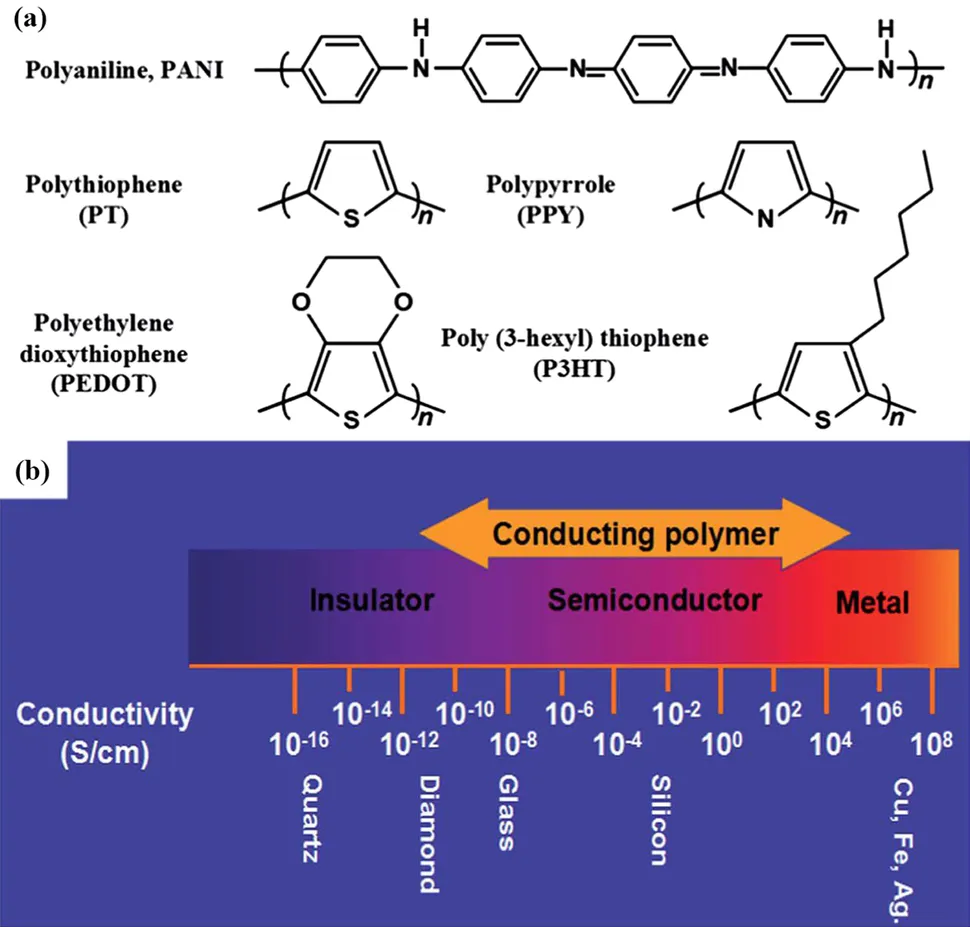
Polymer material has long been considered to be an insulating material. Typically, it was employed in insulating cables in electronic systems, and it was uncommon to use it as an electrode material for conducting [10]. As a result, since the discovery of polyacetylene in 1977, the growth of conducting polymers has quickly piqued the interest of both academia and industry [11]. Conducting polymers are promising energy materials due to their electrical conductivity and reversible electrochemical performance [12]. Polyaniline (PANI), polythiophene (PT), polypyrrole (PPY), poly(ethylene dioxythiophene) (PEDOT), and poly(3-hexylthiophene) (P3HT) are some examples of the conjugated double bonds conducting polymers (Figure 1.1a). They have sp2 in their chemical structure, facilitating charge transport and improving their electrochemical and conductivity properties (Figure 1.1b).
Figure1.1 (a) Chemical formulas of some conducting polymers. (b) Electrical conductivity range of conducting polymers [12].
These polymers exhibit high potentials as electrodes for various energy devices. Although polymer materials have broad applications, this chapter will focus on their energy (conversion and storage).
1.2 Polymer Materials for Energy Storage Applications
The development of a novel electrode material with a large electrochemically active surface area [13], excellent porosity [14], high conductivity [15], and pseudocapacitive properties [16] is the primary key to improving the electrochemical performance of energy storage systems. With the development of supercapacitors, some new materials have appeared gradually. Research interest has expanded beyond numerous conducting polymer materials in recent years, focusing on developing distinct electrode materials for electrochemical capacitors and batteries.
Although batteries are the most common energy source in each field, they have some limitations in the life cycle and power performance [17, 18]. Supercapacitors (SCs), known as electrochemical capacitors and ultracapacitors, are classified as energy storage devices with a high power density and long charge–discharge cycles [15, 19–21]. SCs, as shown in Figure 1.2, have a distinct Ragone plot position that bridges the gap between batteries and capacitors [22]. Also, when compared to a conventional capacitor, SCs have a higher specific energy density. Furthermore, SCs have a higher specific power density than batteries because of their unique charge storage mechanism.
Figure1.2 Ragone plot for energy storage systems [22].
Electrical double-layer capacitors (EDLCs) and faradaic pseudocapacitors (PCs) are the two main types of SCs [23]. EDLCs store electrical charges at the electrode–electrolyte interface using electrostatic force rather than electrochemical reactions on the electrode surface (Figure 1.3a). Carbon-based materials like carbon nanotubes (CNTs), carbon fibers, carbide-derived carbons, activated carbon, and graphene are commonly used as electrode materials for EDLCs [13–15, 24, 25]. Despite having a high power density and fantastic charge–discharge cycling stability, carbon-based materials have a low energy density [26]. Metal oxides, metal sulfides, and conducting polymers have been investigated as the electrode for pseudocapacitors to improve the specific capacitance and energy density of PCs [4, 20, 21, 27–32]. In PCs, energy storage is derived from reversible redox reactions at the electrolyte and electroactive interface. Because metal oxides have multiple oxidation states for redox charge transfer reactions, PCs can typically yield higher energy density than EDLCs.
Figure1.3 Representative diagrams for (a) EDLCs and (b) PCs [23].
Conducting polymers belong to pseudocapacitive electrode material that has been widely investigated for various energy storage applications like supercapacitors and batteries. This is associated with high energy density, redox-storage capability, relatively high conductivity, and large voltage windows [29, 33, 34]. PANI is an intrinsic polymer commonly used as electrode material in electrochemical energy storage applications. It has many distinguishing characteristics, including high conductivity and excellent electrochemical performance. Despite these benefits, it is prone to rapid performance degradation due to repeated charge–discharge cycles. To address this issue, carbon-based materials were combined with PANI material to form a novel composite that contributed to the reinforced PANI stability and enhanced the specific capacitance. For instance, Fusalba et al. synthesized a highly porous PANI film 250 mm thick (Figure 1.4a), and used it as the active material in a supercapacitor device with a nonaqueous electrolyte (1 M Et4NBF4/ACN) [35]. This increased the potential window in an aqueous solution from 0.75 to 1.0 V.
Figure1.4 Scanning electron microscopy image of (a) a PANI-coated carbon paper electrode in cross-section, and (b) a PANI film fabricated by the pulse galvanostatic method (PGM) in 0.5 M H2SO4 and 0.2 M aniline [35].
A low-frequency capacitance of 3 F cm−2 (150 F g−1) was achieved in the as-prepared film. Furthermore, the PANI–PANI capacitor’s cycling stability was low for the first 60 cycles (the loss of charge accounts for approximately 25% of the initial charge). In another study, Zhou et al. obtained a capacitance value of 609 F g−1 and an energy density of 26.8 W h kg−1 for a nanofibrous PANI capacitor at 1.5 mA cm−2 (Figure 1.4b) [36]. According to Zhou et al., the outstanding capacitance is due to a highly porous nanofibrous architecture that provides a high surface area and a great charge-transfer rate, allowing it to be a promising electrode material supercapacitor. Liu and his co-workers [37] used in situ aqueous polymerization to create porous PANI, and they compared its performance to that of as-prepared nonporous PANI. As shown in Figure 1.5a and b, the porous PANI had a more random pore arrangement than the nonporous PANI.
Figure1.5 Scanning elect...
Table of contents
Cover Page
Half Title page
Title Page
Copyright Page
Contents
Preface
Editors
Contributors
1 History and Progress of Polymers for Energy Applications
2 Polymer Electrolytes for Supercapacitor Applications
3 Polyaniline-Based Ternary Composites for Energy Accumulation in Electrochemical Capacitors
4 Self-Healing Gel Electrolytes for Flexible Supercapacitors
5 Polymeric Nanogenerators
6 Pyroelectric and Piezoelectric Polymers
7 Polymers and Their Composites for Solar Cell Applications
8 Polymers and Composites for Fuel Cell Applications
9 Solid Polymer Electrolytes for Solid State Batteries
10 Polymer Batteries
11 Polymer Semiconductors
12 Polymer Organic Photovoltaics
13 Polymers and Their Composites for Wearable Electronics
14 Polymer-Based Organic Electronics
15 Polymers and Their Composites for Thermoelectric Applications
16 Polymeric Materials for Hydrogen Storage
17 Polymers and Their Composites for Water-Splitting Applications
Index
Frequently asked questions
Yes, you can cancel anytime from the Subscription tab in your account settings on the Perlego website. Your subscription will stay active until the end of your current billing period. Learn how to cancel your subscription
No, books cannot be downloaded as external files, such as PDFs, for use outside of Perlego. However, you can download books within the Perlego app for offline reading on mobile or tablet. Learn how to download books offline
Perlego offers two plans: Essential and Complete
Essential is ideal for learners and professionals who enjoy exploring a wide range of subjects. Access the Essential Library with 800,000+ trusted titles and best-sellers across business, personal growth, and the humanities. Includes unlimited reading time and Standard Read Aloud voice.
Complete: Perfect for advanced learners and researchers needing full, unrestricted access. Unlock 1.5M+ books across hundreds of subjects, including academic and specialized titles. The Complete Plan also includes advanced features like Premium Read Aloud and Research Assistant.
Both plans are available with monthly, semester, or annual billing cycles.
We are an online textbook subscription service, where you can get access to an entire online library for less than the price of a single book per month. With over 1.5 million books across 990+ topics, we’ve got you covered! Learn about our mission
Look out for the read-aloud symbol on your next book to see if you can listen to it. The read-aloud tool reads text aloud for you, highlighting the text as it is being read. You can pause it, speed it up and slow it down. Learn more about Read Aloud
Yes! You can use the Perlego app on both iOS and Android devices to read anytime, anywhere — even offline. Perfect for commutes or when you’re on the go. Please note we cannot support devices running on iOS 13 and Android 7 or earlier. Learn more about using the app
Yes, you can access Polymers in Energy Conversion and Storage by Inamuddin, Mohd Imran Ahamed, Rajender Boddula, Tariq A. Altalhi, Inamuddin,Mohd Imran Ahamed,Rajender Boddula,Tariq A. Altalhi in PDF and/or ePUB format, as well as other popular books in Technologie et ingénierie & Chimie. We have over 1.5 million books available in our catalogue for you to explore.