- 288 pages
- English
- ePUB (mobile friendly)
- Available on iOS & Android
eBook - ePub
About this book
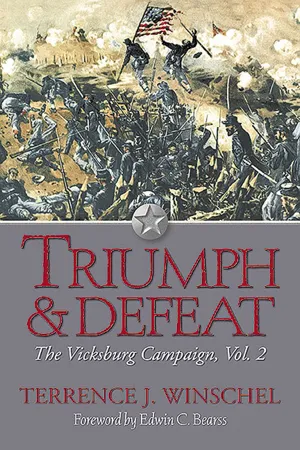
The study of the Civil War in the Western Theater is more popular now than ever before, and the center of that interest is the months-long Vicksburg Campaign, which is the subject of National Park Historian Terrence J. Winschel's new book Triumph & Defeat: The Vicksburg Campaign, Vol 2. Following up on the popular success of his earlier book of the same name, Winschel offers ten new chapters of insights into what has been declared by many to have been the most decisive campaign of the Civil War. Designed to appeal to both general readers and serious students, Winschel's essays cover a wide range of topics, including military operations, naval engagements, leading personalities, and even a specific family caught up in the nightmarish 47-day siege that nearly cost them their lives. Smoothly written and deeply researched, these fresh chapters offer balanced and comprehensive analysis written with the authority that only someone who has served as Vicksburg's Chief Historian since 1978 can produce. Bolstered by photographs, illustrations, and numerous outstanding original maps, this second volume in the Triumph & Defeat series will stand as a lasting contribution to the study of the Civil War. About the author: Winschel is author of many books, including Triumph & Defeat: The Vicksburg Campaign (1998, 2004), Vicksburg is the Key: The Struggle for the Mississippi River (2003), Vicksburg: Fall of the Confederate Gibraltar (1999), and The Civil War Diary of a Common Soldier (2000). Terry is also a popular speaker on the Civil War Round Table circuit and has made frequent appearances on the History Channel. He lives in Vicksburg, where he works as the battlefield's chief historian.
Trusted by 375,005 students
Access to over 1.5 million titles for a fair monthly price.
Study more efficiently using our study tools.
Information
CHAPTER ONE
Beyond the Rubicon: The Union Army Secures its Beachhead on Mississippi Soil
Voices that cried so piteously for water pierced the darkness from every direction and served to hail the Angel of Death who throughout the night of May 1, 1863, stalked the battlefield west of Port Gibson. Before the gray streaks of dawn brightened the eastern sky, most of those voices had been forever stilled and the mangled and torn bodies from whence they came were motionless—their souls mercifully released from the pain and suffering dictated them by a cruel fate. Lingering clouds of white-blue smoke that had shrouded the fields and forest the previous day when two armies clashed in furious combat still drifted under the canopy of trees and gave a ghostly appearance to those who searched for killed or wounded comrades. Pervading the horrific scene of carnage and destruction was the stench of death from which there was no escape. The sights and sounds and smells experienced that fateful day would forever haunt those who survived the opening clash of arms in the campaign for Vicksburg.
At the cost of less than 900 men, the Union Army of the Tennessee under the command of Maj. Gen. Ulysses S. Grant had won a resounding victory at Port Gibson on May 1. The significance of his triumph cannot be overstated as it secured Grant’s beachhead on Mississippi soil and provided his army with a base from which to launch its inland drive against Vicksburg. Of greater impact than the reported 787 casualties inflicted on the Confederate army, the action threw his opponent, Lt. Gen. John C. Pemberton, off balance. Reeling in shock, the commander of the Department of Mississippi and East Louisiana embraced a defensive posture and relinquished the offensive to a dangerous adversary. Michael Ballard, biographer of the general in gray, asserts that “when Grant crossed the Mississippi, he pushed Pemberton across his personal Rubicon.” Confused, uncertain, and with his confidence shattered, Pemberton would stumble through the unfolding crisis with predictable indecision.1
Such character, however, was not woven into the fabric of the Union commander who moved quickly to further his initial success. Grant had seized the initiative in his bold march through Louisiana and had gained the upper hand with his amphibious landing at Bruinsburg and victory on the battlefield at Port Gibson. Seeking to exploit the situation, Grant decided to march on Vicksburg with his entire force and ordered the gruff commander of his XV Corps and most trusted subordinate, Maj. Gen. William T. Sherman, to join him with all possible dispatch.
With the rising sun on Saturday, May 2, blue-clad soldiers of the XIII Corps commanded by Maj. Gen. John A. McClernand formed ranks and advanced cautiously on the town, expecting the battle to be resumed with renewed fury. As they crossed Willow Creek and pushed up the steep slopes from where stiff resistance had been offered the previous afternoon, the soldiers encountered only discarded arms and equipment which littered the road and evidenced that their enemy had fled. Realizing there was no danger, the men moved fluidly from line of battle into column formation and marched into Port Gibson.
As the long column began descending from the heights overlooking Bayou Pierre, the deserted streets of Port Gibson came into view. A magnificent panorama spread before the men for the town wore a lavender crown furnished by the chinaberry trees that lined its streets. Stately homes greeted their gaze and rising toward Heaven through the colorful umbrella were the spires of Port Gibson’s diverse houses of worship. Pvt. Israel Ritter of the Twenty-fourth Iowa Infantry marveled at such elegance and recorded his impression of the town in the pages of his diary: “A most beautiful place, high and fine buildings, four large churches, Meth., Presby., and Catholic, etc. Nearly all the citizens are gone. Much property taken but still the town is well protected.” He declared emphatically that Port Gibson was the “best place I ever saw.”2
The Federal soldiers quickly filed through the tree-shaded streets only to discover that the retreating Confederates had burned the suspension bridge across Little Bayou Pierre on the north edge of town. In order to open the direct route to Vicksburg, pioneers and fatigue parties under the direction of Lt. Col. James H. Wilson and Capt. Stewart R. Tresilian were set to work bridging the deep and sluggish stream. One soldier noted that “teams soon brought the dry trunks of trees, logs, rails and boards, anything that would float and piled them into the water.” Cotton gins and nearby buildings were also torn down to provide material for the bridge that was thrown across the bayou by early afternoon. But the improvised bridge failed under the strain as a cannon pulled by four mules eased out onto the span only to tip and sink. “It was rather an expensive trial,” admitted Thomas B. Marshall of the Eighty-third Ohio who witnessed the incident and selfishly theorized, “but better than a column of infantry.”3
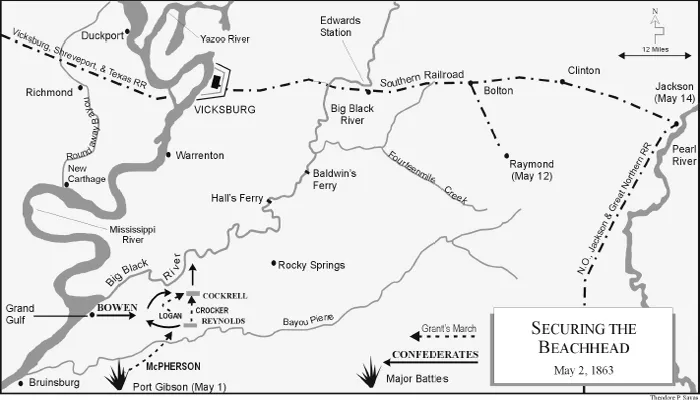
Grant was anxious to push across Little and Big Bayou Pierre and keep the momentum going lest the Confederates move into position to deter his efforts and block his drive on Vicksburg. Rather than wait for the engineers to complete their task, elements of Maj. Gen. James B. McPherson’s XVII Corps were directed to ascend the bayou and, if need be, force a crossing at Askamalla Ford three miles above town. The brigades of Brig. Gens. John E. Smith and Elias Dennis were ordered to shoulder their knapsacks and swing into column. Guided by a local black the rugged soldiers marched out of town and off to the southeast. An hour later they reached the bank of Little Bayou Pierre and were relieved to find that the ford was unguarded. The two brigades quickly splashed across the stream and, pushing on, were soon in position on Confederate Colonel Benjamin Grubb Humphrey’s plantation where they secured possession of the Port Gibson-Vicksburg road. Here they discovered a commissary depot that contained 8,000 pounds of bacon which, much to their delight, was distributed among the men to augment their limited supplies. (The Confederates would later lament loss of this bacon as by the end of June the Vicksburg garrison was issued mule meat.)4
Grant also ordered Maj. Gen. John A. Logan to move with one brigade of his division and investigate the possible use of the road and railroad bridges across Bayou Pierre west of Port Gibson that led to Grand Gulf. As the Federals expected, the highway bridge that had served as the avenue of escape for Brig. Gen. John S. Bowen’s force from the battlefield the previous afternoon had been torched by the retreating Confederates. To further deter the bluecoats, a brigade of infantry led by the aggressive Col. Francis Cockrell, four guns of Capt. Henry Guibor’s Missouri Battery, and the two remaining guns of the Botetourt (Virginia) Artillery guarded the crossing. Logan had no desire to force a crossing in the face of determined opposition and so simply held the Confederates in position for several hours then retired to Port Gibson.
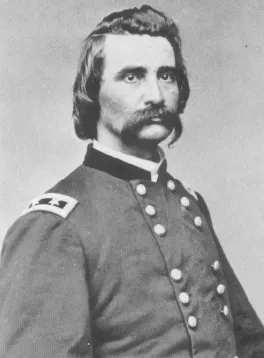
Maj. Gen. John A. Logan
National Archives
Back in town, Wilson and Tresilian completed a more-sturdy span that was a continuous raft which measured 166 feet long and 12 feet wide. As the approaches were over quicksand, the engineers had fatigue parties corduroy the road and cover the planks with dirt. By 4:00 p.m. the bridge was open and the XVII Corps division of Brig. Gen. Marcellus Crocker crossed over the bayou. Turning east, Crocker’s men pushed past Humphreys’ plantation, where the brigades of Smith and Dennis joined the column, and on toward Grindstone Ford in hope of securing intact the suspension bridge across Big Bayou Pierre.
It was near 7:30 p.m. and the last light of day was rapidly fading when the vanguard reached Grindstone Ford. To their disappointment flames were licking at the far end of the bridge and threatened to engulf the structure. Captain Tresilian, who was traveling with the vanguard, organized men into a firefighting brigade and hurried onto the span to extinguish the flames. Their valiant effort managed to put out the blaze and save the bridge, but repairs were needed before troops could cross.
Throughout the night as soldiers of Crocker and Logan’s divisions caught some much needed sleep, the corps’ pioneer company and soldiers from the Fourth Minnesota labored to make repairs. Charred sections were planked over to form a new roadway and long pieces of timber were lashed to the suspension rods by wire to strengthen the bridge. As the new floor was ten inches above the old surface, ramps also had to be raised to facilitate the passage of wagons and artillery. Tresilian pushed the men hard and by 5:30 the following morning the bridge was declared open.
Watching the Federal activity from a safe distance were the weary soldiers of Col. Arthur E. Reynolds’ demi-brigade who had moved into position on the high ground overlooking the bayou after a grueling march from Big Black River Bridge, east of Vicksburg. Consisting of the Fifteenth and Twenty-sixth Mississippi Infantry and the four guns of Company C, Fourteenth Mississippi Artillery Battalion, Reynolds’ men were no match for the powerful Federal force that gathered on the opposite side of the stream. The Mississippians realized that they were all that stood between the enemy and Hankinson’s Ferry on the Big Black River, thus blocking the direct road to Vicksburg. Despite the disparity of numbers they mustered their courage and settled in for a long night during which they prayed that succor would arrive in the morning.
Accompanying the Mississippians to Big Bayou Pierre were Maj. Gen. William W. Loring and Brig. Gen. Lloyd Tilghman who rode on to Grand Gulf to confer with Bowen. The fiery Bowen was visibly shocked when informed of the paucity of troops then en route to his aid. He had hoped to establish a formidable line of defense behind Bayou Pierre, a position he felt he could hold indefinitely. But with the enemy now north of Little Bayou Pierre and threatening Grindstone Ford, it was apparent to the Confederate generals that Grand Gulf had to be abandoned lest the command be trapped in a cul-de-sac from which there could be no escape. The success of their movement would depend on getting across Big Black River at Hankinson’s before the Federals brushed Reynolds’ Mississippians aside and seized the flatboat bridge at the strategic ferry.
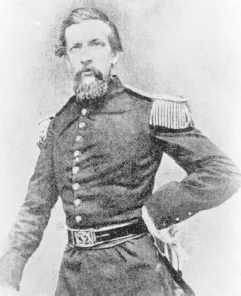
Brig. Gen. John S. Bowen
National Archives
Throughout the night of May 2 Southern soldiers worked feverishly to dismount and spike the heavy guns that had inflicted heavy damage to R. Adm. David Dixon Porter’s ironclads on April 29 and removed the commissary stores and quartermaster supplies. As a parting gesture, the bastion’s three magazines were exploded, the sound of which reverberated among the hills and along the Mississippi River for miles, announcing to the world that Grand Gulf was open. (The explosions were heard at Bruinsburg where Porter’s fleet was tied up for the night. In the light of dawn on May 3, his squadron stood upriver and Union sailors took possession of the fortress that their guns could not silence.)
Though disheartened by the necessity of abandoning the fortress they had worked so hard to construct and valiantly defend, the men of Bowen’s command were still full of fight and took up the line of march by the light of the moon. Daylight, however, found them still many miles from the safety of Big Black River and the ominous rumble of artillery could be heard in the direction of Grindstone Ford. In an effort to stave off disaster, Tilghman was directed to take the brigade of Alabamans and hasten to the assistance of Reynolds’ small command. Despite this reinforcement, there were still too few Confederates to offer stiff resistance to the Federal juggernaut which at that moment was crossing the bayou below.5
With the first light of day, Logan’s Union division pushed across the bridge and started up the steep grade that led to the important road junction of Willow Springs (also referred to as Willows) two miles away. From Willows, a road ran west through Ingleside to Grand Gulf where contact could be made with Porter’s fleet and thus enable Grant to more easily supply his army. Roads also ran northeast to Rocky Springs and north to the important ferry crossing at Hankinson’s. The troops of Crocker’s division followed in support in expectation that battle would soon be joined.
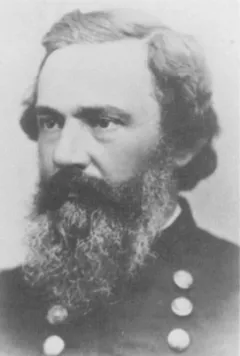
Brig. Gen. John E. Smith
National Archives
Such expectations were well grounded. As the Federals neared the crest, the long column was fired upon by the cannoneers from Mississippi, whose guns were concealed from view. The lead brigade under John E. Smith scurried into line of battle and was hurled forward with the Forty-fifth Illinois on the left, Thirty-first Illinois in the center, and the Twenty-third Indiana on the right. As they formed line of battle three of the Hoosiers were wounded when a shell exploded in their midst. Once formed the line swept forward with a vengeance but only met token resistance and soon gained the crossroads.
Yielding the crossroads compelled the Confederates to fight on two fronts in order to safeguard the army as it crossed Big Black River at Hankinson’s Ferry. Arthur Reynolds’ Mississippians attempted to form line astride the Ingleside-Grand Gulf Road while the Alabamans under Brig. Gen. Stephen D. Lee covered the direct road to Hankinson’s. But terrain prevented these two brigades from forming a connection. With their flanks in the air, both brigades were soon hard pressed and forced back farther.
Having occupied Willows, the Federals pressed the...
Table of contents
- Coverpage
- FM
- Title
- Copyrightpage
- DedicationPage
- FM1
- Contents
- Preface and Acknowledgments
- Foreword
- Chapter 1: Beyond the Rubicon: The Union Army Secures Its Beachhead on Mississippi Soil
- Chapter 2: Blitzkrieg: Grant Style
- Chapter 3: The National Colors Are Restored O’er the Capitol
- Chapter 4: John A. McClernand: Fighting Politician
- Chapter 5: Companion to the Fishes: The Saga of the Gunboat Cincinnati
- Chapter 6: The Lords of Vicksburg
- Chapter 7: “I Am Too Late:” Joseph E. Johnston and the Army of Relief
- Chapter 8: “No Longer A Point of Danger:” The Siege of Jackson
- Chapter 9: Crucial to the Outcome: Vicksburg and the Trans-Mississippi Supply Line
- Chapter 10: Stephen D. Lee and the Making of an American Shrine
- Epilogue
- Notes
- Bibliography
Frequently asked questions
Yes, you can cancel anytime from the Subscription tab in your account settings on the Perlego website. Your subscription will stay active until the end of your current billing period. Learn how to cancel your subscription
No, books cannot be downloaded as external files, such as PDFs, for use outside of Perlego. However, you can download books within the Perlego app for offline reading on mobile or tablet. Learn how to download books offline
Perlego offers two plans: Essential and Complete
- Essential is ideal for learners and professionals who enjoy exploring a wide range of subjects. Access the Essential Library with 800,000+ trusted titles and best-sellers across business, personal growth, and the humanities. Includes unlimited reading time and Standard Read Aloud voice.
- Complete: Perfect for advanced learners and researchers needing full, unrestricted access. Unlock 1.5M+ books across hundreds of subjects, including academic and specialized titles. The Complete Plan also includes advanced features like Premium Read Aloud and Research Assistant.
We are an online textbook subscription service, where you can get access to an entire online library for less than the price of a single book per month. With over 1.5 million books across 990+ topics, we’ve got you covered! Learn about our mission
Look out for the read-aloud symbol on your next book to see if you can listen to it. The read-aloud tool reads text aloud for you, highlighting the text as it is being read. You can pause it, speed it up and slow it down. Learn more about Read Aloud
Yes! You can use the Perlego app on both iOS and Android devices to read anytime, anywhere — even offline. Perfect for commutes or when you’re on the go.
Please note we cannot support devices running on iOS 13 and Android 7 or earlier. Learn more about using the app
Please note we cannot support devices running on iOS 13 and Android 7 or earlier. Learn more about using the app
Yes, you can access Triumph & Defeat by Terrence J. Winschel in PDF and/or ePUB format, as well as other popular books in History & 19th Century History. We have over 1.5 million books available in our catalogue for you to explore.