In 2021, the Chinese Communist Party celebrated a century of existence. Since the Party's humble beginnings in the Marxist groups of the Republican era to its current global ambitions, one thing has not changed for China's leaders: their claim to represent the vanguard of the Chinese working class. Spanning from the night classes for workers organised by student activists in Beijing in the 1910s to the labour struggles during the 1920s and 1930s; from the turmoil of the Cultural Revolution to the social convulsions of the reform era to China's global push today, this book reconstructs the contentious history of labour in China from the early twentieth century to this day (and beyond). This will be achieved through a series of essays penned by scholars in the field of Chinese society, politics, and culture, each one of which will revolve around a specific historical event, in a mosaic of different voices, perspectives, and interpretations of what constituted the experience of being a worker in China in the past century.
Contributors: Corey Byrnes, Craig A. Smith, Xu Guoqi, Zhou Ruixue, Lin Chun, Elizabeth J. Perry, Tony Saich, Wang Kan, Gail Hershatter, Apo Leong, S.A. Smith, Alexander F. Day, Yige Dong, Seung-Joon Lee, Lu Yan, Joshua Howard, Bo ?renlund S?rensen, Brian DeMare, Emily Honig, Po-chien Chen, Yi-hung Liu, Jake Werner, Malcolm Thompson, Robert Cliver, Mark W. Frazier, John Williams, Christian Sorace, Zhu Ruiyi, Ivan Franceschini, Chen Feng, Ben Kindler, Jane Hayward, Tim Wright, Koji Hirata, Jacob Eyferth, Aminda Smith, Fabio Lanza, Ralph Litzinger, Jonathan Unger, Covell F. Meyskens, Maggie Clinton, Patricia M. Thornton, Ray Yep, Andrea Piazzaroli Longobardi, Joel Andreas, Matt Galway, Michel Bonnin, A.C. Baecker, Mary Ann O'Donnell, Tiantian Zheng, Jeanne L. Wilson, Ming-sho Ho, Yueran Zhang, Anita Chan, Sarah Biddulph, Jude Howell, William Hurst, Dorothy J. Solinger, Ching Kwan Lee, Chlo? Froissart, Mary Gallagher, Eric Florence, Junxi Qian, Chris King-chi Chan, Elaine Sio-Ieng Hui, Jenny Chan, Eli Friedman, Aaron Halegua, Wanning Sun, Marc Blecher, Huang Yu, Manfred Elfstrom, Darren Byler, Carlos Rojas, Chen Qiufan.
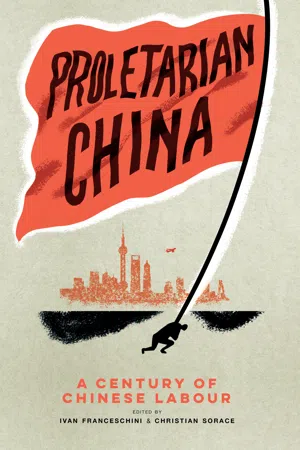
eBook - ePub
Proletarian China
A Century of Chinese Labour
- 720 pages
- English
- ePUB (mobile friendly)
- Available on iOS & Android
eBook - ePub
Proletarian China
A Century of Chinese Labour
About this book
Trusted by 375,005 students
Access to over 1.5 million titles for a fair monthly price.
Study more efficiently using our study tools.
Information
References
Introduction (Ivan Franceschini and Christian Sorace)
1 The unabridged translation of Deng Zhongxia’s essay about his trip to Changxindian is included in this volume. See the chapter ‘A Day Trip to Changxindian’ (1920).
2 For Deng Zhongxia’s early years and contribution to the Chinese labour movement, see Daniel Y.K. Kwan. 1997. Marxist Intellectuals and the Chinese Labor Movement: A Study of Deng Zhongxia 1894–1933. Seattle, WA: University of Washington Press.
3 For an account of the Jasic struggle, see Manfred Elfstrom’s essay about 2018 in the present volume.
4 Yueran Zhang. 2020. ‘Leninists in a Chinese Factory: Reflections on the Jasic Labour Organising Strategy.’ Made in China Journal 5, no. 2: 82–88.
5 ‘Orwell in the Chinese Classroom.’ Made in China Journal, 27 May 2019, available online at: madeinchinajournal.com/2019/05/27/orwell-in-the-chinese-classroom.
6 Rebecca Karl. 2020. China’s Revolution in the Modern World: A Brief Interpretive History. London: Verso Books, 3.
7 Karl Marx and Frederick Engels (translated by Samuel Moore). 1848. Manifesto of the Communist Party. London: Workers’ Educational Association, available online at: www.marxists.org/archive/marx/works/download/pdf/Manifesto.pdf.
8 Jacques Rancière. 2004. The Philosopher and His Poor. Durham, NC: Duke University Press, 113
9 Ibid., 107, 114.
10 Wang Hui. 2020. ‘How Does the Phoenix Achieve Nirvana?’ Made in China Journal 5, no. 1: 94–103.
11 See Lin Chun’s essay about 1921 in the present volume.
12 For a detailed account of competing political visions of labour in late-Imperial and early Republican China, see S.A. Smith. 2002. Like Cattle and Horses: Nationalism and Labor in Shanghai, 1895–1927. Durham, NC: Duke University Press.
13 See Gail Hershatter’s essay about 1925 in the present volume; Rancière, The Philosopher and His Poor, 137.
14 On these debates about the ‘making’ and ‘unmaking’ of the Chinese working class, see Pun Ngai and Chris King-Chi Chan. 2008. ‘The Subsumption of Class Discourse in China.’ Boundary 2 35, no. 2: 75–91; William Hurst. 2016. ‘The Chinese Working Class: Made, Unmade, in Itself, for Itself, or None of the Above?’ Made in China Journal 1, no. 2: 11–14.
15 See, for instance, Andrew G. Walder. 1986. Communist Neo-Traditionalism: Work and Authority in Chinese Industry. Berkeley, CA: University of California Press.
16 On labour activism in the Maoist era, see, for instance, Jackie Sheehan. 1998. Chinese Workers: A New History. London: Routledge; Joel Andreas. 2019. Disenfranchised: The Rise and Fall of Industrial Citizenship in China. New York: Oxford University Press. On continuity, see Robert Cliver. 2020. Red Silk: Class, Gender, and Revolution in China’s Yangzi Delta Silk Industry. Cambridge, MA: Harvard University Press.
17 On the right to strike in China, see Fang Lee Cooke and Chang Kai. 2015. ‘Legislating the Right to Strike in China: Historical Development and Prospects.’ Journal of Industrial Relations 57, no. 3: 440–55.
18 See the essays by Chen Feng about 1957, by Patricia Thornton about 1967, the 1951 speech by Li Lisan, and the 1957 interview by Lai Ruoyu in the present volume.
19 On the dossier, see Michael Dutton. 2004. ‘Mango Mao: Infections of the Sacred.’ Public Culture 16, no. 2: 161–88; Jie Yang. 2011. ‘The Politics of the Dang’an: Spectralization, Spatialization, and Neoliberal Governmentality.’ Anthropological Quarterly 84, no. 2: 507–33; Jie Li. 2020. Utopian Ruins: A Memorial Museum of the Mao Era. Durham, NC: Duke University Press, Ch. 1.
20 Timothy Cheek. 2016. ‘Attitudes in Action: Maoism as Emotional Political Theory.’ In Chinese Thought as Global Theory: Diversifying Knowledge Production in the Social Sciences and Humanities, edited by Leigh Jenco. Albany: SUNY Press, 75–100.
21 Andreas, Disenfranchised, 8–9.
22 Kevin Lin. 2019. ‘Work Unit.’ In Afterlives of Chinese Communism: Political Concepts from Mao to Xi, edited by Christian Sorace, Ivan Franceschini and Nicholas Loubere. Canberra and London: ANU Press and Verso Books, 331–34.
23 Christian Sorace. 2020. ‘Metrics of Exceptionality, Simulated Intimacy.’ Critical Inquiry 46: 555–77.
24 See Andrea Piazzaroli Longobardi’s essay about 1968 in the present volume.
25 Rancière, The Philosopher and His Poor, 219.
26 On anamorphosis, see Slavoj Žižek. 1992. Looking Awry: An Introduction to Jacques Lacan Through Popular Culture. Cambridge, MA: The MIT Press.
27 Feng Chen. 2007. ‘Individual Rights and Collective Rights: Labor’s Predicament in China.’ Communist and Post-Communist Studies 40, no. 1: 59–79.
28 Elaine Sio-Ieng Hui. 2017. Hegemonic Transformation: The State, Laws, and Labour Relations in Post-Socialist China. New York, NY: Palgrave Macmillan. On the instrumental use of the law by the Party-State in China, see also Mary Gallagher. 2017. Authoritarian Legality in China: Law, Workers, and the State. Cambridge, UK: Cambridge University Press.
29 On this subject, see also Ivan Franceschini and Christian Sorace. 2019. ‘In the Name of the Working Class: Narratives of Labour Activism in Contemporary China.’ Pacific Affairs 92, no. 4: 643–64.
30 Alessandro Russo. 2019. ‘Class Struggle.’ In Afterlives of Chinese Communism, 29–35, at p. 34.
31 See Jude Howell’s essay about 1995 and Chloé Froissart and Ivan Franceschini’s essay about 2015 in the present volume.
32 Rancière, The Philosopher and His Poor, 224.
33 Jacques Rancière (translated by John Drury). 2012. Proletarian Nights: The Workers’ Dream in Nineteenth-Century France. London: Verso Books, 10.
34 Marx and Engels, Manifesto of the Communist Party.
35 For analysis of the preservation of communist leaders’ corpses, see Alexei Yurchak. 2015. ‘Bodies of Lenin: The Hidden Science of Communist Sovereignty.’ Representations 129, no. 1: 116–57.
36 Russo, ‘Class Struggle’, 35.
37 Peter Sloterdijk (translated by Sandra Berjan). 2020. Infinite Mobilization. Cambridge, UK: Polity Press, 60.
38 Mark Fisher. 2016. The Weird and the Eerie. London: Repeater Books, 11.
39 Li, Utopian Ruins, 156.
40 Ibid.
41 On emergent private utopias, see Zhang Li. 2010. In Search of Paradise: Middle-Class Living in a Chinese Metropolis. Ithaca, NY: Cornell University Press; Jiwei Ci. 1994. Dialectic of the Chinese Revolution: From Utopianism to Hedonism. Stanford, CA: Stanford University Press.
42 ‘A Strategy for Ruination: An Interview with China Miéville.’ Boston Review, 8 January 2018, available online at: conversations.e-flux.com/t/china-mieville-we-live-in-a-utopia...
Table of contents
- Cover Page
- Halftitle Page
- Title Page
- Copyright Page
- Table of Contents
- The Proletariat Is Dead, Long Live the Proletariat!
- 1898: ‘A Cheaper Machine for the Work’
- 1902: Techno-Utopias and Robots in China’s Past Futures
- 1915: An Extraordinary Journey: Chinese Labourers on the Western Front during the Great War
- 1920: A Day Trip to Changxindian
- 1921: Setting Sail: The Foundation of the Chinese Communist Party
- 1922: The Anyuan Strike of 1922: Lessons in Leadership
- 1923: The 7 February Massacre
- 1925: From the May Thirtieth Movement to the Canton–Hong Kong Strike
- 1925: Everyday Politics in Tianjin Factories
- 1925: The Founding of the All-China Federation of Trade Unions
- 1927: The Third Armed Uprising and the Shanghai Massacre
- 1927: Organising Rural Society: Disintegrating Rural Governance, Peasant Associations, and the Hailufeng Soviet
- 1928: Feminist Agitation inside Chinese Factories
- 1929: Striking for Rice: The Struggle for the ‘Rice Allowance’ in Republican China
- 1938: Resurgence of Labour Activism in Prewar Hong Kong
- 1941: The New China Daily and the Moral Language of Class in Wartime Chongqing
- 1942: The Rise and Fall of Wu Manyou, China’s First Labour Hero
- 1946: Production in Revolution: Agricultural and Political Labour during Land Reform
- 1948: Women Workers and the Shanghai Cotton Mill Strike of 1948
- 1949: On the People’s Democratic Dictatorship (Excerpt)
- 1949: Continuity and Change: Women Workers in the Early People’s Republic of China
- 1949: A Spark Extinguished: Worker Militancy in Taiwan after World War II (1945–1950)
- 1951: Li Lisan on the Relationship between Management and Unions
- 1951: Revolutionising the Factory through the Mass Political Campaign
- 1952: Housing the New Socialist Worker: The ‘Workers’ New Village’ in Shanghai
- 1952: The First Patriotic Locust Extermination Campaign: Rural Labour Mobilisation and Pest Control in the Early People’s Republic of China
- 1955: The Short-Lived Eternity of Friendship: Chinese Workers in Socialist Mongolia (1955–1964)
- 1957: How Do Unions Handle Contradictions among the People?
- Confronting the State: The Strike Wave of 1957
- 1958: Beyond the Wage: Zhang Chunqiao, Bourgeois Right, and Maoism as Theory
- 1958: Reorganising Chinese Labour: The Establishment of the Household Registration System
- 1960: Workers’ Peril in the Workers’ State: The Laobaidong Colliery Disaster
- 1960: The Angang Constitution: Labour, Industry and Bureaucracy during the Great Leap Forward
- 1960: Production First, Life Second: The 1960 Ban on Hand Spinning and Hand Weaving
- 1961: Anatomy of a Woman Worker: Collectivisation and Labour during the Great Leap Forward
- 1962: Working Together in Agricultural Production Teams: The Work Lives of the Majority of Chinese Under Mao
- 1963: Gods, Ghosts, and Workers: ‘Feudal Superstition’ and the Socialist Education Movement, 1963–1966
- 1964: Learning from the Daqing Oilfields
- 1964: The Third Front Campaign
- 1967: The January Storm of 1967: From Representation to Action and Back Again
- 1967: The Hong Kong Riots of 1967
- 1968: The Establishment of the First Workers’ University
- 1969: ‘Oppose Restoring the Old!’: The Culmination of the Rebel Workers’ Movement in Wuhan during the Cultural Revolution
- 1970: Building Uhuru: Chinese Workers and Labour Diplomacy on the Tan–Zam Railway
- 1972: Transforming Urban Youth into Peasants: The Maoist Rustication Movement of the 1960s–1970s
- 1976: The Blank Exam: Crises of Student Labour and Activism in the Late Cultural Revolution Film Juelie
- 1980: Echoes of the Rise of Solidarity in Poland
- 1981: Abandoning Collective Farming and the Effects on Labour
- 1983: Dagongmei: Gendered Troubles in the City of Dreams
- 1986: Sex Workers in China: From Criminalisation and Abuse to Activism
- 1988: The Lifting of Martial Law and the Rise of Taiwan’s Independent Labour Movement
- 1989: Workers on Tiananmen Square
- 1993: Voices from the Zhili Fire: The Tragedy of a Toy Factory and the Conditions It Exposed
- 1994: One Law to Rule Them All: The First Labour Law of the People’s Republic of China
- 1995: From Green Shoots to Crushed Petals: Labour NGOs in China
- 1995: The Blocked Path: Political Labour Organising in the Aftermath of the Tiananmen Crackdown
- 1997: Xiagang: The Fifteenth Party Congress and Mass Layoffs in State-Owned Enterprises
- 2001: China Joins the World Trade Organization: Implications for Workers
- 2002: The Liaoyang Strike and the Unmaking of Mao’s Working Class in China’s Rustbelt
- 2003: The Sun Zhigang Case
- 2007: Slaving Away: The ‘Black Brick Kilns Incident’ of 2007
- 2008: The Labour Contract Law and Its Discontents
- 2008: ‘Make Contributions and Offer Your Youth for Tomorrow’s Dream’: The Establishment of the Shenzhen Migrant Worker Museum
- 2009: Zhang Haichao’s ‘Open-Chest Case’
- 2010: The Nanhai Honda Strike
- 2010: The Foxconn Suicide Express
- 2011: Rupture at the Centre: Evicting Migrant Schools in Beijing
- 2013: Chinese Workers on the Belt and Road
- 2014: Bearing Witness to History: Dagong Poets from the 1980s to the Present
- 2014: The Yue Yuen Strike
- 2015: Replacing Humans with Machines
- 2015: Labour NGOs under Assault
- 2018: The Jasic Struggle
- 2018: Factories of Turkic Muslim Internment
- 2019: The Birth of a New Trade Union Movement in Hong Kong
- The Future: Folding Time: Futuristic Reflections on Class Divisions in Contemporary China
- The Affective Fallacy
- Acknowledgments
- References
- Contributors
Frequently asked questions
Yes, you can cancel anytime from the Subscription tab in your account settings on the Perlego website. Your subscription will stay active until the end of your current billing period. Learn how to cancel your subscription
No, books cannot be downloaded as external files, such as PDFs, for use outside of Perlego. However, you can download books within the Perlego app for offline reading on mobile or tablet. Learn how to download books offline
Perlego offers two plans: Essential and Complete
- Essential is ideal for learners and professionals who enjoy exploring a wide range of subjects. Access the Essential Library with 800,000+ trusted titles and best-sellers across business, personal growth, and the humanities. Includes unlimited reading time and Standard Read Aloud voice.
- Complete: Perfect for advanced learners and researchers needing full, unrestricted access. Unlock 1.5M+ books across hundreds of subjects, including academic and specialized titles. The Complete Plan also includes advanced features like Premium Read Aloud and Research Assistant.
We are an online textbook subscription service, where you can get access to an entire online library for less than the price of a single book per month. With over 1.5 million books across 990+ topics, we’ve got you covered! Learn about our mission
Look out for the read-aloud symbol on your next book to see if you can listen to it. The read-aloud tool reads text aloud for you, highlighting the text as it is being read. You can pause it, speed it up and slow it down. Learn more about Read Aloud
Yes! You can use the Perlego app on both iOS and Android devices to read anytime, anywhere — even offline. Perfect for commutes or when you’re on the go.
Please note we cannot support devices running on iOS 13 and Android 7 or earlier. Learn more about using the app
Please note we cannot support devices running on iOS 13 and Android 7 or earlier. Learn more about using the app
Yes, you can access Proletarian China by Ivan Franceschini, Kevin Lin, Christian Sorace, Nicholas Loubere, Ivan Franceschini,Kevin Lin,Christian Sorace,Nicholas Loubere in PDF and/or ePUB format, as well as other popular books in History & 20th Century History. We have over 1.5 million books available in our catalogue for you to explore.