In this searching, elegant essay, critically acclaimed writer Katherine Angel examines the place of fathers in contemporary culture with her characteristic mix of boldness and nuance, asking how the mixture of love and hatred we feel towards our fathers—and patriarchal father figures—can be turned into a relationship that is generative rather than destructive.Moving deftly between psychoanalysis from Freud to Winnicott, cultural visions of fathering from King Lear to Ivanka Trump, and issues from incest to #MeToo, Angel probes the fraught bond of daughters and fathers, women and the patriarchal regime. What, she asks, is this discomfiting space of love and hate—and how are we to reckon with both fealty and rebellion?As in her earlier Tomorrow Sex Will Be Good Again, Angel proves herself yet again to be one of the most perceptive feminist writers at work today.
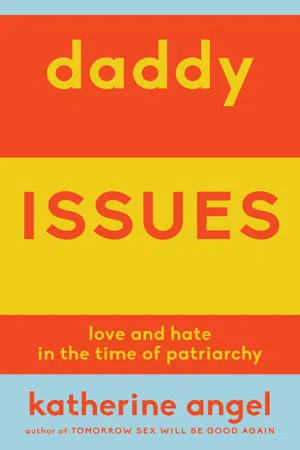
- 96 pages
- English
- ePUB (mobile friendly)
- Available on iOS & Android
eBook - ePub
About this book
Trusted by 375,005 students
Access to over 1.5 million titles for a fair monthly price.
Study more efficiently using our study tools.
Information
daddy
ISSUES
In the awful, wearying months in which Harvey Weinstein’s ritualistic mistreatment of women was being recounted daily in the media, I found myself, like so many others, wondering and talking about the men in my life: ex-boyfriends, ex-stalkers, ex-harassers, exgropers. My friends and I looked back, fitfully, in agitation, at the things we had endured, the things we had kept silent about, and we looked around at the things that were bothering us now. Throughout the autumn and winter, we told and re-told stories, seeing them in a new light, gently mentioning things we knew about one another’s lives, murky memories, events we had not mentioned for years. We talked with a renewed anger and frankness, a renewed sense of permission in so doing—and perhaps, too, a renewed sense of simplicity. We were questioning all the men in our lives, all the forms of patriarchal power. But we rarely spoke about our fathers.
Soon after the allegations against him were published, Weinstein’s wife Georgina Chapman announced she was leaving him. I kept thinking: what about his children? You can, at least in principle, leave a husband, but you can’t leave a father.
In her poem ‘Sunday Night’, Sharon Olds describes her father, during family meals in restaurants, putting
his hand up a waitress’s
skirt if he could—hand, wrist,
forearm.
skirt if he could—hand, wrist,
forearm.
Olds notes that she never warned the young women.
Wooop! he would go, as if we were having
fun together.
fun together.
She fantasises sticking a fork in his arm, hearing ‘the squeak of muscle’, feeling ‘the skid on bone.’
Sometimes
I imagine my way back into the skirts
of the women my father hurt, those bells of
twilight, those sacred tented woods.
I want to sweep, tidy, stack—
whatever I can do, clean the stable
of my father’s mind.
I imagine my way back into the skirts
of the women my father hurt, those bells of
twilight, those sacred tented woods.
I want to sweep, tidy, stack—
whatever I can do, clean the stable
of my father’s mind.
Sharon Olds’s project is reparative; she wants to heal the wounds her father has inflicted—she wants to use language to restore dignity and pleasure. Can words rewind time, undo harms? We might wish they could. But who are we when we make this attempt? Who are we writing as?
*
In her memoir Fierce Attachments, Vivian Gornick writes with horror of feeling consumed by her mother. She evokes familial intimacy as contamination, as infection:
My skin crawled with her … Her influence clung, membrane-like, to my nostrils, my eyelids, my open mouth. I drew her into me with every breath I took. I drowsed in her etherizing atmosphere.
Here, closeness is interpenetration of a dangerous kind; intimacy is drugging, threatening to consciousness, wakefulness, alertness. Boundaries are broken, or never established, and merging ensues. We inhabit, become, and reproduce our parents. They are in us; we are made of them, for good and for ill.
Sharon Olds, like Gornick, has written plentifully from her own life—about her parents, her husband, her children, her divorce—and has spent years navigating the agitated responses to such writing. It’s generally assumed, and insisted upon, that writing from one’s own life is the definition of exposure and of vulnerability. In some ways that is true, not least because the politics of speech and sexuality for women do make them vulnerable to judgement, to shaming, and to violence. But something else is sidelined by this insistence on the vulnerability of first-person writing, which is that writing isn’t simply exposure: it is also protection. Writing is a spell; it conjures a person anew, and erects a protective wall. It can create a clear and ferocious distinction between self and other. It can enable the finding of a way ‘to exist as oneself, and to relate to objects as oneself, and to have a self into which to retreat for relaxation’.
This is how psychoanalyst Donald Winnicott described the experience of ‘feeling real’—an experience dependent on positive early parenting, on ‘good-enough’ mothering. (His language reflects the fact that it has usually been mothers who do the bulk of early parenting, though he underlined that the role of the good-enough mother can be fulfi lled by others.) For Winnicott, this good-enough experience involved the mother’s absorption in the infant; her flexible management of the infant’s frustration and disappointment in her; and her ability to tolerate and survive the infant’s aggression towards her. She must be able both to mirror the child back to itself, and to withstand its destructive impulses; be able to let him pursue a ‘ruthless relation’ to her, a ‘benign exploitation’ of her.
The formidable challenge of parenting is to nurture an environment which is, as Adam Phillips put it in his book on Winnicott, ‘suffi ciently resilient and responsive to withstand the full blast of the primitive love impulse’—and the full blast of aggression. ‘Shall I say’, wrote Winnicott, ‘that, for a child to be brought up so that he can discover the deepest part of his nature, someone has to be defi ed, and even at times hated … without there being a danger of a complete break in the relationship?’
*
Feminism and fathers have long been entangled, often in antagonism. Denouncing the patriarchal family has resonated for white, middle-class feminists in particular—women historically trapped in the bourgeois home, longing for emancipation from the family into the world of work. In 1938, Virginia Woolf’s Three Guineas made powerful use of the figure of the father versus the figure of work. Her long essay is about the ‘daughters of educated men’ entering the professions, and it mulls on the effects of the 1919 Act that unbarred women from doing so: ‘The door of the private house was thrown open.’
Woolf herself was no stranger to tyrannical, possessive fathers; her father Leslie Stephen formed the basis of her depiction of Victorian fathers in her fiction—in The Years, in Night and Day, in To the Lighthouse. Leslie Stephen enacted a suffocating domination of his daughters, particularly his stepdaughter Stella Duckworth, and all the more so after the death of their mother Julia Stephen.
Hermione Lee writes that, after Julia’s untimely death, Leslie Stephen ‘completely appropriated Stella as a substitute and she had allowed him to do it.’ Woolf herself, in ‘Reminiscences’, written between 1907 and 1908, said that
I do not think that Stella lost consciousness for a single moment during all those months of his immediate need … Sometimes at night she spent a long time alone in his study with him, hearing again and again the bitter story of his loneliness, his love and his remorse.
Stella was the audience for Leslie Stephen’s grief, though she too was grieving; she was also expected to take on the work of looking after her half-sisters Virginia and Vanessa. Leslie, moreover, punished Stella for trying to leave the family home once she was to be married; her marriage was delayed by months due to his anguish. In 1939, in a piece entitled ‘Memoir’, looking back at this time as she periodically did, Woolf wrote:
How the family system tortures and exacerbates … I feel that if father could have been induced to say ‘I am jealous’, not ‘You are selfi sh’, the whole family atmosphere would have been cleared and brightened.
No wonder Woolf held out hope for the world of work as the antidote to the stifling father. This was, in part, the argument of A Room of One’s Own—it is money and independence from the family that enables women to write. But it is the argument, too, of Three Guineas, in which she writes that if women are to wield influence, an influence apart from the vulnerable, dependent influence wielded within the patriarchal family, that influence will lie in being able to ‘hold in their hands this new weapon, our only weapon, the weapon of independent opinion based upon independent income’.
This hierarchy of the public over the private—of the freedoms of professional life over the constraints of family—is entangled with social privilege, however. As bell hooks put it in 1984, ‘Many black women were saying “we want to have more time to share with our family, we want to leave the world of alienated work”’. And the workplace to which less privileged women have always been tied may not hold out the same alluring promise of freedom.
Yet Woolf has no illusions about either realm. The daughters of educated men are, she writes, ‘between the devil and the deep sea. Behind us lies the patriarchal system; the private house, with its nullity … its servility.’ And then, tantalisingly but disappointingly, ‘Before us lies the public world, the professional system, with its possessiveness, its jealousy, its pugnacity, its greed’—all words that could be applied to Leslie Stephen. Public and private alike are rotten for women.
Three Guineas charts the resistance of men to women’s incursions into public life. Woolf was, while writing the essay, ruminating, with her familiar mixture of curiosity and ambivalence when assessing other writers’ works, on the ideas of Freud that were garnering interest in England at this time. She describes fathers as ‘massed together in societies, in professions’, and reluctant to let their daughters out to work. ‘Society it seems’, she wrote, ‘was a father, and afflicted with the infantile fixation too.’
Work, however, has not been the refuge it was hoped to be. In ‘Revolutionary Parenting’, bell hooks writes, ‘The women’s liberationists who wanted to enter the work force did not see this world as a world of alienated work. They do now.’ In recent years, public scrutiny of sexual harassment in the workplace has intensifi ed, with good reason, though it has focused largely on the film and music industries, on the media and political classes—on Woolf’s professions. Can this renewed scrutiny be usefully read as, among other things, a story of white, middle-class disillusion with the emancipatory promise of work?
*
Patriarchy—meaning the rule of men more generally, rather than simply the rule of fathers—was once a staple of feminist discourse, its cornerstone even. As an organising concept, however, it fell into some disrepute, due to the wishful universalism that characterised much of its invocation, the way that, in diagnosing such a simple problem, it seemed to hope for a simple solution. Just as the term ‘w...
Table of contents
- Cover Page
- Halftitle Page
- Title Page
- Copyright Page
- Dedication
- Contents
- Daddy Issues
- Works Cited
- Thanks
Frequently asked questions
Yes, you can cancel anytime from the Subscription tab in your account settings on the Perlego website. Your subscription will stay active until the end of your current billing period. Learn how to cancel your subscription
No, books cannot be downloaded as external files, such as PDFs, for use outside of Perlego. However, you can download books within the Perlego app for offline reading on mobile or tablet. Learn how to download books offline
Perlego offers two plans: Essential and Complete
- Essential is ideal for learners and professionals who enjoy exploring a wide range of subjects. Access the Essential Library with 800,000+ trusted titles and best-sellers across business, personal growth, and the humanities. Includes unlimited reading time and Standard Read Aloud voice.
- Complete: Perfect for advanced learners and researchers needing full, unrestricted access. Unlock 1.5M+ books across hundreds of subjects, including academic and specialized titles. The Complete Plan also includes advanced features like Premium Read Aloud and Research Assistant.
We are an online textbook subscription service, where you can get access to an entire online library for less than the price of a single book per month. With over 1.5 million books across 990+ topics, we’ve got you covered! Learn about our mission
Look out for the read-aloud symbol on your next book to see if you can listen to it. The read-aloud tool reads text aloud for you, highlighting the text as it is being read. You can pause it, speed it up and slow it down. Learn more about Read Aloud
Yes! You can use the Perlego app on both iOS and Android devices to read anytime, anywhere — even offline. Perfect for commutes or when you’re on the go.
Please note we cannot support devices running on iOS 13 and Android 7 or earlier. Learn more about using the app
Please note we cannot support devices running on iOS 13 and Android 7 or earlier. Learn more about using the app
Yes, you can access Daddy Issues by Katherine Angel in PDF and/or ePUB format, as well as other popular books in Social Sciences & Feminism & Feminist Theory. We have over 1.5 million books available in our catalogue for you to explore.