There are echoes of Cormac McCarthy's
The Road and Stephen King's
The Stand, plus graphic violence and heart-stopping action set pieces, but what lifts
South above many recent examples of the subgenre is Owen's pared-down prose, slick narrative and the sensitive depiction of Dyce and Vida's relationship. -
Guardian
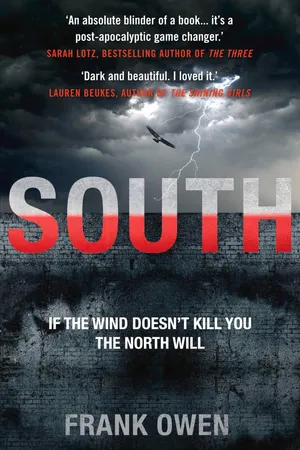
South takes place in a USA ravaged by Civil War. It's been thirty years since the first wind-borne viruses ended the war between North and South - and still they keep coming. Every wind brings a new and terrifying way to die. The few survivors live in constant fear, hiding from the wind - and from each other.
In this harsh Southern expanse, brothers Garrett and Dyce Jackson are on the run from brutal law-enforcers. They meet Vida, a lone traveller on a secret quest. Together, they will journey into the dark heart of a country riven by warfare and disease.
This is the story of Dyce and Vida.
This is the story of end-time.
This is the story of The Cure and how it came too late.
This is the story of South.
eBook - ePub
South
About this book
Information
1
Felix Callahan sat on the rusted exercise bike, naked. He had hung up his dripping clothes bachelor-style and they were drying against the opposite wall. As they stiffened they dripped a line of dots onto the dirt floor below. Old men pedal slowly, but with each turn of the coiled copper wheel the light bulb above him shimmered brighter and cast a wavering halo on the ceiling, a small, insistent glow against the dark. ‘Jesus bids us shine,’ Felix told himself. ‘Yessir, He does.’
Over his head was the shack proper, laid out like many a single man’s lodgings – part bar, part mausoleum – but here in the room below was where Felix did his best work. The light played over the piles of books on the floor, the bronze instruments on the makeshift desks, and the ancient Califone tape player settled on a cardboard fruit box. When Felix finally climbed down, his withered thighs shaking, he’d charged the swollen eighteen-volt car battery enough for forty minutes of power, maybe an hour. It would have to do.
He limped over to fetch a cracked glass from a crate. Felix liked things nice. He set the tumbler on the table and filled it halfway with a brown liquor that looked like cough mixture and tasted worse. It made his eyes water but – goddamn! – it sure woke you up.
He turned, his skinny shanks flexing, and opened a drawer. The rusted Llama Danton was under a stack of maps, some printed, most hand-drawn. He nodded a greeting to the gun and laid it carefully on the table next to the bottle. He sat in the better of the chairs, and behind him the tape player waited like a patient on a drip, connected to the battery with wire interrupted by nodes of brittle duct tape.
Felix needed to get his head straight. Two days ago he’d been out looking for chickadee eggs when a woman stumbled past him, calling for her dog, Pavlov. Felix had stayed hidden in the fescue and watched her go. She’d caught something bad. Brain viruses started with dementia and only went one way. He was willing to bet there was no dog. Maybe there never had been. But she thought there was, and that was what counted.
When he was sure the woman had gone, Felix came out, rubbing the small of his creaking back. He could handle most of the viruses. There was something comfortingly medieval about the boils and rashes, and they ended pretty quick, anyway. It was the speed at which the sicknesses ate their hosts that freaked him out. Renard had engineered that, Felix thought. He was the kind of asshole who would want results. Old-time viruses had taken a couple of days to incubate, but the ones that had started blowing in after The War were different. And Renard had had time to observe disease, Felix supposed. All that time up north, watching and learning as the president gave him his head – and all the laboratory equipment he needed. That was the kind of man that made Felix afraid: one who hadn’t been bad at the outset, but found that he liked the power – the kind that would poison someone, take notes as they died, and call it science. Like Pavlov, now that he thought about it.
But the kind of crazy that came with lonely was what spooked Felix, because you couldn’t fight that. Dog Lady had once had a family, hadn’t she? A place people knew her name, somewhere to bunk, a husband, maybe, or a wife – Felix wasn’t inclined to judge, and even the fur traders had a right to live. The War had wiped out all of those pernickety permutations. And, really, what was there to hang onto now, if you were the only one left? Survival was fine, but Felix thought that a man needed a purpose. And a purpose went hand in hand with community. ‘Love and service,’ he said softly. Take that away, and the mind went with it. How did you hold on to your sanity? It wasn’t enough that he had set up the weather boxes, though that sure as fuck filled his days. The longing had gnawed at him for a long time, and soon after that he’d wired the car battery to the exercise bike.
He’d laid his story down on tape, everything he figured worth knowing, in two thirty-minute segments. One for each side, like the North and South. And when someone like Dog Lady wandered past and rattled his cage, he’d sit down and listen to the tape. He promised himself that if the voice on the tape began to sound like someone else, or began to talk about things he didn’t recall, he’d pick up the pistol and eat it. And he would not think too hard before he did it.
The speaker in the tape player was gone, taken long before Felix had picked it up near Hayden, stashed in a tin box in the rotting ruins of a holiday cabin, but he had found a pair of headphones in an abandoned music store days later – pink, with a pussycat on each side. ‘Cool cat, looking for a kitty,’ Felix sang to himself whenever he saw them. Now he fitted the headphones over his ears, running the cable over his shoulder like a tail. He took a long drink from his tumbler and leant back in his chair so he could press play on the old machine. It whirred, and his recorded voice was deep and distant, stretched out a little further each time he played the tape. He rested a hand on the gun, breathed deep and closed his eyes.
‘Felix,’ his past self warned, ‘I hope you’ve still got the balls to have that gun on the table.’ He nodded and smiled.
‘Okay. Here we go. My name is Felix Callahan, but you know that, don’t you? I was born in Norman, Oklahoma, back when it was still a place.’ Felix had done the math. He’d kept track of his birthdays as best he could, adding another year to his tally each fall when the buckeyes turned orange. He figured there wasn’t a lot left to celebrate, so they were important – a reason to save up rations, a night to get drunk. He poured himself another drink and raised the glass in the gloom: ‘Had more than my three score and ten, so amen to that. Seventy-nine shitty birthdays – give or take a few of those times I was laid so low I didn’t see the seasons changing.’ He downed the drink and went back to listening to his younger voice and the mystery of his old life.
‘I had older brothers, once upon a time, and a mother and a father, the way it ought to be. I was the youngest by far. Not remembering it much probably means it was pretty smooth. There was milkshake vomit in footwells – that I remember – and broken arms from trampolines, and crackers in turds. The usual.
‘The War was where it all went wrong. Hitler’s war, though that’s not saying much, is it? I mean the Second World War. I remember the feeling at the end there, of the narrow escape we had all had, the West. When I heard about how my older brothers had stormed ashore and saved the Allied asses – that there was the first unpicked stitch that turned into the unraveling of civilization. Our corner of the quilt, anyhow. My brothers re-enacted those war scenes when they came home, like it was a game, gunfire coming from the hills: gack-gack-gack. Afterwards, when the show was done, there was always a silence when you were supposed to remember the soldiers who had died. It made me feel like Clark Kent, when he takes off his glasses, you know? America was invincible if young men would die before letting it fall apart. That’s what I believed. We all did.
‘But while everyone was slapping backs and shaking hands, the real threat was creeping up on us – and no one took any notice. I heard about it first years later on the radio. It was playing through the window of a corner shop in downtown Manhattan, that tinny newscaster’s voice, the smell of deep-fried yeast and sugar. I stopped to listen since I’d not heard news for some time. That, along with the Yankee scores, was the first I ever heard of the proposal: a Unified America. Another guy had stopped there too and both of us shook our heads and smiled.
‘“Same money works here as it does in Montana and Utah and the Dakotas. That’s as unified as it gets,” the man said. I nodded and bought a donut and a soda like I was trying to prove the point.
‘What was I doing all the way up there? I’m glad you asked, Future Felix. You’re a nice guy. I ended up opening an appliance store in Greenwich Village when I was twenty. I mainly sold TVs – installed them myself, too. There were only so many times I could hear my brothers go on about the war. They could make each other laugh or cry by saying things like, “Remember Frosty Joe?” or, “Abbiamo surrender!” Me, I was an outsider: too busy dirtying my diapers to fight the Germans when it all began, and by the time I was eighteen the whole damn thing was done and the carpet had been rolled up and packed away for next time.
‘I had to get out of Norman. New York was the only place I knew anything about. I thought I knew it because we used to listen to Lights Out on the radio every Wednesday. Man, I loved having the bejeezus scared out of me back then! One story stuck with me – about the ghosts of the animals from the Natural History Museum living in the sewers beneath the Empire State Building. That was where I was heading – to stand on the sidewalk and peer in through the manhole covers, just for kicks – when I stopped for the soda and the donut and heard about Unified America for the first time.
‘Soon after that came the legislated slum clearance of Greenwich Village. The Northerners wanted parks and new buildings: rent was cheap for those brave enough to pioneer. Or dumb enough, I hear you. I bought three television sets from a store in Jersey and ferried them, one by one, to Felix’s Television Emporium, clutching each set like a newborn on my lap as the Hoboken Ferry bobbed across the Hudson. Got a cat, a tuxedo, and called him Dallas because he was a cowboy. He was good for business: made people come in when they saw this fat-ass tomcat curled up in the window. Reeled them in. Whenever I sold a TV, I could buy two more. Then I made enough to afford a car and save my back from the newer sets, those motherfuckers with their twenty-pound glass screens. Twelve years I was there, and that included a failed marriage. I remember that part real good, let me tell you. But you don’t need to know all that. I still had Dallas. We sidewalk specials got to stick together.
‘I didn’t pay much mind to politics until the day that a UA member was voted into the US senate. As soon as he was in, he called for a national vote on the topic of unification. I laughed at the idea. It became the new How’s-this-weather? “How’re you gonna vote?” I’d ask as I approached a customer, and they’d smile and say something like, “Same money works here as it does in Utah. Can’t see how much more unified we need to be.” Then, when the customer came over to pay, I’d finish the joke by taking their money and looking at it closely, turning it over in my hands a few times and saying, “This ain’t Iowa money, is it?” We sure yukked it up.
‘The joking stopped a few years later when there were enough Unified America supporters in the senate to force a vote. Over the December of . . . jeez . . . nineteen-something . . . sixty-five? Seventy-five? Shit. It all looks the same to us geriatrics. Anyhow, one December came when every American was forced to return to the state of his or her birth. Kinda like Bethlehem in the wayback, know what I mean? The population of New York halved overnight. I closed shop and took the cash from the register and waited for a taxi to take me to the airport. I’d packed my things that morning. Not much: a couple of changes of clothes, a toothbrush, a copy of The Martian Chonicles I meant to reread. I’d need to be back in the city pretty soon if I wanted to make up for the loss of the best business weeks of the year. The Jamaican lady in my building, Mrs Bishop, promised to feed Dallas.
‘JFK Airport hadn’t ever seen so many people, all of them muttering about the crush and the reason for it, the waste of our time and our money. I didn’t know one person who’d voted for Unification. The moaning reinforced the feeling that we’d all be back here in a fortnight, bitching about the same things, being crushed under the same armpits and shoveled through the same doors – only in the opposite direction.
‘When the plane took off, I didn’t even look out at the city, I was that sure I’d be back. Of course, I never was. Poor Dallas—’
Felix snatched the headphones off his head in mid-sentence, as though he’d been stung by a hornet. He stood and pressed stop on the tape, listening. In the sudden silence he heard the shack above him creak, expanding its joints in the midday sun. Whenever he was down below he heard the ghosts walking overhead. He couldn’t count the number of times he’d climbed up to peep out and found nothing. He was getting that creepy-crawly feeling again now, but he could talk himself out of it. Today the tapes had made him paranoid, the unquiet eye of a gathering storm. Some days they were a comfort; some days they were a torture. Felix wasn’t sure what was worse – knowing that everyone you loved was gone, or knowing that they were still circling in some less than friendly form. He shivered. He needed to lay down. This was the time he missed Dallas the most – the furry warmth in the darkness, solid and familiar, even though the cat had been surrendered to history. Somewhere his small bones were littered, from the teeth in his clean skull to the bones of his tail.
Felix went over to his bunk and stretched himself out. Imagine if he was out there now, stumbling into the storm that was coming, calling, ‘Dallas! Dallas! Where are you, boy?’ He’d shit his pants if anything came out of the trees to answer his call.
2
The two brothers fled through the mesquite and along the valley ridge. Some way behind them came the Callahans, stocked with rifles and rage and vengeance.
Garrett thought that he ought to be used to it by now, it being a week since Bethlehem Callahan had given up her thin ghost, but he wasn’t. Some part of his mind was back there with Bethie, watching, hidden, as she lay dying, and maybe it always would be. He pictured her egg-yellow soul coughed up out of her chest and into the wind, where it would join the rest of the dead as they swooped over the living left behind on the Colorado plateau.
Dyce watched his brother side-on but knew better than to say anything. At least they were making good time, not running, exactly, but moving fast, following the course of the Yampa River and zig-zagging over the places where they would leave heavy tracks. The morning had been fair and, anyhow, they could take a couple of rain showers and keep going as long as the chafing wasn’t too rough. The jeans they’d traded in Glenwood Camp had been a bad idea and the boys had swapped them some days back. Now they hiked in cargo pants like an advert from the adventure catalogue they’d used for fuel – one where the dudes were outdoors because they chose to be, not because they were being chased across the country by lunatics.
It was only the wind that slowed the boys down, because then they had to find shelter until it died. No one was crazy enough to be outside when there was a chance of new viruses blowing in – crazy, or suicidal.
The stopping didn’t hurt their escape much: if they were hunkering down someplace then the Callahans were doing the same. Stopped like a paused TV, Dyce thought, reruns of the Road Runner and Coyote in a rictus till the dogs stopped their barking outside and Garrett pressed play again.
Dyce had learnt to feel the wind’s slow rising in his sinuses, a primitive thickening between the eyes as the air pressure changed and the cells responded, as if he were regressing: now man, then amphibian, reduced at last to bacteria, ready to start the cycle all over.
He was grateful that no one traveled at night. That was one quick way to meet your maker, and it could be something simple, too, something laughable and deadly at the same time – a missed turning, a wayward root, a blind fumbling for a place to shelter from a sudden gust, a rabid field mouse striped with panic.
The boys checked each other a couple of times a day without knowing they did it. Their ears had become attuned to the cough that turned wet, the sneeze that propelled a virus six feet through the air to the next carrier. So far, so good. Dyce laughed at himself. Being pursued like cowboys in an old-time Western, and all he could think was that he wasn’t sick yet. God darn, boy! You git goin’ and don’ stop till you hit the Klondike! Garrett looked at him funny, and Dyce sobered up.
‘’Member that time Dad took us to that cave up Salida way?’
Garrett nodded, saving his breath. It was hard to forget. Turned out to be the last road trip they’d all take together before he died, before even the dregs of gas ran dry and folks left their cars abandoned on the roadside – the American Dream scoured for cloth and stuffing and engine oil and radiator water that turned out to be bitter with standing. Any color, Henry Ford had said. Any color as long as it’s black.
The rock face had looked close enough until they were all out in the dust, treading the soft shale. Dyce had on his Batman pajama top, Garrett remembered that, a size too small already, and that their father offered to carry their backpacks even though he was sick by then. Proper s...
Table of contents
- Cover
- Title Page
- Copyright
- Contents
- Chapter 1
- Chapter 2
- Chapter 3
- Chapter 4
- Chapter 5
- Chapter 6
- Chapter 7
- Chapter 8
- Chapter 9
- Chapter 10
- Chapter 11
- Chapter 12
- Chapter 13
- Chapter 14
- Chapter 15
- Chapter 16
- Chapter 17
- Chapter 18
- Chapter 19
- Chapter 20
- Chapter 21
- Chapter 22
- Chapter 23
- Chapter 24
- Chapter 25
- Chapter 26
- Chapter 27
- Chapter 28
- Chapter 29
- Chapter 30
- Chapter 31
- Chapter 32
- Chapter 33
- Chapter 34
- Chapter 35
- Chapter 36
- Chapter 37
- Chapter 38
- Chapter 39
- Chapter 40
- Chapter 41
- Chapter 42
- Chapter 43
- Chapter 44
- Chapter 45
- Chapter 46
- Chapter 47
- Chapter 48
- Chapter 49
- Chapter 50
- Chapter 51
- Chapter 52
- Chapter 53
- Chapter 54
- Chapter 55
- Chapter 56
- Chapter 57
- Chapter 58
- Chapter 59
- Chapter 60
- Chapter 61
Trusted by 375,005 students
Access to over 1.5 million titles for a fair monthly price.
Study more efficiently using our study tools.
Frequently asked questions
Yes, you can cancel anytime from the Subscription tab in your account settings on the Perlego website. Your subscription will stay active until the end of your current billing period. Learn how to cancel your subscription
No, books cannot be downloaded as external files, such as PDFs, for use outside of Perlego. However, you can download books within the Perlego app for offline reading on mobile or tablet. Learn how to download books offline
Perlego offers two plans: Essential and Complete
- Essential is ideal for learners and professionals who enjoy exploring a wide range of subjects. Access the Essential Library with 800,000+ trusted titles and best-sellers across business, personal growth, and the humanities. Includes unlimited reading time and Standard Read Aloud voice.
- Complete: Perfect for advanced learners and researchers needing full, unrestricted access. Unlock 1.5M+ books across hundreds of subjects, including academic and specialized titles. The Complete Plan also includes advanced features like Premium Read Aloud and Research Assistant.
We are an online textbook subscription service, where you can get access to an entire online library for less than the price of a single book per month. With over 1.5 million books across 990+ topics, we’ve got you covered! Learn about our mission
Look out for the read-aloud symbol on your next book to see if you can listen to it. The read-aloud tool reads text aloud for you, highlighting the text as it is being read. You can pause it, speed it up and slow it down. Learn more about Read Aloud
Yes! You can use the Perlego app on both iOS and Android devices to read anytime, anywhere — even offline. Perfect for commutes or when you’re on the go.
Please note we cannot support devices running on iOS 13 and Android 7 or earlier. Learn more about using the app
Please note we cannot support devices running on iOS 13 and Android 7 or earlier. Learn more about using the app
Yes, you can access South by Frank Owen in PDF and/or ePUB format, as well as other popular books in Literature & Literature General. We have over 1.5 million books available in our catalogue for you to explore.