Winner of the 2012 Premio Valle Translation Prize
Shortlisted for the 2011 INDEPENDENT FOREIGN FICTION PRIZE
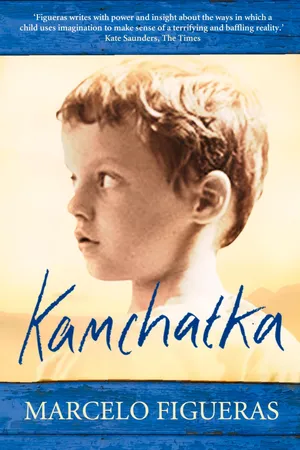
In the forecourt of a petrol station outside of Buenos Aires, a father says goodbye to his son: 'Kamchatka,' he whispers softly into his ear. And then they part, forever.
A ten-year-old boy lives in world of Superman comics and games of Risk - a world in which men have superpowers and boys can conquer the globe on a board game. But in the outside world, a military junta have taken power; and amid a political climate of fear and intimidation, people are beginning to disappear without trace...
Kamchatka is a heartbreaking novel; set in Argentina during the bloody coup d'etat of 1976, it tells the enchanting story of a young boy trying to make sense of a world during a time of extraordinary upheaval.
- 312 pages
- English
- ePUB (mobile friendly)
- Available on iOS & Android
eBook - ePub
Kamchatka
About this book
Information
Third Period: Language
Noun. 1. The faculty, particular to Man, of using articulated sounds to express oneself: ‘The invention of language’. / Speech.
2. The system of communication specific to a particular community or country.
2. The system of communication specific to a particular community or country.
40
ENTER LUCAS
Lucas showed up one afternoon in the Citroën with mamá. We were waiting for him. Or rather, we were ready for him. In the days before he arrived, me and the Midget had turned the quinta into a fortress calculated to repel the invader.
Mamá had announced his arrival a couple of days earlier. ‘There’s a kid coming,’ she told me, just like that, out of the blue. ‘He’ll be staying with us.’
‘You’re going to adopt him?’
‘No, you silly goose. It’s for a few days. He needs a place to stay.’
But I didn’t believe her. This information was coming from the same source who had told me that grandma Matilde’s visit was purely social, when in fact it was part of a devious plan thwarted, among other reasons, by the providential appearance of the kamikaze toad. How could I be sure that this was not another of mamá and papá’s tricks? Maybe they would just wait for us to get used to the presence of the interloper before admitting his true status as a permanent fixture – their new son. The appearance of this ‘kid’ implied that they weren’t satisfied with us. We weren’t enough for them. We didn’t measure up. They needed something more.
‘You see what I’m saying, Midget? You’ll see, I bet he’ll have blond hair. I bet he’ll be this perfectly behaved kid who always remembers to say ‘please’ and ‘thank you’. How much do you bet that he never wets the bed?’
The Midget swore undying loyalty to me and volunteered for battle.
The first thing we did was to barricade our room. Our aim was to prevent it from being occupied by the interloper: if mamá and papá wanted a new son, he could sleep in their room. We made signs so there would be no doubt as to who owned what. The sign on our bedroom door read: ‘Hideout of Harry and The Saint’. There were signs on the headboards of our beds too – and on the outside of the wardrobe door. Lest there be any doubt, we divided the space inside the wardrobe in two, half for me, half for the Midget. (Not that we had anything we needed to put there, but you never know.) We sealed up the drawer of the bedside table with bits of sellotape, which of course meant that we couldn’t open it either, but it was worth it for the sake of the message it sent. The Midget attached Goofy to his bed with a piece of string but, worried that this might not be enough, asked me to make a sign that he could put on him. We hung the last sign on the window screen facing outward. It read ‘Beware of the Dog’, in English, just like in the Merrie Melodies cartoons. Underneath the words we stuck the only picture of a dog we had: Superman’s pet dog Krypto; he didn’t look very fierce but he had superpowers. In case of emergency, me and the Midget agreed we would hide under our beds and bark to give the impression there was an actual guard dog. We practised a couple of times and everything. The Midget sounded like the little puppy he was.
Our preparation extended to the grounds of the quinta. We removed the crosses we’d made out of lollipop sticks that marked the places where the toads were buried; after all, the interloper might easily turn out to be a grave robber. As for the reverse diving board, we decided to say it was already here when we arrived and we didn’t know what it was for. We needed to divert his attention from the swimming pool, away from our rescue mission designed to produce future generations of intelligent toads. The experiment was too important to be jeopardized. If interrogated, we would give only the essentials: name, rank and serial number. Vicente, Simón. International Spy. Number 007. (This was the only number the Midget could remember easily.)
All of this went against everything I had promised mamá. When she had told me that this kid was coming, she had asked me to help keep the Midget from getting upset.
‘You know how he can be, how easily he gets upset by anything new, anything strange. Right now, he’s handling things pretty well, the poor thing. Don’t you think?’
I nodded but I was thinking about how the Midget had started wetting the bed again and had begged me not to tell on him. How could I possible refuse her? This was why I didn’t feel any remorse about breaking my promise to mamá: it had been extracted under duress.
When Lucas showed up, all of our plans proved to be futile.
I was hiding out in the tool shed. From here I could see the place where the Citroën was always parked (behind the lemon trees) without being seen. Stationed in the driveway, the Midget was supposed to warn me when they were coming and then go to the bedroom and lock the door until I knocked: three quick taps followed by two slow ones; that was the secret code. We had stored provisions in our room so that we could hold out there for as long as necessary: ham, cheese, crackers and – obviously – milk and Nesquik.
From the start, everything went wrong. The Midget got bored waiting at his post and went inside to watch TV. Mamá parked the car between the lemon trees and, instead of sizing up the enemy and then running back to the house, I sat there in the tool shed, open-mouthed until I heard them calling me at the tops of their voices.
Lucas was the biggest kid in the world.
41
A HOUSE POSSESSED
Lucas dressed the same way all my friends did: jeans, Flecha trainers and a really cool orange T-shirt with a motorbike and the words ‘Jawa CZ’ on the front – only it was size XXL. Lucas was a giant. He was over six feet tall, which made him quite a bit taller than papá and mamá. He was carrying a light blue bag with a Japan Airlines logo on it and a sleeping bag. He was really skinny, with arms and legs as long as the spiders I’d imagined finding in the mysterious house. It looked as if he’d been stretched on a rack just before he came and wasn’t really used to his new size yet. Because he walked like he had springs inserted into the soles of his feet. And he had three or four black hairs on his chin that looked ridiculous. He looked like Shaggy from Scooby Doo, but creepy: Shaggy possessed by an evil spirit, a victim of voodoo; the sort of Shaggy who’d eat your eyeballs and suck your brains out through the empty sockets.
I had no choice but to come when mamá called me. By the time I joined them, most of the introductions had been made. Everyone was smiling, everyone except the Midget who barely came up to Lucas’s waist.
‘This is Harry,’ said papá.
Lucas held out his hand and said he thought Harry was a really cool name. People who are possessed always try to make out like they’re nice. I shook his hand so he’d think I’d fallen for his trick.
‘Boys, this is Lucas.’
‘Lucas what?’ asked the Midget.
Papá, mamá and Lucas exchanged looks, then Lucas said, ‘Lucas, just Lucas.’
Then papá suggested he show Lucas around the quinta.
The Midget wanted to go with them, but I signalled for him to stay behind. We let the grown-ups head off and we rushed into the house, in a race against time.
In a matter of seconds we tore down all the signs. The Midget didn’t really understand why, but faithful to his oath of obedience, he carried out my orders without a word while I tried to explain the inexplicable.
We had been duped. Lucas wasn’t a kid. He was a grown-up disguised as a kid, an impostor, a guard they had hired to keep an eye on us while papá and mamá were away. Had it not been for the attempt on grandma Matilde’s life, we would have been left with her; at least we would have known what to expect. Now we were at the mercy of a complete stranger – a stranger with legs like springs and arms like wires who moved like no one we had ever seen before. Whatever Lucas was, he certainly wasn’t human but he could mimic human movement. This was the mystery we had to solve. Was Lucas who he claimed to be, who papá and mamá believed him to be? Or was he some messenger from the dark side intent on enslaving us, our own personal Invader?
Reduced to silence by the weight of these doubts, the Midget handed over the signs, picked up Goofy and started hurling it across the room. He liked the noise the string made when it pulled taut and Goofy stopped in mid-air. But he didn’t fool me. I could see through his charade, I could tell how scared he was.
Just as I was about to ask him, mamá and Lucas appeared at the bedroom door.
‘Lucas will be sleeping in here with you guys,’ she announced.
Hands in my pockets, I squeezed the signs we’d torn down into little balls.
‘I can sleep in the dining room if you’d rather,’ Lucas said to mamá, noticing our discomfort.
‘You’ll do no such thing, there’s a terrible draught in the dining room,’ said mamá, and left the room as though nothing had happened.
The moment lasted for centuries. (All time, I believe, is simultaneous.) The Midget was hugging Goofy, Lucas was hugging his sleeping bag and I was squeezing bits of paper. It was as if, without anyone suggesting it, we were all suddenly playing a game of Statues.
It was the Midget who broke the ice. In his little head, he decided on the only way to settle his doubts and immediately put it into practice. He laid Goofy on his bed, brought both hands level with his face and crooked his little fingers several times.
Lucas, who thought this was some sort of greeting, dropped his sleeping bag and imitated the Midget, crooking both fingers over and over.
‘Hello, Simón Vicente,’ said Lucas.
‘Hi, Lucas Just-Lucas. Do you know how to make Nesquik? Come with me, I’ll show you.’ And the Midget headed off in the direction of the kitchen, with Lucas bringing up the rear.
In a fraction of a second, the Midget had confirmed that Lucas was not one of the Invaders, and welcomed him into the human faction.
I was not so gullible. I knew there were different kinds of Invaders.
I threw the balls of paper into the air in a fit of anger and went and hid in the wardrobe.
42
IN PRAISE OF WORDS
In the beginning, words served to name things that already existed. Mother. Father. Water. Cold. In almost all languages, the words that define these fundamental truths are similar, or have something of the same music to them. Mother is ‘’umm’ in Arabic, ‘Mutter’ in German, ‘maht’ in Russian. (All land is land.) On the contrary, words that describe similar human emotions, like fear, do not sound the same anywhere. ‘Miedo’ is not the same as the English ‘fear’ nor the French ‘peur’. I like to believe that we are more alike in our positive experiences than in our negative ones, that what binds us is stronger than what separates us.
Every language is a way of imagining the world. English, for example, is sharp and precise. Spanish tends to be baroque. It is obvious that they have adapted to the needs of the peoples who speak them, because both have stood the test of time. From time to time, academics accept new words that have already been tested in everyday speech, or accept as correct constructions they previously considered ungrammatical. These new words are leaves on a tree that is already lush with foliage, and the new constructions are the pruning, which helps it to grow; but the tree is still the same tree.
Despite the already advanced age of human languages, it is possible to think of things which do not yet have names. For example, there is a word for the fear of confined spaces: claustrophobia. But there is no word for the love of confined spaces. Claustrophilia? Could the monks of Kildare, whose skill as copyists saved much of Western culture, be called claustrophiliacs? Can a miner or a submariner be called claustrophiliac?
My family maintain that I was claustrophiliac from the time I learned to crawl. I would look for small, dark places and squeeze inside: a dog kennel, a wardrobe, the boot of a car. Since I never cried, I would remain hidden until someone noticed I was missing and set out to look for me. If I’d fallen asleep, as I did most of the time, the search might last for hours. If I was still awake, they would quickly find me, because they would hear me laughing. Obviously I must have liked hearing lots of people shouting my name.
Most people argued that my claustrophilia was the result of the ten months I had spent in my mother’s belly. According to this theory, these dark cramped spaces reminded me of the sanctuary of the womb I had been so reluctant to leave. There were other theories – though they were often no more than jokes. For a while, after they had to drag me out of the barrel of an old cannon in the museum in Los Cocos in Córdoba, there was a theory that I had suicidal tendencies.
I was growing and the cannons were a little small for me. But from time to time, when I was really bored or particularly angry, I would still seek refuge in a wardrobe somewhere. I would make myself comfortable among the piles of clothes and listen intently. Inside a wardrobe you can hear everything. It acts as a sound box for the whole house. You discover layer upon layer of noises: the cistern in the bathroom, the hiss of the immersion heater, the TV in the distance, the hum of the fridge, the movements of everyone in the house, the conversations you’re not supposed to overhear. On humid days, you could even hear the creaking of the wood of the wardrobe itself.
The afternoon Lucas arrived (or ‘Lucas Just-Lucas’ as the Midget called him) all I could hear was my own heart beating. It was like a train hurtling along a track, the engine about to explode. My chest hurt as though a fist were thumping on my ribs from the inside. I was furious! I felt I had been tricked by my parents and betrayed by the Midget. I decided that I would repel the intruder, even if I had to do it alone. I wanted to think about how I would go about it, but I couldn’t concentrate. My heart was making too much noise.
Señorita Barbeito says that the heart is a muscle. It expands and contracts. As it beats it makes the sound ‘b-b-buh-bum’. No, it’s not ‘buh-bum’, it’s ‘b-b-buh-bum’; the ‘b’ that starts it off is slower; as with any machine, the initial motion is the most difficult and therefore lasts longer. According to Señorita Barbeito, the fact that it is a muscle suggests that it can be controlled. But the heart is a complicated muscle and has a tough job to do. Most muscles respond to direct, conscious commands, but the heart is automatic rather than manual, like the cars they have in America. You have to work out how to shut off the automatic switch and set it to manual, if only for a short period. It’s a difficult thing to learn, because the body doesn’t come with an instruction manual (if it did, it would save us a lot of time and trouble), and there’s no off switch or key or lever to switch from one system to anot...
Table of contents
- Cover
- Title Page
- Copyright
- Table of Contents
- Dedication
- First Period: Biology
- Second Period: Geography
- Third Period: Language
- Fourth Period: Astronomy
- Fifth Period: History
- Acknowledgements
Trusted by 375,005 students
Access to over 1.5 million titles for a fair monthly price.
Study more efficiently using our study tools.
Frequently asked questions
Yes, you can cancel anytime from the Subscription tab in your account settings on the Perlego website. Your subscription will stay active until the end of your current billing period. Learn how to cancel your subscription
No, books cannot be downloaded as external files, such as PDFs, for use outside of Perlego. However, you can download books within the Perlego app for offline reading on mobile or tablet. Learn how to download books offline
Perlego offers two plans: Essential and Complete
- Essential is ideal for learners and professionals who enjoy exploring a wide range of subjects. Access the Essential Library with 800,000+ trusted titles and best-sellers across business, personal growth, and the humanities. Includes unlimited reading time and Standard Read Aloud voice.
- Complete: Perfect for advanced learners and researchers needing full, unrestricted access. Unlock 1.5M+ books across hundreds of subjects, including academic and specialized titles. The Complete Plan also includes advanced features like Premium Read Aloud and Research Assistant.
We are an online textbook subscription service, where you can get access to an entire online library for less than the price of a single book per month. With over 1.5 million books across 990+ topics, we’ve got you covered! Learn about our mission
Look out for the read-aloud symbol on your next book to see if you can listen to it. The read-aloud tool reads text aloud for you, highlighting the text as it is being read. You can pause it, speed it up and slow it down. Learn more about Read Aloud
Yes! You can use the Perlego app on both iOS and Android devices to read anytime, anywhere — even offline. Perfect for commutes or when you’re on the go.
Please note we cannot support devices running on iOS 13 and Android 7 or earlier. Learn more about using the app
Please note we cannot support devices running on iOS 13 and Android 7 or earlier. Learn more about using the app
Yes, you can access Kamchatka by Marcelo Figueras, Frank Wynne in PDF and/or ePUB format, as well as other popular books in Literature & Literature General. We have over 1.5 million books available in our catalogue for you to explore.