The slacker's guide to parenting from the Twitter's most popular dad!
Overachieving parents want you to believe the harder you work, the better your children your will turn out. That lie ends now. The truth is most kids end up remarkably unremarkable no matter what you do, so you might as well achieve mediocrity by the easiest possible route.
In
Bare Minimum Parenting, amateur parenting sort-of expert James Breakwell will teach you to stop worrying and embrace your child's destiny as devastatingly average. To get there, you'll have to overcome your kid, other parents, unnecessary sporting activity, broccoli, and yourself. Everyone will try to make your life more difficult than necessary. Honestly, by reading this far, you're already trying too hard. But don't stop now. You're exactly the kind of person who needs this book.
Reviews for James Breakwell
Hilarious! -
The Sun
VERY funny Twitter feed -
The Daily Mail
The most hilarious man on Twitter -
The Telegraph
The funniest dad on Twitter -
BuzzFeed
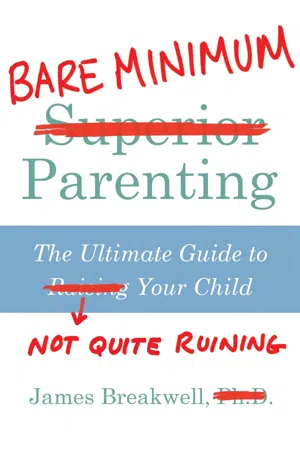
eBook - ePub
Bare Minimum Parenting
The Ultimate Guide to Not Quite Ruining Your Child
- English
- ePUB (mobile friendly)
- Available on iOS & Android
eBook - ePub
About this book
Information
Print ISBN
9781786496966
Chapter 1
A Call to Inaction
Facts. Figures. Hard evidence. Peer-reviewed studies. None of those things are in this book. This is a book about kids. Science is as powerless to explain them as it is to make you friends or get you laid. After studying children for generations, all that scientists know for sure is that scientists won’t know anything for sure unless they get more grant money. And maybe tenure.
This lack of empirical data hasn’t stopped countless “experts” from writing libraries of books on the right and wrong ways to raise a child. Their aim is to make you a better parent so you can make better kids who in turn make the world a better place.
Pass.
Why work harder to be a great parent when your kid will turn out just as well if you’re a mediocre one? As for making the world a better place, the sun will swallow the earth in a mere five billion years. It’s a waste of time to fix up temporary housing.
The world doesn’t need another guide for raising children. In fact, it doesn’t need another book of any kind. Reading can lead to eyestrain, headaches, and even war. Guess who made the best-seller list before he invaded Poland.
Clearly there’s nothing more unethical than writing a parenting book. But people pay money for them, so I wrote one anyway. Trust me, no one is more disappointed in me than me. Except maybe my parents.
In my defense, this isn’t really a book. Despite all the evidence to the contrary—it looks like a book, it smells like a book, and I called it a book literally four sentences ago—it’s actually an unbook. It exists solely to counteract the countless parenting books already in print. If those authors stopped publishing bad advice, I’d gladly abandon my unbook as well. But I made some phone calls, and none of the other writers agreed to give up their careers just because I asked them to. I guess I’ll have to write this unbook after all. There goes my weekend.
Here’s the tricky part: I’ve never actually read any of those other parenting books. All I know is that people who buy them go online and blame “underachieving” parents like me for ruining kids today. That’s pretty much the only thing the internet is good for. Well, the only thing it’s good for that doesn’t lead to you clearing your browser history.
I get where those other parents are coming from. If I were them, I’d hate me, too. I’m doing everything wrong, yet the universe hasn’t struck me down. My kids are on track to be self-sufficient adults all the same. Maybe my parenting approach works just as well as the overachieving one, but with less effort on my part. That sounds like the kind of thing other people might want to know about. I should write it down—and sell it for a modest but fair profit. Operators are standing by.
How the Children of Different Kinds of Parents Turn Out

You made the smartest decision of your life just by picking up this book (and, yes, I’m calling it a book again; typing two extra letters was exhausting). You see, this isn’t a book about overachieving as a parent. This isn’t even a book about achieving exactly the right amount. This is a book about doing as little as possible without quite ruining your child. The goal of bare minimum parenting is to turn your kid into a functional adult using only a fraction of the effort spent by over-achieving parents. Your kid will be just as good as their kids—if not better. Often, the easiest approach for you is also the best approach for your child. But if it’s not, be lazy anyway. It’s good to be consistent.
Overparenting is killing kids today. Well, not literally—although I wouldn’t put anything past health-food nuts. No one knows the long-term effects of kale. Many overachieving mums and dads assume the harder they work, the better their kids will turn out, but the evidence doesn’t bear that out. In fact, most parents who do too much raise a child who amounts to too little. Those are the cases I’ll focus on, not because they’re statistically relevant, but because they prove my point. Just don’t accuse me of cherry-picking my data. Like my kids, I’ll die before I touch fruit.
And, yes, you really do need this book to tell you how to do as little as possible. To avoid overparenting, you can’t simply underparent. You must be strategically lazy. Many times, the course that takes the least effort today will create huge amounts of work down the road. This book is meant to save you time and energy overall. Parenting is all about the long game. It has to be. Kids grow up too damn slow.
Guilt by Association
If you’re a parent, your guilt response is already kicking in. You feel terrible just for reading this far. What self-respecting parent would admit they DON’T want to work hard for their kid?
A wise one, that’s who. There’s no reason to feel bad about making something as easy as possible. Do you feel guilty when you solve a maths problem with a calculator instead of an abacus? Do you consider yourself a failure if you use a shopping trolley instead of holding thirty-five different items in your bare hands? Are you tormented by inner turmoil when you fly across the country rather than walking the whole way?
Of course not.
The only thing using a calculator or a shopping trolley or an aeroplane makes you guilty of is being human. We’re not the fastest or strongest creatures on earth, but we are the smartest. Our survival as a species depends on thinking up ways to make life easier. The prize for doing things the hard way isn’t self-satisfaction. It’s extinction.
Bare minimum parenting is just another tool. Sure, there are other, more effort-intensive ways to bring up a kid, but those are just more difficult means of arriving at the same end. Raising your child the hard way doesn’t make you a better parent, just a less evolved one. Why start a fire by rubbing two sticks together when you could use a flamethrower? Time for toasted marshmallows.
Citation Needed
Why am I qualified to give you this advice?
The short answer is I’m not. The longer, more nuanced answer is I’m really, really not. That’s why you should trust me completely.
I don’t have a degree in primary education, child psychology, or early childhood development. My degree is in English, which only makes me an expert at making bad choices. No wonder I’m a parent.
I do have four kids age eight and under, although that doesn’t make me a childcare expert, either. I might have some credibility if I’d already raised successful children, but all of mine are still too young for me to tell how they’ll turn out. For all I know, they could become astronauts or bank robbers. Maybe they’ll be both. Now I hope that happens. Thieves in High Orbit sounds like a better book than Bare Minimum Parenting.
Unfortunately, I can’t wait around for the world’s first space heist. If I raised my kids first and wrote a book afterward, I’d be an expert on children but a fraud on slacking off. You couldn’t believe a word I said. Instead, you should believe me unconditionally because I’m not believable at all.
How Much You Should Trust a Parenting “Expert”

All Downhill from Here
The time to stop trying is now. The fact that you’re reading this book at all suggests you’re already working too hard. Don’t put it down, though. You’re exactly the kind of person who needs it.
Over the course of this book, I’ll teach you to get by while doing less. If you do it right, you’ll out-parent overachieving mums and dads without putting in much effort at all. Some might call that laziness; I call it efficiency. Don’t worry, the lesson will stick. I’ll beat that dead horse until it’s glue. Clear your schedule. We have a lot of nothing to do.
Chapter 2
Your Child Is Uniquely Unoriginal
Your child is a special, one-of-a-kind human being the likes of which the world has never seen. And chances are they’ll lead an ordinary life not that different from your own. Right now, there are literally billions of amazing, creative, and brilliant people who will never do anything particularly amazing, creative, or brilliant. Never believe anything you read in a letter of recommendation. Or an obituary.
That’s okay. Your kid doesn’t have to be a once-in-a-generation talent to lead a good life. Being a genius at something doesn’t come with a high job-satisfaction rate. Tortured artists seldom die of old age surrounded by loved ones. It’s almost impossible in a world of drugs, guns, and sandwiches on toilets.
That’s not a message overachieving parents want to hear. They expect their kid to set the world on fire and earn the rewards that come with it: wealth, prestige, and—if there’s time—happiness. But your child will turn out better if you don’t try for any of those goals—not even the last one. The best things in life happen by accident.
To succeed as a parent—and outperform most overachieving parents in the process—you simply need to raise a kid who hits these three benchmarks:
1. They can support themselves.
2. They aren’t a social deviant.
3. They don’t blame you for everything that’s wrong with their life.
Your goal as a bare minimum parent is to achieve all three in the easiest way possible. The result will be a functional adult you can be proud of, or at least one you can make move out of your house. Don’t be intimidated by overachieving parents who aim higher. The only thing they’ll hit is their kid. When you shoot for the stars, the bullets fall back to earth.
Boiling down child-rearing to those terms makes raising a kid seem easy, and in the parenting world, easy means wrong. But not in my book. Here’s a closer look at all three benchmarks to show you why successful parenting is so simple even I can do it. It’s hard to set the bar any lower than that.
And Stay Out
The fastest way to tell if your child turned out okay is if you can get rid of them. Gently shoving a kid out the door is the crowning achievement of any parent’s life. But your kid isn’t going anywhere unless they have a job. That’s why raising your child to support themselves is the first benchmark of successful parenting. Without gainful employment, your kid will live with you forever—unless you’re okay with them being homeless. After the tenth time they put an empty milk carton back in the fridge, you just might be.
As a bare minimum parent, you mainly want your kid to pay their own bills and not hit you up for money every month. At some point, the freeloading has to stop. It’s just a shame it doesn’t end earlier. Good luck getting grocery money from a toddler.
When it comes to your child’s future job, the money matters, because if they don’t make any, that money will come from you. Interpretive pottery-making might be a fulfilling career, but unless your child can find someone to pay for existential angst as expressed through clay dishes, you’ll have to support them financially until you die. Or until they die. Kilns are more dangerous than they look.
Never encourage your kid down a path that could lead to them living in your basement. You don’t have to actively discourage them from choosing a fun but impoverishing career. Just sit back and watch as the invisible hand of the free market slaps them in the face. The best lessons are the ones that leave a mark.
The Price of Luxury
Successful children need enough money to make it on their own, but not much more than that. Contrary to what over-achieving parents might tell you, your kid doesn’t need to be a millionaire for you to be proud of them. Far from it. Rich people are some of the biggest failures I know. Well, that I know of. You’ve read enough of this book to guess I don’t have any rich friends. Or any friends at all.
Once your child is no longer living paycheck to paycheck, wage increases don’t make life much easier. Sure, extra money can speed up retirement or help put the next generation through university, but in terms of day-to-day living, there’s only so much that money can do. The truth is the average person in Western civilization today is better off than the richest kings in Europe centuries ago. If you want pepper, you get it by going to the supermarket, not by sending a fleet of galleons around the world. Although you’ll still complain if you forgot your coupon.
The biggest benefit of wealth is not what it lets people do, but what it lets them get out of doing. The upper class can pay someone to do all their grunt work for them. Unpleasant tasks like cooking, cleaning, and child-rearing can be foisted upon the hired help. Anything worth doing is worth paying someone else to do for minimum wage or less.
But rich people who rise above life’s trivial hassles find a new level of even more trivial hassles to complain about. We all do it to some degree. History is just a...
Table of contents
- Cover
- Title Page
- Dedication
- Contents
- Chapter 1: A Call to Inaction
- Chapter 2: Your Child Is Uniquely Unoriginal
- Chapter 3: You Won’t Make a Difference
- Chapter 4: Fending Off the Mob
- Chapter 5: The Wrong Time to Have a Kid
- Chapter 6: Subtraction by Multiplication
- Chapter 7: Space Not to Kill Each Other
- Chapter 8: Take a Picture—It’ll Last Longer
- Chapter 9: Their Eyes Only
- Chapter 10: Schooled
- Chapter 11: Benched
- Chapter 12: Imperfect Attendance
- Chapter 13: Screened Out
- Chapter 14: Rules Are Rules (Unless They’re Hard to Enforce)
- Chapter 15: Food Fight
- Chapter 16: Dressing Your Child for Survival
- Chapter 17: Early Endings
- Chapter 18: Making Up History
- Chapter 19: The Point of No Return
- Acknowledgments
- About the Author
- Also by James Breakwell
- Copyright
Trusted by 375,005 students
Access to over 1.5 million titles for a fair monthly price.
Study more efficiently using our study tools.