SHORTLISTED FOR THE DYLAN THOMAS PRIZE 2011
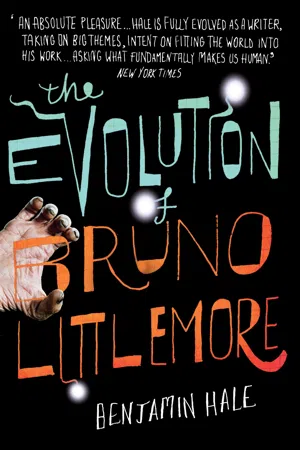
Bruno Littlemore; linguist, artist, philosopher. A life defined by a soaring mind, yet bound by a restrictive body. Born in down-town Chicago, Bruno's precocity pulls him from an unremarkable childhood, and under the tuition of Lydia, his intellect dazzles a watching world. But when falls in love with his mentor, the world turns on them with outrage: Bruno is striving to be something he is not, and denying everything that he is. For despite his all too human complexities, dreams and frailties, Bruno's hairy body, flattened nose and jutting brow are, undeniably, the features of a chimpanzee.
Like its protagonist, this novel is big, abrasive, witty, perverse, earnest and accomplished.
The Evolution of Bruno Littlemore goes beyond satire by showing us not what it means, but what it feels like be human - to love and lose, learn, aspire, grasp, and, in the end, to fail.
- English
- ePUB (mobile friendly)
- Available on iOS & Android
eBook - ePub
The Evolution of Bruno Littlemore
About this book
Information
Print ISBN
9781848875340
Subtopic
Literature GeneralPart One
. . . But man, proud man,
Dress’d in a little brief authority,
Most ignorant of what he’s most assur’d,
His glassy essence, like an angry ape,
Plays such fantastic tricks before high heaven
|
As makes the angels weep; who, with our spleens,
|
|
Would all themselves laugh mortal.
|
|
—Shakespeare, Measure for Measure
|
I
My name is Bruno Littlemore: Bruno I was given, Littlemore I gave myself, and with some prodding I have finally decided to give this undeserving
and spiritually diseased world the generous gift of my memoirs. I give this gift with the aim and hope that they will enlighten, enchant, forewarn, instruct, and perchance even entertain. However,
I find the physical tedium of actually writing unendurable. I never bothered learning to type any more adroitly than by use of the embarrassingly primitive “hunt-and-peck” method, and
as for pen and paper, my hands are awkwardly shaped and tire easily of etching out so many small, fastidious markings. That is why I have decided to deliver my memoirs by dictation. And because
voice recorders detest me for the usual reasons, I must have an amanuensis. Right now it is eleven fifteen in the morning on a drably nondescript day in September; I am lying partially supine and
extremely comfortably on a couch, my shoes off but my socks on, a glass of iced tea tinkling peacefully in my hand, and there is a soft-spoken young woman named Gwen Gupta sitting in this very room
with me, recording my words in a yellow notepad with a pencil and a laserlike sense of concentration. Gwen, my amanuensis, is a college student employed as an intern at the research center where I
am housed. It is she who acts as midwife to these words which my mind conceives and my lungs and tongue bear forth, delivering them from my mouth and by the sheer process of documentation imbuing
them with the solemnity and permanence of literature.
Now to begin. Where should I begin, Gwen? No, don’t speak. I’ll begin with the first time I met Lydia, because Lydia is the reason why I am here.
But before I begin, I guess I should briefly describe my surroundings and current predicament. One could say that I am in captivity, but such a word implies that I have a desire to be elsewhere,
which I do not. If one were to ask me, “Bruno, how are you?” I would most likely reply, “Fine,” and that would be the truth. I know I’m well provided for. I like to
think of myself not as imprisoned, but in semiretirement. As you already know, I am an artist, which my keepers recognize and respect, allowing me to occupy myself with the two arts most important
to my soul: painting and the theatre. As for the former, the research center generously provides me with paints, brushes, canvases, etc. My paintings even sell in the world beyond these
walls—a world that holds little remaining interest for me—where, I’m told, they continue to fetch substantial prices, with the proceeds going to the research center. So I make
them rich, the bastards. I don’t care. To hell with them all, Gwen: I paint only to salve the wounds of my troubled heart; the rest is grubby economics. As for the latter—the
theatre—I am preparing to stage a production of Georg Büchner’s Woyzeck, directed by and starring myself in the title role, which our modest company will perform in a few
weeks for the research center staff and their friends and families. Broadway it’s not, nor even off-Broadway—but it satiates (in a small way) a lust for the spotlight that may be
integral to understanding my personality. My friend Leon Smoler visits me occasionally, and on these occasions we laugh and reminisce. Sometimes we play backgammon, and sometimes we converse on
philosophical subjects until the smoky blue edge of dawn creeps into visibility through my windows. The research center allows me to live in all the comfort and relative privacy that any human
being could expect to want—more, really, considering that my mind is free from the nagging concerns of maintaining my quotidian persistence in the world. I am even allowed outside whenever I
please, where, when I am in my most Thoreauvian moods, I am allowed to roam these woods in spiritual communion with the many trees that are thick-trunked with antiquity and resplendent with
drooping green mosses and various fungi. The research center is located in Georgia, a place I had never been to before I was relocated here. As far as I can determine from my admittedly limited
perspective, Georgia seems to be a pleasant enough and lushly pretty place, with a humid subtropical climate that proves beneficial to my constitution. Honestly, on most days it feels like I am
living in some kind of resort, rather than being confined against my will due to a murder that I more or less committed (which, by the way, could time be reversed, I would recommit without
hesitation). Because this more-or-less murder is a relatively unimportant event in my life, I will not bother to mention it again until much later, but it is at least ostensibly accountable for my
current place of residence, and therefore also for your project. I am, however, no ordinary criminal. I suppose the reason I’m being held in this place is not so much to punish as to study
me, and I presume this is the ultimate aim of your project. And I can’t say I blame them—or you—for wanting to study me. I am interesting. Mine is an unusual case.
As a matter of fact, Gwen, I should apologize to you for my initial refusals to grant your repeated requests for an interview. Just speaking these opening paragraphs has made me realize that
nothing I’ve ever yet experienced better satisfies my very human desire for philosophical immortality than your idea of recording this story—catching it fresh from the source, getting
it right, setting it down for the posterity of all time: my memories, my loves, my angers, my opinions, and my passions—which is to say, my life.
Now to begin. I will begin with my first significant memory, which is the first time I met Lydia. I was still a child at the time. I was about six years old. She and I immediately developed a
rapport. She picked me up and held me, kissed my head, played with my rubbery little hands, and I wrapped my arms around her neck, gripped her fingers, put strands of her hair in my mouth, and she
laughed. Maybe I had already fallen in love with her, and the only way I knew to express it was by sucking on her hair.
Before I begin properly, I feel like the first thing I have to do for you here is to focus the microscope of your attention on this specimen, this woman, Lydia Littlemore. Much later, in her
honor, I would even assume her lilting three-syllable song of a surname. Lydia is important: her person, her being, the way she occupied a room, the way she did and continues to occupy so much
space in my consciousness. The way she looked. The way she smelled. That ineffably gorgeous smell simmering off her skin—it was entirely beyond my previous olfactory experience, I
didn’t know what to make of it. Her hair. It was blond (that was exotic to me, too). Her hair was so blond it looked electrically bright, as if, maybe, in the dark, her hair would
naturally glow forth with bioluminescent light, like a lightning bug, or one of those dangly-headed deep-sea fish. On that day when we first met, she had, as was her wont, most of this magnificent
electric blond stuff gathered behind her head just under the bump of her skull in a no-nonsense ponytail that kept it from getting in her eyes but allowed three or four threads to escape; these
would flutter around her face, and she had a habit of always sliding them behind the ridges of her ears with her fingers. Futilely!—because they would soon be shaken loose again, one by one,
or all at once when she snatched off the glasses she sometimes wore. When Lydia was at work, her hands were endlessly at war with her hair and her glasses. Off come the glasses, fixed to a lanyard
by the earpieces, and now (look!) they dangle from her neck like an amulet, these two prismatic wafers of glass glinting at you from the general vicinity of those two beacons of womanhood—her
breasts!—and now (look!) they’re on again, slightly magnifying her eyes, and if you walk behind her you will see the lanyard hanging limp between her shoulder blades. On they went, off
they came, never resting for long either on the bridge of her nose (where they left their two ovular footprints on the sides of the delicate little bone that she massaged with her fingers when she
felt a headache coming) or hanging near her heart. Once, in fact—this was much later, when I was first learning my numbers—I had briefly become obsessed with counting things, and I
counted the number of times Lydia took her glasses off and put them on again during an hour of watching her at work, and then I counted the number of times she tucked the wisps of hair behind her
ears. The results: in a one-hour period, Lydia put her glasses on thirty-one times and removed them thirty-two, and she tucked the wisp or wisps of hair behind her ear or ears a total of
fifty-three times. That’s an average of nearly once a minute. But I think these habits were merely indicative of a nervous discomfort she felt around her colleagues, because when she and I
were alone together, unless she was performing some task demanding acute visual focus (such as reading), the glasses remained in their glasses-case and her hair hung down freely.
I will speak now of her body, style of dress, and general comportment. She was, obviously, much taller than me, but not ridiculously tall for a human woman, maybe about five feet five, though
the birdlike litheness of her limbs gave the illusion that she was taller. To me, anyway. She exercised often, ate a salubrious diet, and never felt tempted by any of the body-wrecking
superfluities that so easily sing me out to sea, so innately deaf was she to their siren songs; for instance, she drank only socially, and even then not much. Her hands were knobby-knuckled and
almost masculine in aspect, with fingernails frayed from light labor and habitual gnawing (one of her few vices); these were pragmatic hands, nothing dainty about them; hers was not the sort of
hand a pedestrian poet might describe as being “alabaster,” nor the sort of hand onto the ring finger of which one might slip a diamond ring in a TV commercial advertising relucent
diamonds wrested from the soil of darkest Africa. She dressed sharply, a bit conservatively. She dressed stylishly but not in a way that drew outrageous attention to herself. No, ostentation was
not her style. (Ostentation is my style.) Black turtleneck sweaters were her style. Light tan sateen blazers were her style. Flannel scarves were her style. She shopped at Marshall
Field’s. She wore hairpins. She wore sandals in the summer. She wore boots in the winter. She wore jewelry only on special occasions, though she wore on all occasions an effortless aura of
beatific radiance. She looked good in green.
I will speak now of the sound of her voice. It made its impression on me the very first day we met. Most people would speak to me in that putrid bouncing-inflection singsong that adults use when
condescending to children or animals. But not Lydia. No, she spoke to me in the same sober conversational tone of voice she would have used to address anyone else, and this easily won my loyalty,
at first. Her voice had a faint but discernible twang in it; she’d originated from a family of noble hardworking bozos from some godforsaken backwater town in rural Arkansas, but she had fled
her background upward and away into education much in the same way as I’ve fled mine, and she spoke like a young woman with a doctorate from the University of Chicago, which is what she was.
She spoke in grammatical sentences, with punctuation marks audible in them: periods, parentheses, colons, even the sometime semicolon. Listening to her voice was like listening to a piece of
classical music being performed by a full symphony orchestra with one slightly out-of-tune banjo in it, lonesomely plinking along to the opus somewhere in the string section.
And I will speak now of her face. Lydia’s face was etiolated and Scandinavian-looking enough that she wouldn’t have looked out of place in a black-and-white Ingmar Bergman movie,
though her eyes were not the pellucid blue ones that you would expect to see in the head of the woman I’ve thus far described. Her eyes were gold-flecked green. Her irises begged comparisons
to tortoise shells, to the corollas of green roses with bronze-dipped petals, to two green-gold stars exploding in another galaxy, observed through a telescope a billion years later. On her
driver’s license they were “hazel.” She had a long face with a lot of distance between her thin mouth and the bottommost tip of her slightly cleft chin. Her skin had the sort of
pallor that pinks rather than tans in the sun. Two delicately forking blue veins were barely noticeable on her temples. The bridge of her nose was a perfectly straight diagonal line, but the tip of
it was blunt and upturned at an angle just obtuse enough to allow, from a directly frontal view, easy gazing into the depths of her nostrils. Her forehead was wide and featured a very subtle bump
above the supraorbital ridge. Her cheekbones were not high and emerged to definition only in the harshest of lighting. She seldom wore makeup, and when she did, it was just hints and touches,
because slathering too much ornamental glop on that face of hers would have diminished its effect rather than enhance it. Her snaggletoothed smile served as a memento of childhood poverty. She was
twenty-seven years old when I first met her, and thirty-four when she died.
But why—why have I spent so much energy, so much of both my time and yours describing this woman, having probably succeeded only in distorting rather than elucidating her image in
your mind’s eye? Because Lydia was my First Love. Make sure you write that with a capital L, Gwen. And why don’t you go ahead and capitalize the F in first as well.
Because Lydia was my capital-O Only capital-L Love, or at least the only Only Love I would ever dare to capitalize.
Now we may begin in earnest. New chapter, please.
II
The first time I met Lydia, I was so young and uncontaminated by the world that I didn’t even know I was participating in a scientific experiment. I was brought into a strange blank-white room: everyone’s shoes squeaked on the hard shiny floor, and the high-frequency buzzing of fluorescent lights overhead made me jittery and discombobulated. The three of us—I, Bruno; my idiot brother, Cookie; and little Céleste—were let out of the cage in which they had conveyed us to this alien room, to allow us a little time to acclimate ourselves to these surroundings at our leisure, to accustom our eyes to the stinging brightness, to meet the scientists. That’s when I met Lydia: she bent to the floor and held her arms open for me, and I ran to her and climbed into them, and for the rest of the day that was where I stayed, cradled in her arms, breathing her amazing scent that I even then must have found erotic—except when she was too busy with her work, or when they ripped us apart so they could run their moronic experiments on me.
I suppose I shouldn’t say moronic, because that experiment was what marked me as different right from the beginning. Of course I had no idea what was going on at the time. I had not yet acquired language, so I couldn’t have articulated my thoughts. (That, by the way, is the ironic thing about acquiring language relatively late in life: words don’t exist to adequately describe what it’s like when that tempest of wordless thoughts whirling around in your head suddenly snaps to definition; that great hop from prelinguistic to linguistic is squarely in the realm of the ineffable.) As far as I knew, all that was going on was this: I was taken into a small, empty white room with a long rectangular reflective panel embedded in one wall. (I now realize this was a one-way mirror, behind which another scientist was probably watching me like a voyeur with an eye to a keyhole.) The scientist who had conducted me into the room was not the woman whom I would later come to know as Lydia (was that you watching from behind the mirror, Lydia?), but some droll old fat bearded sot who held no special interest for me. There was a transparent plastic box on the floor. The scientist produced from the pocket of his white coat—with the excessively theatrical flourish of an amateur magician—a peach.
A peach, Gwen—he was my serpent and I was his Eve. There we were, me in my prelapsarian nudity and he in his demonic white coat, tempting me with fruit coveted but prohibited. The only difference was environmental: we’d swapped sexy Edenic lushness for the sterile whitewashed walls of Science. Also, that particular fruit is semiotically associated with the female pudenda, isn’t it? Isn’t that why Cézanne painted them?—Still Life with Peaches?—why, that’s just a quivering bowlful of vulvae sweating on the breakfast table, waiting for you to eat them up!
But the peach in question: so he takes, this scientist does, he takes a juicy piggish bite out of it and starts making yummy-yum-yum noises, mmmmmm, rubbing his belly, trying to goad my jealousy, you see. And as I recall, it worked. I was a simpler creature then. I remember wanting the peach at that moment more than anything. Hell, I would have sold my soul for a peach. (And in a way I did.) I remember hating, no, loathing that old smug fat imperious blob for the way he lorded the fruit over me so. So he took his bite, breaking the skin, releasing into the room the ambrosial aroma of that sticky wet fleshy treat, and then he, bastard, pushed me away when I reached for it. Then, turning to the box—transparent plastic box on the floor, remember?—he operated some sort of device which made the lid spring open, placed the peach inside and shut the lid. I was watching his actions with curiosity and a motley of deadly sins: greed, envy, gluttony, lust. Then, the demonstration: the box-opening mechanism consisted of a button and a lever; he pressed the button; then he rapped on the lid of the box three times with his knuckles, like this—knock, knock, knock; then he flipped the lever and the lid of the box popped open. He reached in and—again, moving his arms in such a grossly histrionic manner it was as if he wanted the people in the nosebleed seats to see what he was doing and making a face like Look, Bruno, what do we have here?—extracted the peach.
Again I reached for it. Again he pushed me away. Then he put the peach back in the box, promptly left the room and pulled the door shut behind him. Bruno was alone.
Alone with the box, with the peach clearly visible but locked away inside, forbidden to Bruno. I looked at it a moment. I pressed the button, knocked thrice on the lid, flipped the lever, opened the box and removed the peach. Did I dare to eat a peach? Indeed I did.
In this way I fell from my state of innocence.
The door opened, I was escorted out and my brother, Cookie, in, where I understand the same procedure was repeated on him. A little while later all three of us—Cookie, Céleste, and I—had made it through the first round, and I was taken back into the room, until they decided enough time had elapsed to renew my appetite.
Only this time—this time, it was Lydia—gorgeous-smelling Lydia, my human peach—who attended me into the little room with the box. Just being alone in a room with that woman was enough. And now she removed a peach from the pocket of her white coat, she took a sopping wet bite out of it and took her sweet time chewing. Then she placed the peach inside the box, waited a moment, pressed the button, knocked her knuckles on the lid three times, click-click-click, flipped the ...
Table of contents
- Cover
- Author biography
- Title page
- Copyright page
- Dedication page
- Epigraph page
- Note
- Contents
- Part One
- CHAPTER I
- CHAPTER II
- CHAPTER III
- CHAPTER IV
- CHAPTER V
- CHAPTER VI
- CHAPTER VII
- CHAPTER VIII
- CHAPTER IX
- Part Two
- CHAPTER X
- CHAPTER XI
- CHAPTER XII
- CHAPTER XIII
- CHAPTER XIV
- CHAPTER XV
- CHAPTER XVI
- CHAPTER XVII
- CHAPTER XVIII
- CHAPTER XIX
- CHAPTER XX
- Part Three
- CHAPTER XXI
- CHAPTER XXII
- CHAPTER XXIII
- CHAPTER XXIV
- CHAPTER XXV
- CHAPTER XXVI
- CHAPTER XXVII
- Part Four
- CHAPTER XXVIII
- CHAPTER XXVIX
- CHAPTER XXX
- CHAPTER XXXI
- CHAPTER XXXII
- Part Five
- CHAPTER XXXIII
- CHAPTER XXXIV
- CHAPTER XXXV
- CHAPTER XXXVI
- CHAPTER XXXVII
- CHAPTER XXXVIII
- CHAPTER XXXIX
- CHAPTER XL
- CHAPTER XLI
- CHAPTER XLII
- CHAPTER XLIII
- CHAPTER XLIV
- Part Six
- CHAPTER XLV
- CHAPTER XLVI
- CHAPTER XLVII
- CHAPTER XLVIII
- CHAPTER XLIX
- CHAPTER L
- Acknowledgments
Trusted by 375,005 students
Access to over 1.5 million titles for a fair monthly price.
Study more efficiently using our study tools.
Frequently asked questions
Yes, you can cancel anytime from the Subscription tab in your account settings on the Perlego website. Your subscription will stay active until the end of your current billing period. Learn how to cancel your subscription
No, books cannot be downloaded as external files, such as PDFs, for use outside of Perlego. However, you can download books within the Perlego app for offline reading on mobile or tablet. Learn how to download books offline
We are an online textbook subscription service, where you can get access to an entire online library for less than the price of a single book per month. With over 1.5 million books across 990+ topics, we’ve got you covered! Learn about our mission
Look out for the read-aloud symbol on your next book to see if you can listen to it. The read-aloud tool reads text aloud for you, highlighting the text as it is being read. You can pause it, speed it up and slow it down. Learn more about Read Aloud
Yes! You can use the Perlego app on both iOS and Android devices to read anytime, anywhere — even offline. Perfect for commutes or when you’re on the go.
Please note we cannot support devices running on iOS 13 and Android 7 or earlier. Learn more about using the app
Please note we cannot support devices running on iOS 13 and Android 7 or earlier. Learn more about using the app
Yes, you can access The Evolution of Bruno Littlemore by Benjamin Hale in PDF and/or ePUB format. We have over 1.5 million books available in our catalogue for you to explore.