Nearly sixty years after Freedom Summer, its events—especially the lynching of Andrew Goodman, James Chaney, and Mickey Schwerner—stand out as a critical episode of the civil rights movement. The infamous deaths of these activists dominate not just the history but also the public memory of the Mississippi Summer Project.
Beginning in the late 1970s, however, movement veterans challenged this central narrative with the shocking claim that during the search for Goodman, Chaney, and Schwerner, the FBI and other law enforcement personnel discovered many unidentified Black bodies in Mississippi's swamps, rivers, and bayous. This claim has evolved in subsequent years as activists, journalists, filmmakers, and scholars have continued to repeat it, and the number of supposed Black bodies—never identified—has grown from five to more than two dozen.
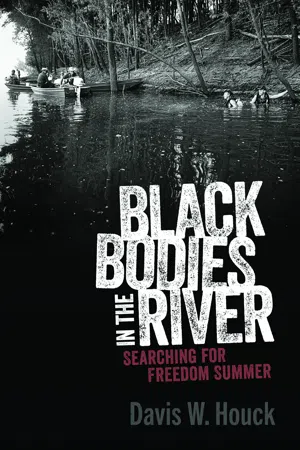
In Black Bodies in the River: Searching for Freedom Summer, author Davis W. Houck sets out to answer two questions: Were Black bodies discovered that summer? And why has the shocking claim only grown in the past several decades—despite evidence to the contrary? In other words, what rhetorical work does the Black bodies claim do, and with what audiences?
Houck's story begins in the murky backwaters of the Mississippi River and the discovery of the bodies of Henry Dee and Charles Moore, murdered on May 2, 1964, by the Ku Klux Klan. He pivots next to the Council of Federated Organization's voter registration efforts in Mississippi leading up to Freedom Summer. He considers the extent to which violence generally and expectations about interracial violence, in particular, serve as a critical context for the strategy and rhetoric of the Summer Project.
Houck then interrogates the unnamed-Black-bodies claim from a historical and rhetorical perspective, illustrating that the historicity of the bodies in question is perhaps less the point than the critique of who we remember from that summer and how we remember them. Houck examines how different memory texts—filmic, landscape, presidential speech, and museums—function both to bolster and question the centrality of murdered white men in the legacy of Freedom Summer.
- 164 pages
- English
- PDF
- Available on iOS & Android
eBook - PDF
About this book
Trusted by 375,005 students
Access to over 1.5 million titles for a fair monthly price.
Study more efficiently using our study tools.
Information
Table of contents
- Cover
- BLACK BODIES IN THE RIVER
- Title
- Copyright
- Dedication
- CONTENTS
- PREFACE
- BLACK BODIES IN THE RIVER
- NOTES
- ABOUT THE AUTHOR
Frequently asked questions
Yes, you can cancel anytime from the Subscription tab in your account settings on the Perlego website. Your subscription will stay active until the end of your current billing period. Learn how to cancel your subscription
No, books cannot be downloaded as external files, such as PDFs, for use outside of Perlego. However, you can download books within the Perlego app for offline reading on mobile or tablet. Learn how to download books offline
Perlego offers two plans: Essential and Complete
- Essential is ideal for learners and professionals who enjoy exploring a wide range of subjects. Access the Essential Library with 800,000+ trusted titles and best-sellers across business, personal growth, and the humanities. Includes unlimited reading time and Standard Read Aloud voice.
- Complete: Perfect for advanced learners and researchers needing full, unrestricted access. Unlock 1.5M+ books across hundreds of subjects, including academic and specialized titles. The Complete Plan also includes advanced features like Premium Read Aloud and Research Assistant.
We are an online textbook subscription service, where you can get access to an entire online library for less than the price of a single book per month. With over 1.5 million books across 990+ topics, we’ve got you covered! Learn about our mission
Look out for the read-aloud symbol on your next book to see if you can listen to it. The read-aloud tool reads text aloud for you, highlighting the text as it is being read. You can pause it, speed it up and slow it down. Learn more about Read Aloud
Yes! You can use the Perlego app on both iOS and Android devices to read anytime, anywhere — even offline. Perfect for commutes or when you’re on the go.
Please note we cannot support devices running on iOS 13 and Android 7 or earlier. Learn more about using the app
Please note we cannot support devices running on iOS 13 and Android 7 or earlier. Learn more about using the app
Yes, you can access Black Bodies in the River by Davis W. Houck in PDF and/or ePUB format, as well as other popular books in Languages & Linguistics & North American History. We have over 1.5 million books available in our catalogue for you to explore.