eBook - PDF
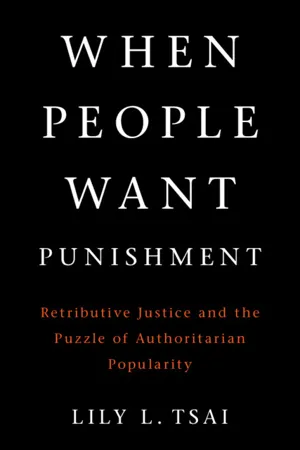
When People Want Punishment
About this book
Against the backdrop of rising populism around the world and democratic backsliding in countries with robust, multiparty elections, this book asks why ordinary people favor authoritarian leaders. Much of the existing scholarship on illiberal regimes and authoritarian durability focuses on institutional explanations, but Tsai argues that, to better understand these issues, we need to examine public opinion and citizens' concerns about retributive justice. Government authorities uphold retributive justice - and are viewed by citizens as fair and committed to public good - when they affirm society's basic values by punishing wrongdoers who act against these values. Tsai argues that the production of retributive justice and moral order is a central function of the state and an important component of state building. Drawing on rich empirical evidence from in-depth fieldwork, original surveys, and innovative experiments, the book provides a new framework for understanding authoritarian resilience and democratic fragility.
Trusted by 375,005 students
Access to over 1.5 million titles for a fair monthly price.
Study more efficiently using our study tools.
Information
Table of contents
- Cover
- Half-title page
- Series page
- Title page
- Copyright page
- Dedication
- Contents
- List of Figures
- List of Tables
- Acknowledgments
- 1 The Puzzle of Authoritarian Popularity
- 2 A Retributive Justice Model of Citizen Engagement
- 3 Retributive Justice and State Production of Moral Order
- 4 Evaluating the Impact of Retributive Justice on Citizen Evaluations of Government Authorities in Rural China
- 5 Retributive Justice and Citizen Engagement in Rural China and Beyond
- 6 Democratic Dissatisfaction, Punitive Populism, and the Rise of the “Benevolent” Dictator
- Bibliography
- Index
Frequently asked questions
Yes, you can cancel anytime from the Subscription tab in your account settings on the Perlego website. Your subscription will stay active until the end of your current billing period. Learn how to cancel your subscription
No, books cannot be downloaded as external files, such as PDFs, for use outside of Perlego. However, you can download books within the Perlego app for offline reading on mobile or tablet. Learn how to download books offline
Perlego offers two plans: Essential and Complete
- Essential is ideal for learners and professionals who enjoy exploring a wide range of subjects. Access the Essential Library with 800,000+ trusted titles and best-sellers across business, personal growth, and the humanities. Includes unlimited reading time and Standard Read Aloud voice.
- Complete: Perfect for advanced learners and researchers needing full, unrestricted access. Unlock 1.5M+ books across hundreds of subjects, including academic and specialized titles. The Complete Plan also includes advanced features like Premium Read Aloud and Research Assistant.
We are an online textbook subscription service, where you can get access to an entire online library for less than the price of a single book per month. With over 1.5 million books across 990+ topics, we’ve got you covered! Learn about our mission
Look out for the read-aloud symbol on your next book to see if you can listen to it. The read-aloud tool reads text aloud for you, highlighting the text as it is being read. You can pause it, speed it up and slow it down. Learn more about Read Aloud
Yes! You can use the Perlego app on both iOS and Android devices to read anytime, anywhere — even offline. Perfect for commutes or when you’re on the go.
Please note we cannot support devices running on iOS 13 and Android 7 or earlier. Learn more about using the app
Please note we cannot support devices running on iOS 13 and Android 7 or earlier. Learn more about using the app
Yes, you can access When People Want Punishment by Lily L. Tsai in PDF and/or ePUB format, as well as other popular books in Politics & International Relations & Politics. We have over 1.5 million books available in our catalogue for you to explore.