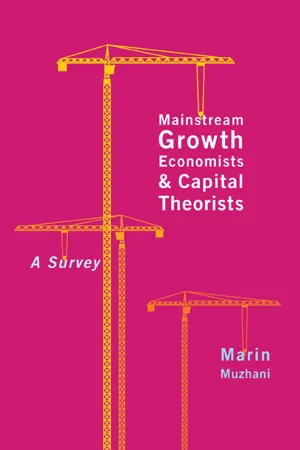
Mainstream Growth Economists and Capital Theorists provides a historical survey and ideal introduction to modern economics, arguing that due to significant changes in recent years, a re-evaluation is in order.
Marin Muzhani presents an informed study of the debates regarding economic growth and development that began in the 1930s in response to the Great Depression. He argues that in the wake of that crisis, the challenge for economists was to understand how to generate stable economic growth in order to prevent future crises. The theories of John Maynard Keynes, in particular, sought to explain the reasons for unemployment and recessions, paving the way for the field of macroeconomics and challenging the basic premises of neoclassical economics. In the late 1930s and 1940s, economists began to extend Keynes' ideas, synthesizing them with neoclassical ideas in order to explain economic growth. This "neoclassical synthesis" would dominate mainstream macroeconomic thought for the next forty years until the mid-1980s with the introduction of endogenous growth theories.
Taking into account the historical background, the multitude of interpretations of modern growth models, and the geography of mainstream economists, Mainstream Growth Economists and Capital Theorists will simplify the structure of growth theory for the next generation of economists.
- English
- ePUB (mobile friendly)
- Available on iOS & Android
eBook - ePub
About this book
Information
Publisher
McGill-Queen's University PressYear
2014Print ISBN
9780773543669
9780773543652
eBook ISBN
9780773592117
Table of contents
- Mainstream Growth Economists and Capital Theorists
- Title
- Copyright
- Contents
- Figures and Tables
- Introduction
- Part One: Origins of Modern Growth Theory
- Part Two: The Rise And Decline of the Neoclassical Theory of Growth
- Part Three: Endogenous Growth Theory
- Notes
- Bibliography
- Index
Trusted by 375,005 students
Access to over 1.5 million titles for a fair monthly price.
Study more efficiently using our study tools.
Frequently asked questions
Yes, you can cancel anytime from the Subscription tab in your account settings on the Perlego website. Your subscription will stay active until the end of your current billing period. Learn how to cancel your subscription
No, books cannot be downloaded as external files, such as PDFs, for use outside of Perlego. However, you can download books within the Perlego app for offline reading on mobile or tablet. Learn how to download books offline
Perlego offers two plans: Essential and Complete
- Essential is ideal for learners and professionals who enjoy exploring a wide range of subjects. Access the Essential Library with 800,000+ trusted titles and best-sellers across business, personal growth, and the humanities. Includes unlimited reading time and Standard Read Aloud voice.
- Complete: Perfect for advanced learners and researchers needing full, unrestricted access. Unlock 1.5M+ books across hundreds of subjects, including academic and specialized titles. The Complete Plan also includes advanced features like Premium Read Aloud and Research Assistant.
We are an online textbook subscription service, where you can get access to an entire online library for less than the price of a single book per month. With over 1.5 million books across 990+ topics, we’ve got you covered! Learn about our mission
Look out for the read-aloud symbol on your next book to see if you can listen to it. The read-aloud tool reads text aloud for you, highlighting the text as it is being read. You can pause it, speed it up and slow it down. Learn more about Read Aloud
Yes! You can use the Perlego app on both iOS and Android devices to read anytime, anywhere — even offline. Perfect for commutes or when you’re on the go.
Please note we cannot support devices running on iOS 13 and Android 7 or earlier. Learn more about using the app
Please note we cannot support devices running on iOS 13 and Android 7 or earlier. Learn more about using the app
Yes, you can access Mainstream Growth Economists and Capital Theorists by Marin Muzhani in PDF and/or ePUB format, as well as other popular books in Economics & Economic Theory. We have over 1.5 million books available in our catalogue for you to explore.