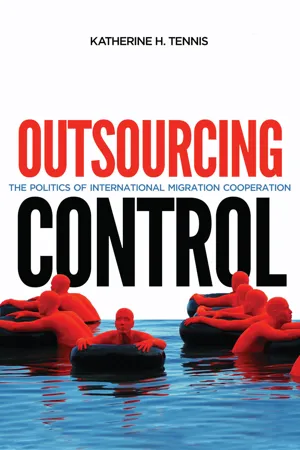
Outsourcing Control
The Politics of International Migration Cooperation
- English
- ePUB (mobile friendly)
- Available on iOS & Android
About this book
When the European Union signed an agreement with Turkey in 2016 to end irregular migration from Syria using extraterritorial measures, the media framed it as a radical new low in migrant protection. Similarly, when then presidential candidate Donald Trump called on Mexico to "pay for the wall," critics argued it was an outlandish departure from established norms. Extraterritorial migration control arrangements of this type have become more visible in recent years, but they are not new.
Katherine Tennis traces the emergence of these agreements in the Americas, Europe, and Southeast Asia. Grounded in case studies of negotiations between the United States and Haiti and Mexico, Italy's negotiations with Tunisia and Libya, and Spain's negotiations with Senegal, Outsourcing Control argues that while some countries - sharing an interest in ensuring orderly migration or recognizing the opportunity for kickbacks - have been happy to cooperate, others have objected, claiming wealthy destination states are exploiting them to do their dirty work. Tennis shows that these different responses depend on how the government in the partner country secures its power. Autocracies and strong democracies tend to cooperate, though for different reasons and in different ways. The most unpredictable partners are fragile democracies, who are prone to nationalism and populist backlash.
The first comprehensive study to trace the emergence of extraterritorial migration control agreements across nations, Outsourcing Control reveals the international and domestic pressures behind the complex, brutal, and often deadly situation facing migrants today.
Trusted by 375,005 students
Access to over 1 million titles for a fair monthly price.
Study more efficiently using our study tools.
Information
Table of contents
- Cover
- Title Page
- Copyright
- Dedication
- Contents
- Tables and Figures
- Preface
- Acknowledgments
- 1 Why Do Weak States Cooperate? A Typological Model
- 2 Where Did Extraterritorial Interdiction Agreements Come From? A Historical Comparative Perspective
- 3 Tumultuous Relations in the Caribbean: Haiti and the US
- 4 Expanding Cooperation with a Democratizing Regime: Mexico and the US
- 5 North African Strongmen and Their Successors: Tunisia and Libya Negotiate with Italy
- 6 Democratic Pragmatism in West Africa: Senegal and Spain
- 7 Conclusion
- Appendix: Extraterritorial Interdiction Agreements between Major Destination States and Nearby Potential Partner States
- Notes
- Index
Frequently asked questions
- Essential is ideal for learners and professionals who enjoy exploring a wide range of subjects. Access the Essential Library with 800,000+ trusted titles and best-sellers across business, personal growth, and the humanities. Includes unlimited reading time and Standard Read Aloud voice.
- Complete: Perfect for advanced learners and researchers needing full, unrestricted access. Unlock 1.4M+ books across hundreds of subjects, including academic and specialized titles. The Complete Plan also includes advanced features like Premium Read Aloud and Research Assistant.
Please note we cannot support devices running on iOS 13 and Android 7 or earlier. Learn more about using the app