- 224 pages
- English
- ePUB (mobile friendly)
- Available on iOS & Android
eBook - ePub
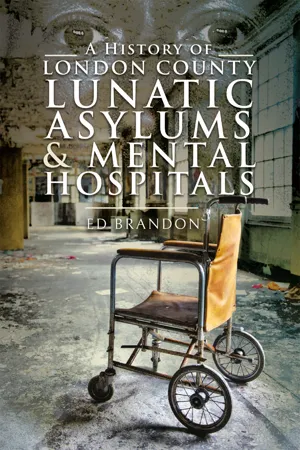
A History of London County Lunatic Asylums & Mental Hospitals
About this book
From the Middle-Ages onwards, London's notorious Bedlam lunatic hospital saw the city's 'mad' locked away in dank cells, neglected and abused and without any real cure and little comfort. The unprecedented growth of the metropolis after the Industrial Revolution saw a perceived 'epidemic' of madness take hold, with 'county asylums' seen by those in power as the most humane or cost-effective way to offer the mass confinement and treatment believed necessary. The county of Middlesex – to which London once belonged – would build and open three huge county asylums from 1831, and when London became its own county in 1889 it would adopt all three and go on to build or run another eight such immense institutions. Each operated much like a self-contained town; home to thousands and often incorporating its own railway, laundries, farms, gardens, kitchens, ballroom, sports pitches, surgeries, wards, cells, chapel, mortuary, and more, in order to ensure the patients never needed to leave the asylum's grounds. Between them, at their peak London's eleven county asylums were home to around 25,000 patients and thousands more staff, and dominated the physical landscape as well as the public imagination from the 1830s right up to the 1990s. Several gained a legacy which lasted even beyond their closure, as their hulking, abandoned forms sat in overgrown sites around London, refusing to be forgotten and continuing to attract the attention of those with both curious and nefarious motives. Hanwell (St Bernard's), Colney Hatch (Friern), Banstead, Cane Hill, Claybury, Bexley, Manor, Horton, St Ebba's, Long Grove, and West Park went from being known as 'county lunatic asylums' to 'mental hospitals' and beyond. Reflecting on both the positive and negative aspects of their long and storied histories from their planning and construction to the treatments and regimes adopted at each, the lives of patients and staff through to their use during wartime, and the modernisation and changes of the 20th century, this book documents their stories from their opening up to their eventual closure, abandonment, redevelopment, or destruction.
Trusted by 375,005 students
Access to over 1.5 million titles for a fair monthly price.
Study more efficiently using our study tools.
Information
Subtopic
British HistoryIndex
HistoryTable of contents
- Cover
- Title
- Copyright
- Contents
- Acknowledgements
- Introduction
- Chapter One Hanwell – 1st Middlesex (later London) County Asylum, aka St Bernard’s Hospital
- Chapter Two Colney Hatch – 2nd Middlesex (later London) County Asylum, aka Friern Hospital
- Chapter Three Banstead – 3rd Middlesex (later London) County Asylum
- Chapter Four Cane Hill – 3rd Surrey (later 4th London) County Asylum
- Chapter Five Claybury – 5th London County Asylum
- Chapter Six Bexley – 7th London County Asylum, aka Heath Asylum
- Chapter Seven The Epsom Cluster
- Glossary
- Endnotes
- Select Bibliography
Frequently asked questions
Yes, you can cancel anytime from the Subscription tab in your account settings on the Perlego website. Your subscription will stay active until the end of your current billing period. Learn how to cancel your subscription
No, books cannot be downloaded as external files, such as PDFs, for use outside of Perlego. However, you can download books within the Perlego app for offline reading on mobile or tablet. Learn how to download books offline
Perlego offers two plans: Essential and Complete
- Essential is ideal for learners and professionals who enjoy exploring a wide range of subjects. Access the Essential Library with 800,000+ trusted titles and best-sellers across business, personal growth, and the humanities. Includes unlimited reading time and Standard Read Aloud voice.
- Complete: Perfect for advanced learners and researchers needing full, unrestricted access. Unlock 1.5M+ books across hundreds of subjects, including academic and specialized titles. The Complete Plan also includes advanced features like Premium Read Aloud and Research Assistant.
We are an online textbook subscription service, where you can get access to an entire online library for less than the price of a single book per month. With over 1.5 million books across 990+ topics, we’ve got you covered! Learn about our mission
Look out for the read-aloud symbol on your next book to see if you can listen to it. The read-aloud tool reads text aloud for you, highlighting the text as it is being read. You can pause it, speed it up and slow it down. Learn more about Read Aloud
Yes! You can use the Perlego app on both iOS and Android devices to read anytime, anywhere — even offline. Perfect for commutes or when you’re on the go.
Please note we cannot support devices running on iOS 13 and Android 7 or earlier. Learn more about using the app
Please note we cannot support devices running on iOS 13 and Android 7 or earlier. Learn more about using the app
Yes, you can access A History of London County Lunatic Asylums & Mental Hospitals by Ed Brandon in PDF and/or ePUB format, as well as other popular books in History & British History. We have over 1.5 million books available in our catalogue for you to explore.