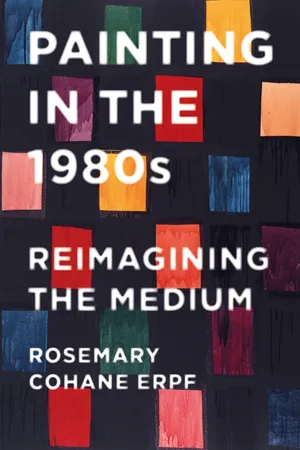
This book is the first to explore, in depth, major painters of the period and the factors that shaped their art. Accessible to both art novice and specialist, it is written in jargon-free, readable language, blending vignettes about the soaring art market of the eighties with illuminating interpretations of paintings by leading artists from around the world. Painting in the 1980s details where and how painting embodied the zeitgeist of the 1980s in original fusions of style and content.
Erpf knows each artist's work well, and her discussions of the individual paintings are vivid and insightful. They bring the vitality of the art world in this understudied period to the fore. The individual descriptions and discussions of paintings are lively, engaging and provocative. They infuse each chapter with the author's passion for the subject and carry the reader along. The thematics – painting as puzzle, German history, Italian place – hold each chapter together and set the foundation for the author's original thinking and point of view.
This book explores painting by a broad swathe of artists who were at the heart of that painting resurgence. The many books that examine twentieth-century art tend to emphasize painting as part of European Modernism, American Abstract Expressionism, and Pop Art, with late twentieth-century painting often given short shrift. Excellent monographs and exhibition catalogues on individual artists exist, but Erpf's intention is to counter the paucity of literature devoted to a larger group of painters. This is not a comprehensive look at all the artists who contributed to 1980s paintings revival.
Gallerists, curators and art historians assigned labels such as New Image Painting, Neo-Expressionism, Italian Transavanguardia, Neo-Geo and the blanket designation Postmodernism to categorize painting in this era. Yet these classifications denote a false sense of homogeneity, which will be made clear in this book. This book's narrative aims to excavate and analyse the art and ideas that shaped each artist's style and their diverse and often ambiguous content.
Works by the following artists are included: Nicolas Africano, Georg Baselitz, Jean-Michel Basquiat, Joseph Beuys, Francesco Clemente, Sandro Chia, George Condo, Enzo Cucchi, Marlene Dumas, Eric Fischl, Denise Green, Philip Guston, Peter Halley, Mary Heilmann, Neil Jenney, Donald Judd, Anselm Kiefer, Gordon Matta-Clark, Robert Moskowitz, Mimmo Paladino, A.R.Penck, Lari Pittman, Sigmar Polke, Gerhard Richter, Susan Rothenberg, David Salle, Julian Schnabel, Joel Shapiro, Frank Stella and David True.
The artists discussed are all well known, but the surprises are in the innovative ways the artists insisted on returning to painting in a decade when it had been pronounced dead. Their courage and creativity comes through in the text.
This will appeal to artists, art and cultural historians more broadly, and is suitable as a textbook for undergraduate and postgraduate courses in twentieth-century and contemporary art history.
Novice art historians, art enthusiasts and collectors will also find much to enjoy here – it has appeal well beyond simply those professionally involved in the art world.