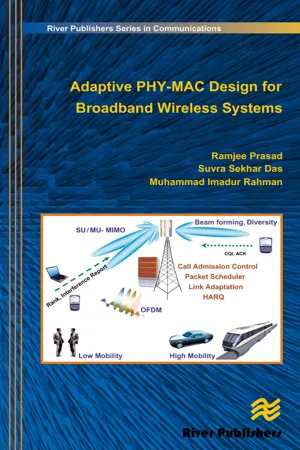
eBook - ePub
Adaptive PHY-MAC Design for Broadband Wireless Systems
- 518 pages
- English
- ePUB (mobile friendly)
- Available on iOS & Android
eBook - ePub
Adaptive PHY-MAC Design for Broadband Wireless Systems
About this book
The next generation mobile communication networks (4G) have the challenging target of The next generation mobile communication networks (4G) have the challenging target of providing a peak data rate of 1 Gigabit per second local area and 100 Megabit per second wide area. The ability to offer such high data rates in 100MHz bandwidth requires overall a very high spectral efficiency, and hence the need for multi-antenna techniques (MIMO) with spatial multiplexing, fast dynamic link adaptation and packet scheduling, wideband access techniques, and most likely non-contention based spectrum sharing among multiple operators. Many of these required technology components and techniques are well researched and established. Adaptive PHY-MAC Design for Broadband Wireless Systems explains how one can integrate and optimise their use in providing the target cell data rates with high availability. The authors address the ability to cope with interference and enhanced physical layer processing, and simultaneously, the multifaceted system level design. Focus is also on the selection of technology components and techniques, which leads to the highest spectral efficiency and peak data rate availability with reasonable Quality of Service (QoS) support, such as improved outage scenario, reduced delay, guaranteed bit rate, etc.In short, this book will answer questions such as, how individual techniques relate to each other, how can we benefit the gains by suitable combinations of different technologies and how to choose different technological solutions in different scenarios, etc.The next generation mobile communication networks (4G) have the challenging target of The next generation mobile communication networks (4G) have the challenging target of providing a peak data rate of 1 Gigabit per second local area and 100 Megabit per second wide area.
Information
Table of contents
- Cover
- Half Title
- Series
- Title
- Copyright
- Endorsements
- Contents
- Dedication
- Preface
- Acknowledgement
- List of Figures
- List of Tables
- List of Abbreviations
- 1 Introduction
- 2 Wireless Channel, Multicarrier Systems and Cellular Architecture
- 3 Adaptive Subcarrier Bandwidth
- 4 Variable Guard Interval
- 5 Hybrid Multicarrier Spread Spectrum
- 6 Coordinated Subcarrier and Band Hopping in OFDMA Systems
- 7 Hybrid Link Adaptation
- 8 Link Adaptation under Transceiver Impairments
- 9 Bit Loading on Pilot Subcarriers
- 10 Joint Link Adaptation and Resource Allocation in SISO/SIMO Systems
- 11 MIMO Precoding in Multi-User Scenarios
- 12 Simulation Results for Linear MIMO Precoding Techniques
- 13 Impact of MIMO CCI: SINR Analysis and System Performance
- 14 MIMO Systems at Cell Edge: Robust Receiver Design
- 15 Conclusions and Future perspectives
- A The System-Level Simulator
- B LA in OFDM Systems under HPA
- Bibliography
- About the Authors
Trusted by 375,005 students
Access to over 1.5 million titles for a fair monthly price.
Study more efficiently using our study tools.
Frequently asked questions
Yes, you can cancel anytime from the Subscription tab in your account settings on the Perlego website. Your subscription will stay active until the end of your current billing period. Learn how to cancel your subscription
No, books cannot be downloaded as external files, such as PDFs, for use outside of Perlego. However, you can download books within the Perlego app for offline reading on mobile or tablet. Learn how to download books offline
Perlego offers two plans: Essential and Complete
- Essential is ideal for learners and professionals who enjoy exploring a wide range of subjects. Access the Essential Library with 800,000+ trusted titles and best-sellers across business, personal growth, and the humanities. Includes unlimited reading time and Standard Read Aloud voice.
- Complete: Perfect for advanced learners and researchers needing full, unrestricted access. Unlock 1.5M+ books across hundreds of subjects, including academic and specialized titles. The Complete Plan also includes advanced features like Premium Read Aloud and Research Assistant.
We are an online textbook subscription service, where you can get access to an entire online library for less than the price of a single book per month. With over 1.5 million books across 990+ topics, we’ve got you covered! Learn about our mission
Look out for the read-aloud symbol on your next book to see if you can listen to it. The read-aloud tool reads text aloud for you, highlighting the text as it is being read. You can pause it, speed it up and slow it down. Learn more about Read Aloud
Yes! You can use the Perlego app on both iOS and Android devices to read anytime, anywhere — even offline. Perfect for commutes or when you’re on the go.
Please note we cannot support devices running on iOS 13 and Android 7 or earlier. Learn more about using the app
Please note we cannot support devices running on iOS 13 and Android 7 or earlier. Learn more about using the app
Yes, you can access Adaptive PHY-MAC Design for Broadband Wireless Systems by Ramjee Prasad,Suvra Sekhar Das,Muhammad Imadur Rahman in PDF and/or ePUB format, as well as other popular books in Physical Sciences & Electrical Engineering & Telecommunications. We have over 1.5 million books available in our catalogue for you to explore.