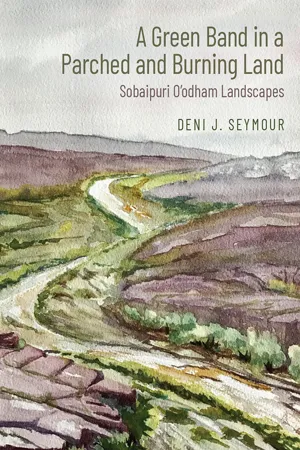
The result of decades of research, A Green Band in a Parched and Burning Land presents a thorough and detailed understanding of the Sobaipuri O'odham—arguably the most influential and powerful Indigenous group in southern Arizona in the terminal prehistoric and early historic periods, yet one of the least understood and under-studied to have occupied the region. Deni J. Seymour combines historical sources with fresh archaeological data and oral history to reveal an astonishingly different view of, and revise conventional wisdom around, the native history of the region.
First and foremost irrigation farmers, the Sobaipuri O'odham permanently occupied verdant strips along all the major rivers in the region—including the headwaters of the San Pedro and various other areas thought to be beyond their domain. Seymour draws on career-spanning fieldwork, conversations with direct descendants (the O'odham residents of Wa:k), and recent breakthroughs in archaeological, ethnographic, and ethnohistorical research to shed light on their unique forms of landscape use, settlement patterns, and way of life. She details the building materials, linear site layout, and other elements of their singular archaeological signature; newly established dating for individual sites, complex building episodes, and occupational sequences; and evidence of cumulative village occupation as well as the habitation of river valleys and other locales long after supposed abandonment. The book also explains the key relationships between site distributions and landscape characteristics.
Addressing some of the longest-standing archaeological and historical questions about the Sobaipuri O'odham, A Green Band in a Parched and Burning Land reorients the discussion of their crucial place in the history of the region in constructive new directions.
- English
- ePUB (mobile friendly)
- Available on iOS & Android
eBook - ePub
About this book
Information
Table of contents
- Cover
- Title Page
- Copyright Page
- Dedication
- Contents
- Acknowledgments
- 1. Those Who Sing of the Green Band
- 2. The Sobaipuri Landscape
- 3. Documentary Clarification of the Gila River Sobaipuri Pima in Kino’s Time
- 4. Ethnogeographic Evaluation of the Great Principal Settlement of San Xavier del Bac
- 5. Ópata or O’odham: The San Pedro Headwaters, Huachuca, and Babocomari
- 6. Sobaipuri Settlement along Sonoita Creek
- 7. San Pablo de Quiburi: The Sobaipuri O’odham Ranchería of Kino’s Conception
- 8. The Waning Days of Quiburi in 1780
- 9. Evaluating Di Peso’s 1757 Jesuit Mission
- 10. The Lower San Pedro: Tres Alamos to the Confluence
- 11. New Understandings in Sobaipuri Research
- References Cited
- Index
Trusted by 375,005 students
Access to over 1.5 million titles for a fair monthly price.
Study more efficiently using our study tools.
Frequently asked questions
Yes, you can cancel anytime from the Subscription tab in your account settings on the Perlego website. Your subscription will stay active until the end of your current billing period. Learn how to cancel your subscription
No, books cannot be downloaded as external files, such as PDFs, for use outside of Perlego. However, you can download books within the Perlego app for offline reading on mobile or tablet. Learn how to download books offline
Perlego offers two plans: Essential and Complete
- Essential is ideal for learners and professionals who enjoy exploring a wide range of subjects. Access the Essential Library with 800,000+ trusted titles and best-sellers across business, personal growth, and the humanities. Includes unlimited reading time and Standard Read Aloud voice.
- Complete: Perfect for advanced learners and researchers needing full, unrestricted access. Unlock 1.5M+ books across hundreds of subjects, including academic and specialized titles. The Complete Plan also includes advanced features like Premium Read Aloud and Research Assistant.
We are an online textbook subscription service, where you can get access to an entire online library for less than the price of a single book per month. With over 1.5 million books across 990+ topics, we’ve got you covered! Learn about our mission
Look out for the read-aloud symbol on your next book to see if you can listen to it. The read-aloud tool reads text aloud for you, highlighting the text as it is being read. You can pause it, speed it up and slow it down. Learn more about Read Aloud
Yes! You can use the Perlego app on both iOS and Android devices to read anytime, anywhere — even offline. Perfect for commutes or when you’re on the go.
Please note we cannot support devices running on iOS 13 and Android 7 or earlier. Learn more about using the app
Please note we cannot support devices running on iOS 13 and Android 7 or earlier. Learn more about using the app
Yes, you can access Green Band in a Parched and Burning Land by Deni J. Seymour in PDF and/or ePUB format, as well as other popular books in Social Sciences & Archaeology. We have over 1.5 million books available in our catalogue for you to explore.