Originally published as a collection in 2006, the essays in this volume discuss the reasons for the end of the slave trade and the institution of slavery itself. They examine the rise of the abolitionist movement in different countries and how the move towards abolition was swifter in some areas than others. Attention is also paid to the economic consequences of abolition, popular attitudes to abolition and the role of the Church. The volume also has an introduction by the editor commenting on the contribution each essay makes.
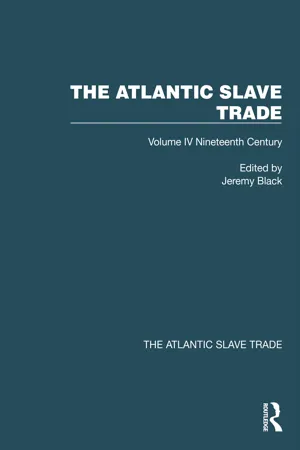
- 494 pages
- English
- ePUB (mobile friendly)
- Available on iOS & Android
eBook - ePub
Table of contents
- Cover
- Half Title
- Title Page
- Copyright Page
- Original Title Page
- Original Copyright Page
- Table of Contents
- Acknowledgements
- Series Preface
- Introduction
- 1 Erik Gøbel (2001), ‘The Danish Edict of 16th March 1792 to Abolish the Slave Trade’
- 2 Jennifer J. Pierce (1997), ‘The Struggle for Black Liberty: Revolution and Emancipation in Saint Domingue’
- 3 David Geggus (1989), ‘Racial Equality, Slavery, and Colonial Secession during the Constituent Assembly’
- 4 Daniel P. Resnick (1972), ‘The Société des Amis des Noirs and the Abolition of Slavery’
- 5 Karl Jacoby (1994), ‘Slaves by Nature? Domestic Animals and Human Slaves’
- 6 Seymour Drescher (1994), ‘Whose Abolition? Popular Pressure and the Ending of the British Slave Trade’
- 7 Roger T. Anstey (1968), ‘Capitalism and Slavery: A Critique’
- 8 Ann M. Burton (1996), ‘British Evangelicals, Economic Warfare and the Abolition of the Atlantic Slave Trade, 1794–1810’
- 9 W.A. Green (1973), ‘The Planter Class and British West Indian Sugar Production, before and after Emancipation’
- 10 D. Eltis (1979), ‘The British Contribution to the Nineteenth-Century Transatlantic Slave Trade’
- 11 Herbert S. Klein and Stanley L. Engerman (1975), ‘Shipping Patterns and Mortality in the African Slave Trade to Rio de Janeiro, 1825–1830’
- 12 David Eltis and Stanley L. Engerman (1993), ‘Fluctuations in Sex and Age Ratios in the Transatlantic Slave Trade, 1663–1864’
- 13 J.R. Ward (1989), ‘The Amelioration of British West Indian Slavery, 1750–1834: Technical Change and the Plough’
- 14 Bernard Marshall (1982), ‘Slave Resistance and White Reaction in the British Windward Islands, 1763–1833’
- 15 Izhak Gross (1980), ‘The Abolition of Negro Slavery and British Parliamentary Politics, 1832–3’
- 16 Betty Fladeland (1966), ‘Abolitionist Pressures on the Concert of Europe, 1814–1832’
- 17 Laurent Dubois (2001), ‘The Road to 1848: Interpreting French Anti-Slavery’
- 18 Richard Graham (1966), ‘Causes for the Abolition of Negro Slavery in Brazil: An Interpretive Essay’
- 19 Richard Graham (1970), ‘Brazilian Slavery Re-Examined: A Review Article’
- 20 Robert Conrad (1969), ‘The Contraband Slave Trade to Brazil, 1831–1845’
- 21 Seymour Drescher (1988), ‘Brazilian Abolition in Comparative Perspective’
- 22 O. Nigel Bolland (1981), ‘Systems of Domination after Slavery: The Control of Land and Labor in the British West Indies after 1838’
- 23 Henrice Altink (2001), ‘Slavery by Another Name: Apprenticed Women in Jamaican Workhouses in the Period 1834–8’
- 24 John Lean and Trevor Burnard (2002), ‘Hearing Slave Voices: The Fiscal’s Reports of Berbice and Demerara-Essequebo’
- 25 David Northrup (1976), ‘The Compatibility of the Slave and Palm Oil Trades in the Bight of Biafra’
- Name Index
Trusted by 375,005 students
Access to over 1.5 million titles for a fair monthly price.
Study more efficiently using our study tools.
Frequently asked questions
Yes, you can cancel anytime from the Subscription tab in your account settings on the Perlego website. Your subscription will stay active until the end of your current billing period. Learn how to cancel your subscription
No, books cannot be downloaded as external files, such as PDFs, for use outside of Perlego. However, you can download books within the Perlego app for offline reading on mobile or tablet. Learn how to download books offline
Perlego offers two plans: Essential and Complete
- Essential is ideal for learners and professionals who enjoy exploring a wide range of subjects. Access the Essential Library with 800,000+ trusted titles and best-sellers across business, personal growth, and the humanities. Includes unlimited reading time and Standard Read Aloud voice.
- Complete: Perfect for advanced learners and researchers needing full, unrestricted access. Unlock 1.5M+ books across hundreds of subjects, including academic and specialized titles. The Complete Plan also includes advanced features like Premium Read Aloud and Research Assistant.
We are an online textbook subscription service, where you can get access to an entire online library for less than the price of a single book per month. With over 1.5 million books across 990+ topics, we’ve got you covered! Learn about our mission
Look out for the read-aloud symbol on your next book to see if you can listen to it. The read-aloud tool reads text aloud for you, highlighting the text as it is being read. You can pause it, speed it up and slow it down. Learn more about Read Aloud
Yes! You can use the Perlego app on both iOS and Android devices to read anytime, anywhere — even offline. Perfect for commutes or when you’re on the go.
Please note we cannot support devices running on iOS 13 and Android 7 or earlier. Learn more about using the app
Please note we cannot support devices running on iOS 13 and Android 7 or earlier. Learn more about using the app
Yes, you can access The Atlantic Slave Trade by Jeremy Black in PDF and/or ePUB format, as well as other popular books in History & World History. We have over 1.5 million books available in our catalogue for you to explore.