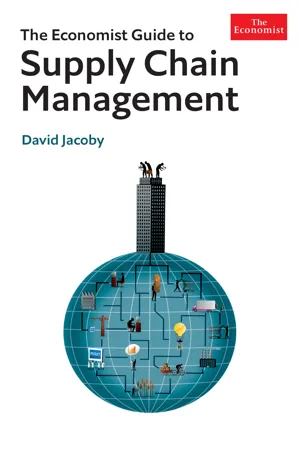
Globalisation, technology and an increasingly competitive business environment have encouraged huge changes in what is known as supply chain management, the art of sourcing components and delivering finished goods to the customer as cost effectively and efficiently as possible. Dell transformed the way people bought and were able to customise computers. Wal-Mart and Tesco have used their huge buying power and logistical skills to ensure the supply and stock management of their stores is finely honed. Manufacturers now make sure that components are where they are needed on the production line just in time for when they are needed and no longer. Such finessing of the way the supply chain works boosts the corporate bottom line and can make the difference between being a market leader or an also ran. This guide explores all the different aspects of supply chain management and gives hundreds of real life examples of what firms have achieved in the field.
- English
- ePUB (mobile friendly)
- Available on iOS & Android
eBook - ePub
The Economist Guide To Supply Chain Management
About this book
Information
Subtopic
ManagementIndex
BusinessTable of contents
- Copyright Page
- Contents
- List of figures
- List of tables
- Acknowledgements
- Introduction
- 1 A historical perspective on industry, trade and transport
- 2 The bullwhip problem
- 3 What supply chain management is and where it is going
- 4 Why CEOs need supply chain management today
- 5 Setting the right supply chain strategy
- 6 Rationalisation: competing on low cost
- 7 Synchronisation: competing on reliability
- 8 Customisation: competing on customer intimacy
- 9 Innovation: competing on revitalisation
- 10 Organising, training and developing staff
- 11 Leveraging information technology
- 12 Measuring success
- 13 Challenges for the future
- Notes and references
- Appendices
- Index
Trusted by 375,005 students
Access to over 1.5 million titles for a fair monthly price.
Study more efficiently using our study tools.
Frequently asked questions
Yes, you can cancel anytime from the Subscription tab in your account settings on the Perlego website. Your subscription will stay active until the end of your current billing period. Learn how to cancel your subscription
No, books cannot be downloaded as external files, such as PDFs, for use outside of Perlego. However, you can download books within the Perlego app for offline reading on mobile or tablet. Learn how to download books offline
Perlego offers two plans: Essential and Complete
- Essential is ideal for learners and professionals who enjoy exploring a wide range of subjects. Access the Essential Library with 800,000+ trusted titles and best-sellers across business, personal growth, and the humanities. Includes unlimited reading time and Standard Read Aloud voice.
- Complete: Perfect for advanced learners and researchers needing full, unrestricted access. Unlock 1.5M+ books across hundreds of subjects, including academic and specialized titles. The Complete Plan also includes advanced features like Premium Read Aloud and Research Assistant.
We are an online textbook subscription service, where you can get access to an entire online library for less than the price of a single book per month. With over 1.5 million books across 990+ topics, we’ve got you covered! Learn about our mission
Look out for the read-aloud symbol on your next book to see if you can listen to it. The read-aloud tool reads text aloud for you, highlighting the text as it is being read. You can pause it, speed it up and slow it down. Learn more about Read Aloud
Yes! You can use the Perlego app on both iOS and Android devices to read anytime, anywhere — even offline. Perfect for commutes or when you’re on the go.
Please note we cannot support devices running on iOS 13 and Android 7 or earlier. Learn more about using the app
Please note we cannot support devices running on iOS 13 and Android 7 or earlier. Learn more about using the app
Yes, you can access The Economist Guide To Supply Chain Management by David Steven Jacoby in PDF and/or ePUB format, as well as other popular books in Business & Management. We have over 1.5 million books available in our catalogue for you to explore.