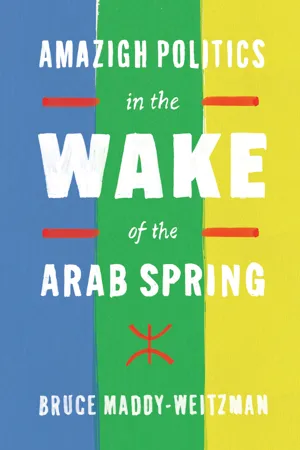
Amazigh Politics in the Wake of the Arab Spring
eBook - ePub

Amazigh Politics in the Wake of the Arab Spring

  1. English
  2. ePUB (mobile friendly)
  3. Available on iOS & Android
eBook - ePub

Amazigh Politics in the Wake of the Arab Spring

About this book

On television, the Arab Spring took place in Cairo, Tunis, and the city-states of the Persian Gulf. Yet the drama of 2010, and the decade of subsequent activism, extended beyond the cities—indeed, beyond Arabs. Bruce Maddy-Weitzman brings to light the sustained post–Arab Spring political movement of North Africa's Amazigh people.

The Amazigh movement did not begin with the Arab Spring, but it has changed significantly since then. Amazigh Politics in the Wake of the Arab Spring details the increasingly material goals of Amazigh activism, as protest has shifted from the arena of ethnocultural recognition to that of legal and socioeconomic equality. Amazigh communities responded to the struggles for freedom around them by pressing territorial and constitutional claims while rejecting official discrimination and neglect. Arab activists, steeped in postcolonial nationalism and protective of their hegemonic position, largely refused their support, yet flailing regimes were forced to respond to sharpening Amazigh demands or else jeopardize their threadbare legitimacy. Today the Amazigh question looms larger than ever, as North African governments find they can no longer ignore the movement's interests.

Frequently asked questions

Yes, you can cancel anytime from the Subscription tab in your account settings on the Perlego website. Your subscription will stay active until the end of your current billing period. Learn how to cancel your subscription.
At the moment all of our mobile-responsive ePub books are available to download via the app. Most of our PDFs are also available to download and we're working on making the final remaining ones downloadable now. Learn more here.
Perlego offers two plans: Essential and Complete
  • Essential is ideal for learners and professionals who enjoy exploring a wide range of subjects. Access the Essential Library with 800,000+ trusted titles and best-sellers across business, personal growth, and the humanities. Includes unlimited reading time and Standard Read Aloud voice.
  • Complete: Perfect for advanced learners and researchers needing full, unrestricted access. Unlock 1.4M+ books across hundreds of subjects, including academic and specialized titles. The Complete Plan also includes advanced features like Premium Read Aloud and Research Assistant.
Both plans are available with monthly, semester, or annual billing cycles.
We are an online textbook subscription service, where you can get access to an entire online library for less than the price of a single book per month. With over 1 million books across 1000+ topics, we’ve got you covered! Learn more here.
Look out for the read-aloud symbol on your next book to see if you can listen to it. The read-aloud tool reads text aloud for you, highlighting the text as it is being read. You can pause it, speed it up and slow it down. Learn more here.
Yes! You can use the Perlego app on both iOS or Android devices to read anytime, anywhere — even offline. Perfect for commutes or when you’re on the go.
Please note we cannot support devices running on iOS 13 and Android 7 or earlier. Learn more about using the app.
Yes, you can access Amazigh Politics in the Wake of the Arab Spring by Bruce Maddy-Weitzman in PDF and/or ePUB format, as well as other popular books in Politics & International Relations & Middle Eastern History. We have over one million books available in our catalogue for you to explore.

Table of contents

  1. Cover
  2. Title Page
  3. Copyright
  4. Dedication
  5. Contents
  6. List of Maps
  7. Acknowledgments
  8. Introduction
  9. 1. Toward a Second Republic? Algeria and the Amazigh Question
  10. 2. Obscure No Longer: Libyan Imazighen in a Fractured Polity
  11. 3. Azawad: The Abortive Republic
  12. 4. Tunisia: The Amazigh Factor Enters the Realm
  13. 5. Moroccan Imazighen and the Makhzen: From Recognition to Malaise
  14. Conclusion
  15. Notes
  16. Index