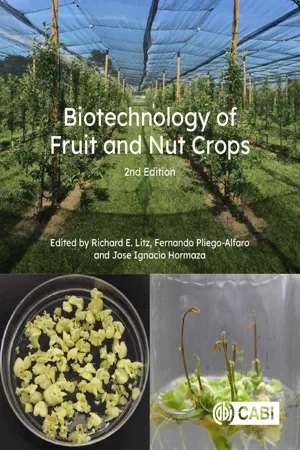
This book covers the biotechnology of all the major perennial fruit and nut species. Since the publication of the first edition of this book in 2005, there has been significant progress in cell culture, genomics and genetic transformation for many of these species. This book covers these biotechnologies and also traditional ones, such as regeneration pathways, protoplast culture, in vitro mutagenesis, and ploidy manipulation that have been applied to many of these species. Three species, Diospyros kaki (persimmon), Punica granatum (pomegranate) and Eriobotrya japonica (loquat) are included for the first time, and several Prunus species now receive separate coverage. The species are organized by plant family to facilitate comparisons among related ones. Each species is discussed in relation to its family and its related wild forms, and most are accompanied by full colour illustrations. This book is a vital resource for those working on the improvement of perennial fruit, nut and plantation crops.The book features: Detailed coverage of major perennial fruit and crop species.Coverage of traditional and new biotechnologies.Full colour illustrations to aid identificationThis book is an essential resource for scientists and postgraduate students who are engaged in the improvement of perennial fruit, nut and plantation crops and will also be an important accession for university and agricultural research libraries.
eBook - PDF
Biotechnology of Fruit and Nut Crops
- 703 pages
- English
- PDF
- Available on iOS & Android
eBook - PDF
Biotechnology of Fruit and Nut Crops
About this book
Information
Table of contents
- Biotechnology of Fruit and Nut Crops, 2nd Edition
- Copyright
- Contents
- List of Contributors
- Preface
- 1 Actinidiaceae
- 1.1 Actinidia spp. Kiwifruit
- 2 Anacardiaceae
- 2.1 Anacardium occidentale Cashew
- 2.2 Mangifera indica Mango
- 2.3 Pistacia vera Pistachio
- 3 Annonaceae
- 3.1 Annona spp. Atemoya, Cherimoya, Soursop and Sugar Apple
- 4 Arecaceae
- 4.1 Cocos nucifera Coconut
- 4.2 Elaeis guineensis Oil palm
- 4.3 Phoenix dactylifera Date palm
- 5 Bromeliaceae
- 5.1 Ananas comosus Pineapple
- 6 Caricaceae
- 6.1 Carica papaya Papaya
- 7 Clusiaceae
- 7.1 Garcinia mangostana Mangosteen
- 8 Ebenaceae
- 8.1 Diospyros kaki Persimmon
- 9 Ericaceae
- 9.1 Vaccinium spp. Blueberry and Cranberry
- 10 Fagaceae
- 10.1 Castanea spp. Chestnut
- 11 Juglandaceae
- 11.1 Carya illinoinensis Pecan
- 11.2 Juglans regia Walnut
- 12 Lauraceae
- 12.1 Persea americana Avocado
- 13 Malvaceae
- 13.1 Theobroma cacao Cacao
- 14 Musaceae
- 14.1 Musa Banana and Plantain
- 15 Myrtaceae
- 15.1 Psidium guajava Guava
- 16 Oleaceae
- 16.1 Olea europaea Olive
- 17 Oxalidaceae
- 17.1 Averrhoa carambola Carambola
- 18 Passifloraceae
- 18.1 Passiflora spp. Passionfruit
- 19 Rosaceae
- 19.1 Eriobotrya japonica Loquat
- 19.2 Fragaria x ananassa Strawberry
- 19.3 Malus x domestica Apple
- 19.4 Prunus persica Peach and Nectarine
- 19.5 Prunus armeniaca Apricot
- 19.6 Prunus domestica Plum
- 19.7 Prunus spp. Cherry
- 19.8 Prunus dulcis syn. Prunus amygdalus Almond
- 19.9 Pyrus spp. Pear and Cydonia spp. Quince
- 19.10 Rubus spp. Cane Fruit
- 20 Rutaceae
- 20.1 Citrus
- 21 Sapindaceae
- 21.1 Dimocarpus longan Longan and Litchi chinensis Litchi
- 22 Vitaceae
- 22.1 Vitis spp. Grape
- Index
Trusted by 375,005 students
Access to over 1.5 million titles for a fair monthly price.
Study more efficiently using our study tools.
Frequently asked questions
Yes, you can cancel anytime from the Subscription tab in your account settings on the Perlego website. Your subscription will stay active until the end of your current billing period. Learn how to cancel your subscription
No, books cannot be downloaded as external files, such as PDFs, for use outside of Perlego. However, you can download books within the Perlego app for offline reading on mobile or tablet. Learn how to download books offline
Perlego offers two plans: Essential and Complete
- Essential is ideal for learners and professionals who enjoy exploring a wide range of subjects. Access the Essential Library with 800,000+ trusted titles and best-sellers across business, personal growth, and the humanities. Includes unlimited reading time and Standard Read Aloud voice.
- Complete: Perfect for advanced learners and researchers needing full, unrestricted access. Unlock 1.5M+ books across hundreds of subjects, including academic and specialized titles. The Complete Plan also includes advanced features like Premium Read Aloud and Research Assistant.
We are an online textbook subscription service, where you can get access to an entire online library for less than the price of a single book per month. With over 1.5 million books across 990+ topics, we’ve got you covered! Learn about our mission
Look out for the read-aloud symbol on your next book to see if you can listen to it. The read-aloud tool reads text aloud for you, highlighting the text as it is being read. You can pause it, speed it up and slow it down. Learn more about Read Aloud
Yes! You can use the Perlego app on both iOS and Android devices to read anytime, anywhere — even offline. Perfect for commutes or when you’re on the go.
Please note we cannot support devices running on iOS 13 and Android 7 or earlier. Learn more about using the app
Please note we cannot support devices running on iOS 13 and Android 7 or earlier. Learn more about using the app
Yes, you can access Biotechnology of Fruit and Nut Crops by Richard Litz, Fernando Pliego-Alfaro, Jose Ignacio Hormaza, Richard E Litz,Fernando Pliego-Alfaro,Jose Ignacio Hormaza in PDF and/or ePUB format, as well as other popular books in Ciencias biológicas & Biotecnología. We have over 1.5 million books available in our catalogue for you to explore.