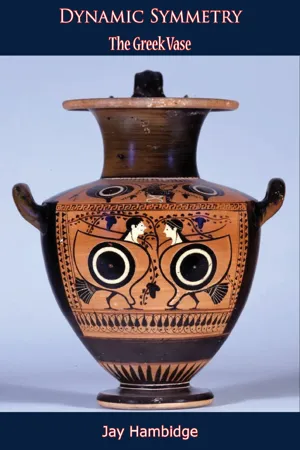
Hambidge's highly detailed work analyzing the intimate details of Dynamic Symmetry as ideally exemplified in the Greek Vase.
"SOME twenty years ago, the writer, being impressed by the incoherence of modern design and convinced that there must exist in nature some correlating principle which could give artists a control of areas, undertook a comparative study of the bases of all design, both in nature and in art. This labor resulted in the determination of two types of symmetry or proportion, one of which possessed qualities of activity, the other of passivity. For convenience, the active type was termed dynamic symmetry, the other, static symmetry. It was found that the passive was the type which was employed most naturally by artists, either consciously or unconsciously; in fact, no design which would be recognized as such—unless, indeed, it were dynamic—would be possible without the use, in some degree, of this passive or static type. It is apparent in nature in certain crystal forms, radiolaria, diatoms, flowers and seed pods, and has been used consciously in art at several periods.
The principle of dynamic symmetry is manifest in shell growth and in leaf distribution in plants. A study of the basis of design in art shows that this active symmetry was known to but two peoples, the Egyptians and the Greeks; the latter only having developed its full possibilities for purposes of art. The writer believes that he has now recovered, through study of natural form and shapes in Greek and Egyptian art, this principle for the proportioning of areas."-Introduction.
- 182 pages
- English
- ePUB (mobile friendly)
- Available on iOS & Android
eBook - ePub
About this book
Information
Subtopic
Ancient HistoryIndex
HistoryTable of contents
- Title page
- TABLE OF CONTENTS
- THE RUTHERFORD TROWBRIDGE MEMORIAL PUBLICATION FUND
- ACKNOWLEDGMENT
- DEDICATION
- LIST OF PLATES
- FOREWORD
- VITRUVIUS ON GREEK SYMMETRY
- PREDICTION BY EDMOND POTTIER IN 1906 RELATIVE TO GREEK SYMMETRY
- CHAPTER ONE: THE BASIS OF DESIGN IN NATURE
- CHAPTER TWO: THE ROOT RECTANGLES
- CHAPTER THREE: THE LEAF
- CHAPTER FOUR: ROOT RECTANGLES AND SOME VASE FORMS
- CHAPTER FIVE: PLATO’S MOST BEAUTIFUL SHAPE
- CHAPTER SIX: A BRYGOS KANTHAROS AND OTHER POTTERY EXAMPLES OF SIMILAR RECTANGLE SHAPES
- CHAPTER SEVEN: A HYDRIA, A STAMNOS, A PYXIS AND OTHER VASE FORMS
- CHAPTER EIGHT: FURTHER ANALYSES OF VASE FORMS
- CHAPTER NINE: SKYPHOI
- CHAPTER TEN: KYLIKES
- CHAPTER ELEVEN: VASE ANALYSES, CONTINUED
- CHAPTER TWELVE: STATIC SYMMETRY
- APPENDIX: NOTES
Trusted by 375,005 students
Access to over 1.5 million titles for a fair monthly price.
Study more efficiently using our study tools.
Frequently asked questions
Yes, you can cancel anytime from the Subscription tab in your account settings on the Perlego website. Your subscription will stay active until the end of your current billing period. Learn how to cancel your subscription
No, books cannot be downloaded as external files, such as PDFs, for use outside of Perlego. However, you can download books within the Perlego app for offline reading on mobile or tablet. Learn how to download books offline
We are an online textbook subscription service, where you can get access to an entire online library for less than the price of a single book per month. With over 1.5 million books across 990+ topics, we’ve got you covered! Learn about our mission
Look out for the read-aloud symbol on your next book to see if you can listen to it. The read-aloud tool reads text aloud for you, highlighting the text as it is being read. You can pause it, speed it up and slow it down. Learn more about Read Aloud
Yes! You can use the Perlego app on both iOS and Android devices to read anytime, anywhere — even offline. Perfect for commutes or when you’re on the go.
Please note we cannot support devices running on iOS 13 and Android 7 or earlier. Learn more about using the app
Please note we cannot support devices running on iOS 13 and Android 7 or earlier. Learn more about using the app
Yes, you can access Dynamic Symmetry by Jay Hambidge in PDF and/or ePUB format, as well as other popular books in History & Ancient History. We have over 1.5 million books available in our catalogue for you to explore.